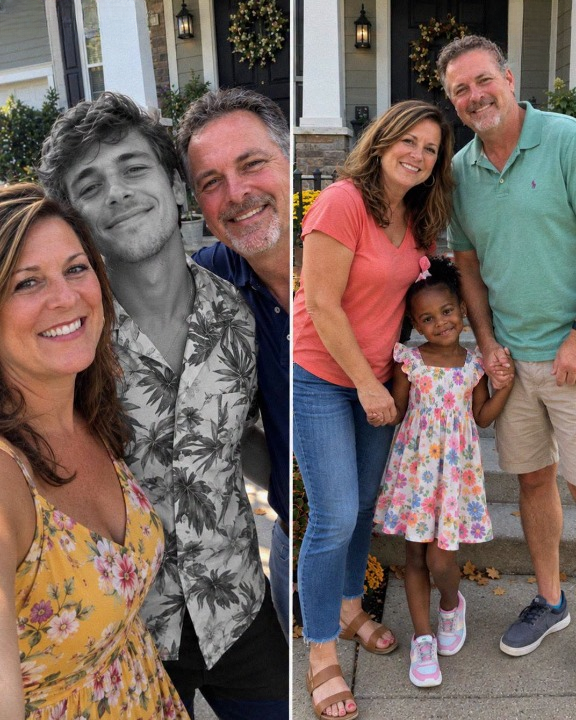
Our son, Ethan, was twenty-four years old when we lost him.
He had been away at college and was supposed to come home for the holidays.
That was all we knew when the phone rang.
I remember the exact time.
7:18 p.m.
My husband answered.
I was in the kitchen, preparing the dinner Ethan had requested before leaving for school.
His favorite meal.
I still remember standing there, holding a wooden spoon, when I heard my husband’s voice change.
“Where?”
Then silence.
He asked another question.
Then another.
Finally, he hung up.
I looked at him.
“What happened?”
He didn’t answer immediately.
He simply walked toward me.
I’ll never forget his face.
“There was an accident.”
The rest of that night became a blur.
We drove to the hospital.
We sat in a hallway.
We spoke with doctors.
And eventually, we received news no parent should ever have to hear.
Ethan was gone.
I remember gripping my husband’s hand and repeating the same sentence over and over.
“He was coming home.”
He had been coming home.
That was what my mind couldn’t accept.
He had plans.
He had a suitcase packed.
He had promised to help his father fix the old fence during the holiday break.
He had even sent me a message earlier that afternoon asking whether I wanted him to bring home some coffee from the little shop near his campus.
Then, suddenly, there would be no coffee.
No suitcase arriving at the front door.
No familiar voice calling from upstairs.
No late-night conversations in the kitchen.
Our son was simply no longer coming home.
The months afterward were difficult.
Our house became painfully quiet.
His bedroom remained exactly as he had left it.
His shoes stayed beside the closet.
His favorite mug remained in the kitchen cabinet.
I couldn’t bring myself to move anything.
My husband was the same.
Neither of us knew what to do with the silence.
People tried to help.
Friends visited.
Family called.
Neighbors brought food.
Everyone meant well.
But eventually, the visitors stopped coming.
And our house became quiet again.
For nearly two years, we lived with that silence.
Then one evening, I said something to my husband that I had been thinking about for months.
“I don’t think Ethan would want us to stay this lonely forever.”
My husband looked at me.
“What do you mean?”
I took a breath.
“He loved helping people.”
He nodded.
“He always talked about wanting to make a difference.”
I looked toward the staircase.
“Maybe we could give that love to someone who needs it.”
My husband understood immediately.
We began researching adoption.
At first, it was simply an idea.
Then came paperwork.
Interviews.
Home visits.
Background checks.
Classes.
More paperwork.
The process took months.
Eventually, we were introduced to a six-year-old girl named Nia.
She was quiet.
Very quiet.
During our first meeting, she sat in a chair with her hands folded in her lap and barely spoke.
The social worker explained that Nia had experienced several changes in her young life and needed stability.
We didn’t expect her to trust us immediately.
So we didn’t push.
We visited again.
And again.
During our third visit, Nia showed us a drawing.
It was a picture of a house.
There were three people standing outside.
One was very small.
The other two were adults.
“Is this your family?” I asked.
She nodded.
“Maybe.”
“Maybe?”
She shrugged.
“I’m still deciding.”
My husband smiled.
“That sounds fair.”
For the first time, Nia smiled back.
A few months later, she came home with us.
I had never been so nervous about making someone comfortable.
We had prepared her bedroom carefully.
There were books on the shelves.
A small night-light.
A stuffed rabbit.
Fresh pajamas folded on the bed.
My husband had even painted one wall a soft green because Nia had told us that green was her favorite color.
When she arrived, she stood in the doorway for several seconds.
“This is my room?”
“Yes,” I said.
“All mine?”
“All yours.”
She touched the blanket.
Then she smiled.
It was a small smile.
But I’ll never forget it.
The first day was peaceful.
She explored the house.
She asked questions.
She wanted to see the garden.
She helped my husband make sandwiches.
That evening, we watched a children’s movie together.
For the first time in years, the house sounded different.
There was laughter.
There were footsteps.
There was someone asking for another glass of water before bedtime.
It felt strange.
But good.
The next afternoon, I was preparing dinner while my husband helped Nia with a puzzle in the living room.
Then everything became quiet.
Too quiet.
I walked into the living room.
Nia was standing beside the bookshelf.
She was staring at a photograph.
I knew exactly which photograph it was.
It was one of my favorites.
Ethan had been home from college for a weekend.
He was standing between my husband and me.
All three of us were smiling.
Ethan had one arm around his father’s shoulder.
I had one around him.
Nia stared at the photograph.
I walked closer.
“What are you looking at?”
She pointed.
“Him.”
I smiled sadly.
“That’s Ethan.”
She continued staring.
Then she said something that made me stop.
“I know him.”
I thought I had misunderstood.
“What?”
She pointed at Ethan again.
“I know him.”
My husband had entered the room.
He heard her.
He looked at me.
I looked at him.
“How do you know Ethan?” I asked gently.
Nia turned toward me.
“He talked to me.”
My heart started beating faster.
“When?”
She thought for a moment.
“Before.”
“Before what?”
“Before I came here.”
I sat down.
My husband remained standing.
Nia looked confused by our reactions.
“He told me about this house.”
My mouth went dry.
“What did he tell you?”
She shrugged.
“He said there was a garden.”
My husband and I exchanged another glance.
There was nothing particularly unusual about that.
Maybe someone had mentioned it.
Maybe she had seen photographs.
Maybe the social worker had described our home.
I tried to remain calm.
“What else?”
Nia looked back at the photograph.
“He said you liked yellow flowers.”
I stared at her.
My husband slowly sat down.
That detail was strange.
My garden had many flowers.
But yellow flowers were Ethan’s favorite.
He used to bring them home whenever he visited.
Still, there could be an explanation.
“Where did you meet him?” I asked.
Nia pointed toward the window.
“Outside.”
“When?”
“Before I came here.”
My husband looked at me.
“Did someone show you his photograph?”
Nia shook her head.
“No.”
“Did someone tell you his name?”
“No.”
“Then how do you know him?”
She looked at us with the innocent expression only a child can have.
“He told me.”
I swallowed.
“What did he tell you?”
She hesitated.
Then she said:
“He said you would be sad when I came.”
I felt tears forming.
Nia continued.
“He said you might be scared.”
My husband reached for my hand.
I squeezed it.
“What else did he say?”
Nia looked at the photograph again.
“He said I shouldn’t be afraid of you.”
I couldn’t speak.
Then she added something that completely changed the feeling in the room.
“He said you needed someone to laugh with again.”
My husband covered his face with one hand.
I started crying.
Not because I believed we had received some impossible message.
Not necessarily.
Children sometimes absorb things from conversations, photographs, stories, and adults around them without remembering where they heard them.
There could have been an ordinary explanation.
But Nia didn’t know that.
She was simply telling us what she remembered.
And what she remembered was deeply connected to the life we had lost.
I knelt beside her.
“Nia, did you ever see Ethan’s photograph before today?”
She shook her head.
“No.”
“Did anyone talk to you about him?”
“No.”
“Are you sure?”
She nodded.
Then she looked at me.
“He told me one more thing.”
“What?”
“He said you would know I was the right girl when you saw my drawing.”
My husband and I stared at each other.
“What drawing?” I asked.
Nia ran upstairs.
A few moments later, she returned holding the picture she had made during our third visit.
The drawing of the house.
The three people standing outside.
I looked at it carefully.
Then I noticed something I hadn’t seen before.
The smallest figure wasn’t a child.
It was a girl holding a yellow flower.
Behind the house was a large tree.
And beside the tree was a tiny figure drawn in blue.
“Who’s that?” I asked.
Nia pointed.
“Ethan.”
My eyes filled with tears.
“Why is he there?”
“He said he would always be nearby.”
My husband took the drawing.
He stared at it for a long time.
Then he smiled through his tears.
Nia looked between us.
“Are you sad?”
I wiped my eyes.
“A little.”
“Why?”
“Because we miss him.”
She nodded.
“I know.”
Then she put her small hand in mine.
“He said you shouldn’t be sad forever.”
I pulled her into a hug.
She hugged me back.
That evening, after Nia went to bed, my husband and I sat in the kitchen.
For nearly two years, we had been afraid that bringing another child into our home would somehow mean leaving Ethan behind.
But that night, we realized something.
Love doesn’t work that way.
We hadn’t replaced Ethan.
We never could.
We had simply made room for another person to become part of our family.
Whether Nia’s memories had a mysterious explanation or a perfectly ordinary one, the message had affected us deeply.
She had reminded us of something Ethan had taught us while he was still alive.
He had always believed that love was something you gave away, not something you protected until it disappeared.
The next morning, I walked into Nia’s room.
She was sitting on the floor, arranging her toys.
She looked up.
“Mom?”
It was the first time she had called me that.
I sat beside her.
“Yes?”
“Can we plant yellow flowers?”
I smiled.
“Yes.”
“Lots of them?”
“As many as you want.”
She smiled.
And that spring, we planted an entire row of yellow flowers in the garden.
Not because we believed they were a message from somewhere beyond our understanding.
But because they reminded us of Ethan.
And because they became something new, too.
A symbol of the life we still had.
Years later, whenever someone asks me how we found the courage to open our hearts again after losing our son, I think about that evening.
A little girl standing beside an old photograph.
A quiet sentence.
A simple drawing.
And the realization that grief doesn’t mean love has to end.
Sometimes, the people we lose remain part of our story through the memories they leave behind.
And sometimes, the best way to honor those memories is not to remain trapped in the past.
It’s to let love continue.
That is what Ethan would have wanted.