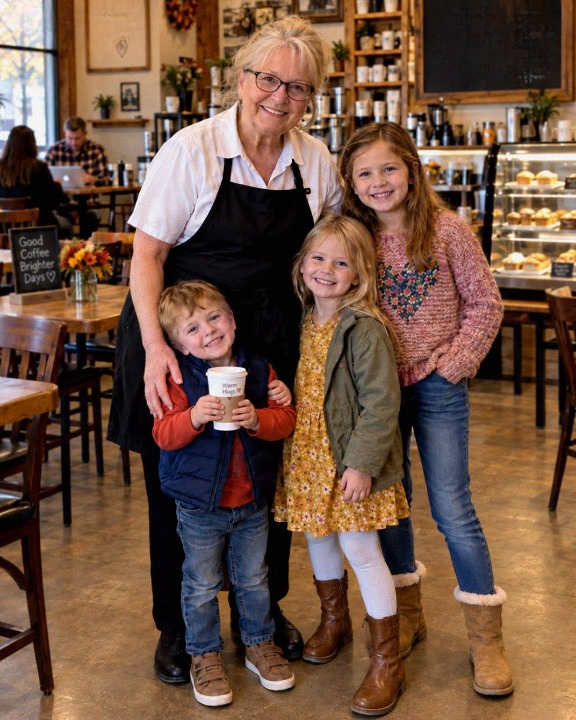
At sixty-eight, I never imagined that I would be starting over.
But life doesn’t always follow the plans we make.
After my son and his wife passed away unexpectedly several years ago, I became the primary caregiver for my three grandchildren.
They were still young.
They needed someone to help them with homework, prepare their meals, get them ready for school, and reassure them when they had difficult days.
I never wanted them to feel alone.
They were my family.
My pension helped, but it wasn’t enough to cover everything.
School expenses, groceries, utilities, clothing, transportation, and the ordinary costs of raising three children added up quickly.
So I found a part-time job as a waitress at a small café near our neighborhood.
It wasn’t glamorous work, but I was proud of it.
I enjoyed meeting the regular customers.
I liked knowing which people preferred tea and which wanted coffee.
And my grandchildren sometimes stopped by after school.
They had their favorite drinks, and seeing their faces light up when I brought them a warm cup of cocoa made even the longest shift worthwhile.
The café was located near one of the most prestigious private schools in the area.
Because of that, students frequently came in after classes.
Most were polite.
Some were energetic and loud, but that was normal for teenagers.
I had no reason to expect that one ordinary lunch shift would completely change my life.
A few days ago, a group of students from the school came into the café.
There were several of them.
They were laughing and talking as they entered, and they chose a large table near the back.
My manager assigned me to their section.
I brought them menus.
They ordered several dishes, drinks, and desserts.
They seemed to be having a good time.
One girl in particular caught my attention because she wore a beautiful bracelet.
It was delicate and sparkled whenever the light hit it.
I didn’t think much about it.
People wore jewelry all the time.
I brought their food.
Checked on them.
Refilled their drinks.
Eventually, they finished eating.
They paid their bill and left together.
A few minutes later, I returned to the table to clear the dishes.
I collected the plates, glasses, and napkins.
I wiped down the table.
Then I moved on to my other customers.
I didn’t notice anything unusual.
About two or three minutes later, the café door opened again.
One of the girls from the group rushed inside.
She looked worried.
She immediately walked toward the table where her group had been sitting.
But the table was already clean.
She turned around.
“Where is it?”
I looked up.
“Excuse me?”
“My bracelet.”
She looked directly at me.
“My diamond bracelet was right here.”
I felt confused.
“I didn’t see a bracelet.”
“I left it on the table.”
I shook my head.
“I honestly didn’t notice one.”
Her expression changed.
“You were the one who cleared the table.”
“Yes.”
“Then where is my bracelet?”
“I don’t know.”
She stared at me.
“You took it.”
I felt my face grow warm.
“No. I didn’t.”
“I know I left it here.”
“I understand, but I didn’t see it.”
She raised her voice.
“It’s worth two thousand dollars!”
Several customers turned toward us.
I tried to remain calm.
“Please, I’m telling you the truth.”
My manager quickly came over.
“What happened?”
The girl explained that she had left her bracelet on the table and believed it had disappeared while the table was being cleared.
My manager asked me what I had seen.
“I didn’t see any jewelry.”
He looked concerned.
“Let’s check the cameras.”
We went into the office.
The café had security cameras throughout the building.
Unfortunately, the camera covering that section of the room didn’t provide a perfect view.
A decorative column partially blocked the table.
Still, the footage showed the students leaving.
Then, shortly afterward, it showed me approaching the table.
I cleared the dishes.
No one else appeared to approach the table during that period.
From the camera’s angle, it looked suspicious.
But the footage didn’t show me taking anything.
It simply showed me cleaning the table.
I repeated that I hadn’t seen a bracelet.
The girl called her mother.
I could hear the conversation from behind the counter.
Her mother sounded upset.
She demanded that the manager take the situation seriously.
She also said that if the bracelet wasn’t returned, she would make sure other parents heard about what had happened.
My manager became increasingly nervous.
The café depended heavily on its local reputation.
The student’s family was apparently well known in the community.
After several minutes of discussion, my manager called me into the office.
“I have to let you go.”
I stared at him.
“What?”
“Until this is resolved, I can’t keep you working here.”
“But I didn’t take anything.”
“I know you’re saying that.”
“I’m telling you the truth.”
He looked uncomfortable.
“I understand.”
“No, you don’t.”
I could feel tears forming in my eyes.
“I need this job.”
He didn’t answer.
I collected my things.
I walked home that afternoon carrying my small work bag.
The entire way, I kept thinking about my grandchildren.
How would I explain this to them?
How would I pay for everything?
What would happen if I couldn’t find another job quickly?
When I opened the door, my youngest grandson ran toward me.
“Grandma!”
He hugged me.
I hugged him tightly.
The other two came downstairs.
They immediately noticed that something was wrong.
“Are you okay?”
I tried to smile.
“I’m fine.”
But I wasn’t.
That evening, after the children went to bed, I sat at the kitchen table and cried quietly.
I didn’t care about the embarrassment.
I cared about my family.
Every dollar mattered.
The next morning, there was a knock at the door.
I wasn’t expecting anyone.
When I opened it, I saw Harold.
Harold worked at the café as a janitor.
He was one of the kindest people there.
He held a small cardboard box in his hands.
“Susie,” he said.
“Harold? What are you doing here?”
“You need to see something.”
He looked serious.
“What happened?”
“Yesterday, after you left, I was cleaning the café.”
He held up the box.
“I found something under that table.”
My heart started beating faster.
“What?”
“I didn’t want to bring it to the café manager before talking to you.”
“Why?”
“Because I wasn’t sure what it meant.”
He handed me the box.
My hands trembled as I opened it.
Inside was a folded piece of fabric.
And beneath it was something small.
Something I recognized immediately.
I looked at Harold.
“What is this?”
He didn’t answer.
I carefully lifted the object.
It wasn’t the missing bracelet.
But it was clearly connected to what had happened.
There was a small envelope underneath it.
My name was written on the front.
Susie.
I stared at it.
“I’ve never seen this before.”
Harold nodded.
“Neither have I.”
“Where exactly did you find it?”
“Under the table.”
“Under the table where the students were sitting?”
“Yes.”
I opened the envelope.
Inside was a handwritten note.
I read the first sentence.
Then I read it again.
My hands began to shake.
“Harold…”
“What?”
“This isn’t about the bracelet.”
He stepped closer.
“What does it say?”
I handed him the note.
His expression changed as he read it.
The message was short.
If you’re reading this, someone has made a serious mistake. Look beneath the third table from the window before you trust anyone’s story.
Harold looked at me.
“What does that mean?”
“I don’t know.”
Then I remembered something.
The café had several cameras.
And the third table from the window was covered by a different camera.
I looked at Harold.
“Did you tell anyone about this?”
“No.”
“Did you show the manager?”
“No.”
“Why not?”
He hesitated.
“Because when I found the envelope, I also found something else.”
“What?”
He reached into his coat pocket.
This time, he pulled out a small key.
I stared at it.
“What’s that?”
“It was taped beneath the table.”
I felt a chill run through me.
“A key?”
He nodded.
“And there was a number written on it.”
“What number?”
Harold turned the key over.
On the metal tag was a handwritten number.
17.
Neither of us spoke.
Then my oldest granddaughter appeared in the hallway.
“Grandma?”
I quickly closed the box.
“What is it, sweetheart?”
“Why is that man here?”
I smiled.
“Harold brought me something from work.”
She looked at him.
Then at the box.
“Is everything okay?”
I looked at Harold.
He nodded slightly.
I didn’t want my grandchildren worrying about adult problems.
“Yes,” I said. “Everything is going to be okay.”
But I wasn’t sure.
After my granddaughter went back upstairs, Harold lowered his voice.
“Susie, there’s something else you should know.”
“What?”
“Last night, after everyone left, I checked the area underneath that table again.”
“And?”
“There was a small compartment beneath the wooden frame.”
I stared at him.
“A compartment?”
“Yes.”
“What’s inside?”
“I didn’t open it.”
“Why?”
“Because I thought you should be there.”
He handed me the key.
I looked at it again.
For the first time since losing my job, I felt something other than fear.
I felt hope.
Maybe the truth was still out there.
Maybe the security footage didn’t tell the whole story.
Maybe the missing bracelet had never been taken by anyone at all.
And perhaps the small box Harold had brought to my door was the first piece of evidence that could clear my name.
I looked toward the kitchen window.
The morning sunlight was beginning to fill the room.
I thought about my grandchildren upstairs.
Then I looked at Harold.
“Let’s go back to the café.”
He nodded.
“But before we do,” he said, “there’s one thing you need to know.”
I waited.
Harold looked at the key in my hand.
“The compartment wasn’t empty.”
My heart stopped for a moment.
“What was inside?”
He took a deep breath.
“A second bracelet.”
I stared at him.
“Another bracelet?”
He nodded.
“And beside it was a photograph.”
“Of whom?”
Harold looked at me.
“That’s what I couldn’t understand.”
He reached into his pocket and carefully unfolded a small photograph.
I looked at it.
And the moment I saw the people standing around that café table, I realized the situation was far more complicated than a missing piece of jewelry.
Because one of the people in the photograph was someone I had known for years.
Someone who had never told me they had been at the café that afternoon.
And suddenly, I understood why someone had left that note beneath the table.