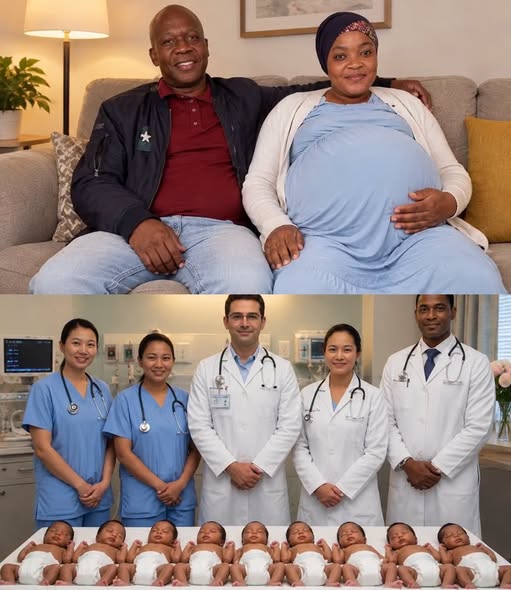
The Remarkable Story of the Mother Who Gave Birth to Nine Babies
In May 2021, a remarkable birth captured international attention when a young woman from Mali became the mother of nine babies from a single pregnancy.
Her name is Halima Cissé.
At just 25 years old, Halima had traveled far from home for specialized medical care. What initially appeared to be an extraordinary pregnancy soon became one of the most closely followed multiple births in recent history.
Nine babies were born during the same delivery.
Five girls and four boys.
The arrival of nine children at once created an enormous medical challenge for the doctors, nurses, and specialists involved. It also brought attention to the extraordinary risks associated with very high-order multiple pregnancies and the intensive care required for babies born extremely early.
But behind the headlines was something much more personal: a young mother suddenly responsible for nine newborns, each needing specialized medical attention and careful monitoring.
Her story began several months before the delivery.
A Pregnancy That Quickly Became Extraordinary
Halima Cissé was already a mother when she became pregnant again. She and her husband, Abdelkader Arby, were expecting another child.
At first, however, medical examinations in Mali suggested that Halima was carrying twins.
Later, doctors discovered that there were more babies.
The number eventually became difficult for even experienced medical teams to comprehend.
Halima was carrying multiple fetuses, and the pregnancy required increasingly specialized attention.
As doctors monitored her condition, concerns grew about the health of both the mother and the babies. Carrying so many babies places tremendous demands on the mother’s body, while the babies face a significant risk of being born prematurely.
The situation became serious enough that the Malian government became involved in arranging specialized medical care.
Halima was eventually transferred to Morocco, where she could receive treatment at a facility equipped to manage an exceptionally complicated multiple pregnancy.
There, the medical team continued monitoring her closely.
Then came the discovery that made the pregnancy even more remarkable.
There were nine babies.
Five Girls and Four Boys
On May 4, 2021, Halima gave birth by cesarean section at the Ain Borja Clinic in Casablanca, Morocco.
The delivery involved a large medical team.
Five girls and four boys were born.
The babies were extremely premature and required specialized neonatal care.
For doctors and nurses, the delivery was not simply a matter of helping nine babies enter the world. Each newborn required individual attention.
Premature babies can have difficulty breathing, maintaining body temperature, feeding, and fighting infections. Their organs may not yet be fully developed, which means neonatal intensive care can become essential.
In Halima’s case, the medical team had to care for nine vulnerable newborns simultaneously.
The challenge was enormous.
Doctors later described the delivery as an exceptional medical event.
The babies were given names that reflected their family’s culture and traditions.
The girls were named Hawa, Oumou, Oumou Koudjou, Oumou Fanta, and Oumou Bah.
The boys were named Oumar, El Hadji, Mohammed, and Bah.
For their parents, these were not simply numbers in a medical record.
They were nine individual children.
The Delivery Was Planned Carefully
A pregnancy involving nine babies cannot be treated like an ordinary pregnancy.
From the moment doctors realized how many babies Halima was carrying, the medical team had to consider numerous possibilities.
Would the babies arrive early?
Would all of them survive?
Would Halima’s health remain stable?
Would the hospital have enough specialists and equipment to care for so many newborns?
These questions required careful planning.
A cesarean delivery was arranged because of the complexity of the pregnancy.
Multiple medical specialists were involved, including obstetricians, anesthetists, pediatricians, nurses, and neonatal specialists.
The room had to be prepared for nine newborns.
That meant having enough equipment, staff, incubators, monitoring devices, and medical supplies available at the same time.
In an ordinary birth, medical staff are focused on one newborn.
In this case, they had to be prepared for nine.
Why Multiple Births Can Be Medically Complicated
A pregnancy involving twins or triplets already requires additional medical monitoring.
Higher-order multiple pregnancies are considerably more complicated.
The mother’s body must support several developing babies simultaneously. As the number of fetuses increases, so does the likelihood of complications such as premature delivery.
For the babies, prematurity can create a variety of challenges.
A newborn born too early may need assistance with breathing. Some premature babies require specialized nutrition because they are not yet able to feed normally. They may also need help maintaining their body temperature because they have less body fat than babies born at full term.
This is why neonatal intensive care units are so important.
In Halima’s case, the babies spent time receiving specialized care after their birth.
Their survival was considered an extraordinary outcome given the circumstances.
A Medical Team Working Around the Clock
The birth of nine babies was not the achievement of one doctor.
It required a coordinated medical effort.
Doctors had to monitor the babies individually while also watching for complications that could affect the group.
Nurses played an especially important role.
With nine premature babies, routine tasks become a major undertaking.
Feeding schedules, temperature monitoring, medication, respiratory support, weight measurements, and other medical observations all have to be carefully recorded.
Each baby has different needs.
One may gain weight more quickly than another.
Another may need additional respiratory support.
Another may require more time before being able to feed independently.
The medical team therefore had to treat each newborn as an individual patient.
That meant countless hours of observation and care.
The Family’s Journey Did Not End With the Delivery
When people hear about a record-setting birth, it can be easy to imagine that the story ends when the babies are born.
For Halima and her husband, however, the birth was only the beginning.
The family had to adjust to caring for nine children born at the same time.
There was also the emotional challenge of spending months separated from their normal home environment while the babies received medical care.
The family eventually returned to Mali after the children were considered well enough to leave Morocco.
The transition home represented another major milestone.
Nine babies require an enormous amount of time and organization.
There are nine feeding schedules, nine sets of clothing, nine sleeping arrangements, and nine developing personalities.
Even ordinary household tasks can become complicated when multiplied by nine.
The Children Became Known Around the World
News of Halima’s pregnancy and the birth spread internationally.
The story attracted attention because births involving nine babies are extraordinarily rare.
Photographs of the family circulated widely, and people around the world followed updates about the children’s development.
Yet the family also faced the challenge of maintaining some sense of normality.
The children were not simply a medical story.
They were growing siblings.
As they became older, they began developing individual interests, personalities, and relationships with one another.
For their parents, raising them meant balancing the enormous practical demands of a large family with the desire to give each child individual attention.
Nine Babies, Nine Personalities
One of the most interesting parts of the story is what happens after the medical headlines disappear.
The babies grow.
They begin to walk.
They learn to communicate.
They develop preferences.
They discover toys, foods, games, and activities they enjoy.
And although they share the same birthday, they are nine different people.
This distinction is important.
When an extraordinary family becomes famous because of a medical event, there is a natural tendency to describe the children collectively.
They are “the nine babies.”
But to their parents, each child has a separate identity.
As the children grow older, their differences become increasingly noticeable.
Some may be more energetic.
Others may be quieter.
Some may enjoy music.
Others may prefer physical activities.
One might become fascinated by books while another enjoys drawing.
Being born during the same delivery does not make them identical in personality.
The Importance of Support
Raising nine young children simultaneously is an enormous responsibility.
Even families with one or two children often rely on relatives, friends, teachers, childcare providers, and community support.
For a family raising nine children of roughly the same age, support becomes even more important.
Practical assistance can include childcare, transportation, education, household organization, medical appointments, and financial planning.
The family also has to think about the children’s future.
As the children grow, their needs change.
Infancy eventually becomes early childhood.
Early childhood becomes school age.
School brings another set of responsibilities, including transportation, homework, activities, uniforms, supplies, and communication with teachers.
Everything happens on a much larger scale.
A Story That Changed How People Think About Multiple Births
Halima’s story also helped draw attention to an important medical subject: the risks associated with high-order multiple pregnancies.
Multiple births can occur naturally, but fertility treatments can also increase the likelihood of twins or higher-order pregnancies depending on the treatment used.
Modern reproductive medicine has made it possible for many people to become parents who might otherwise have struggled with infertility.
At the same time, medical professionals carefully consider the risks associated with transferring multiple embryos or stimulating the ovaries.
The goal in fertility care is generally not simply to create the largest possible number of pregnancies at once.
Doctors aim to balance the possibility of pregnancy with the health and safety of the mother and babies.
Halima’s pregnancy was an extremely unusual case, and it should not be interpreted as a typical outcome of fertility treatment or pregnancy.
The Meaning Behind the Numbers
Nine is a number that immediately captures attention.
Nine babies.
Nine cribs.
Nine sets of clothes.
Nine feeding schedules.
Nine children growing up together.
But numbers alone cannot describe the experience of raising such a family.
There are also nine individual journeys.
Each child will eventually make decisions about school, friendships, interests, work, relationships, and adulthood.
The extraordinary circumstance of their birth is only one part of their lives.
As the children grow older, the record surrounding their birth may become less important than who they become.
The Parents’ New Reality
For Halima and Abdelkader, life changed dramatically in 2021.
Before the birth, they were preparing for another child.
Instead, they became parents to nine newborns.
The responsibilities that followed were enormous.
Their daily routine had to be organized around the needs of the children.
There was little room for an ordinary schedule.
Feeding and sleeping arrangements had to be carefully coordinated.
Medical follow-ups were important because the children had been born prematurely.
As they grew, developmental milestones had to be monitored.
Eventually, the family had to begin thinking about education and the children’s social development.
Every stage brought new challenges.
But it also brought new milestones.
The first smiles.
The first steps.
The first words.
The first birthdays.
The first time the children began playing together.
For parents, these moments can be deeply meaningful regardless of how unusual the circumstances surrounding the birth may have been.
What Makes the Story So Unusual?
The birth attracted attention because nine babies from one pregnancy is extraordinarily uncommon.
Large multiple births are medically challenging because the probability of premature delivery increases as the number of babies increases.
There is also a practical issue.
Hospitals must be prepared for the possibility that several newborns will require intensive care simultaneously.
A hosp