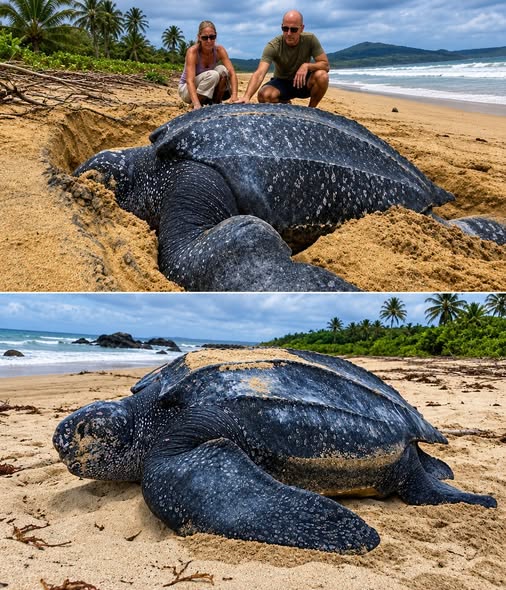
A Leatherback Sea Turtle Returns to Sanibel Island in a Remarkable Nesting Journey
Along the beautiful coastline of Sanibel Island, Florida, the arrival of a sea turtle can turn an ordinary night into a memorable moment for wildlife observers. For conservationists and nature enthusiasts, few sights are as fascinating as a large female leatherback turtle emerging from the ocean to lay her eggs.
The leatherback sea turtle is the largest living species of turtle, known for its impressive size, distinctive shell and extraordinary ocean journeys. When one returns to a nesting beach after years away, the event offers a glimpse into the remarkable life cycle of one of the ocean’s most unique animals.
A reported return to Sanibel Island after several years has drawn attention to the importance of Florida’s beaches as nesting habitat. While individual turtle sightings and nesting records should be verified through local wildlife authorities, the broader story highlights a fascinating natural behavior: female sea turtles often return to familiar regions to lay their eggs.
This behavior is commonly associated with natal homing, a process in which sea turtles return to the general area where they hatched to reproduce.
Meet the Leatherback Sea Turtle
The leatherback sea turtle, scientifically known as Dermochelys coriacea, is unlike most other sea turtles.
Rather than having a hard, bony shell covered with large plates, it has a flexible, leathery covering supported by a network of small bones. Its dark body is often marked with pale spots, creating a distinctive appearance.
Leatherbacks are also known for their impressive size. Large adults can reach lengths of several feet and weigh hundreds of kilograms. Exceptional individuals may approach or exceed 900 kilograms, although such sizes are not typical.
Their powerful front flippers help them travel long distances through the ocean. Unlike many coastal marine animals, leatherbacks are capable of moving through a wide range of ocean temperatures and can undertake extensive migrations between feeding areas and nesting beaches.
Their size, unusual shell and ocean-going lifestyle make them one of the most recognizable sea turtle species.
Why Sanibel Island Matters
Sanibel Island is known for its beaches, coastal habitats and wildlife. Located along Florida’s Gulf Coast, the island provides habitat for a variety of marine and shore-dwelling species.
Florida is an important nesting region for sea turtles, including loggerheads, green turtles and, less frequently, leatherbacks.
When a leatherback chooses a beach for nesting, it becomes an important event for local conservation observers. Leatherbacks do not nest in the same numbers as some other sea turtle species in Florida, so each confirmed nest can contribute valuable information to monitoring and protection efforts.
However, the presence of a turtle on a beach does not automatically mean that a nest has been successfully laid. Wildlife teams generally look for tracks, nesting activity and other evidence before confirming a nest.
This distinction helps ensure that reports about sea turtle activity remain accurate while still recognizing the importance of the sighting.
The Remarkable Behavior Known as Natal Homing
One of the most fascinating aspects of sea turtle biology is the ability of many females to return to familiar nesting regions after spending years at sea.
This behavior is often called natal homing.
After hatching, young sea turtles make their way toward the ocean and begin a long period of development. Depending on the species, they may travel across vast areas before reaching maturity.
Years later, adult females return to nesting areas to lay eggs.
Researchers believe sea turtles use a combination of environmental cues to navigate. The Earth’s magnetic field appears to play an important role, potentially helping turtles recognize broad geographic regions and navigate across the ocean.
Other factors, including ocean currents and local environmental signals, may also contribute to their movements.
Scientists continue to study exactly how these animals navigate over such long distances. Although natal homing is well documented, it is not necessarily a precise return to the exact point where an individual hatched. Turtles may return to a broader coastal region or nesting area.
The behavior remains an impressive example of animal navigation.
A Nesting Season Begins With a Journey From the Sea
For a female sea turtle, nesting begins with a journey from the ocean onto the beach.
The turtle typically approaches the shoreline after dark, when cooler conditions and reduced human activity can make the beach more suitable for nesting.
Once ashore, she may move slowly across the sand, searching for a location that provides appropriate conditions for her nest.
The process can take time. A turtle may investigate several areas before selecting a spot.
When she begins digging, she uses her rear flippers to create a chamber in the sand. She then deposits her eggs before carefully covering the nest.
Afterward, she returns to the ocean.
The entire process is physically demanding, particularly for a large animal that is adapted primarily for life in the water.
For observers, it is important to watch from a respectful distance and avoid interfering with the turtle’s movement or nesting activity.
Why Sea Turtles Nest at Night
Many sea turtles nest at night, although nesting patterns can vary by species and location.
Darkness may reduce exposure to daytime heat and limit encounters with people. It can also help turtles move onto beaches during quieter periods.
Artificial lighting is a concern because it can affect both nesting females and hatchlings.
Bright lights near the shoreline may discourage females from nesting in certain areas. After hatching, young turtles typically use natural light cues reflecting from the ocean to find their way toward the water.
Artificial lighting from homes, roads and beachfront businesses can confuse hatchlings, drawing them inland instead of toward the sea.
For this reason, coastal communities often encourage residents and visitors to reduce unnecessary lighting during nesting season.
Simple steps, such as using turtle-friendly lighting and closing curtains facing the beach, can help reduce disruption.
What Happens After the Eggs Are Laid?
Once a female leatherback has covered her nest and returned to the ocean, the eggs remain buried in the sand.
The temperature and conditions within the nest influence how the embryos develop. Incubation generally takes several weeks, though the exact period can vary depending on environmental conditions.
When the hatchlings emerge, they begin a challenging journey toward the ocean.
Their small size makes them vulnerable to predators, disorientation and environmental obstacles. Even after reaching the water, they face many natural challenges.
Sea turtles produce many eggs, but only a small proportion of hatchlings are expected to survive to adulthood.
This is one reason nesting beaches are so important. Protecting nests and reducing avoidable disturbances can improve the chances that hatchlings will reach the ocean safely.
The Importance of Protecting Nesting Beaches
Sea turtle nesting beaches face several challenges, many of which are connected to human activity.
Coastal development can reduce available nesting habitat. Artificial lighting can disrupt nesting and hatchling movement. Beach furniture, vehicles and other obstacles may interfere with turtles attempting to reach suitable nesting areas.
Pollution is another concern. Plastic debris and other waste can affect marine wildlife, while fishing gear can create hazards for sea turtles in the ocean.
Climate conditions also influence nesting success. Sand temperature affects hatchling development, and rising sea levels or coastal erosion can alter the availability of suitable nesting areas.
Conservation organizations, local authorities and volunteers work to monitor nesting activity and reduce these risks.
Their work may include documenting turtle tracks, protecting nests when necessary, educating beach visitors and supporting responsible coastal lighting practices.
How Visitors Can Help Sea Turtles
People visiting Sanibel Island and other Florida beaches can help protect sea turtles by following a few basic guidelines.
Keep a respectful distance. If a sea turtle is on the beach, observe quietly from far enough away that the animal can continue without disturbance.
Avoid using flash photography. Bright lights can interfere with nesting behavior. Follow local guidance about photography and lighting.
Keep beaches clear. Remove beach chairs, toys and other equipment before leaving, especially during nesting season.
Do not touch turtles or nests. Sea turtles are protected wildlife, and disturbing them can cause harm or interfere with conservation efforts.
Follow posted instructions. Local wildlife officials may close or mark certain areas to protect nesting activity.
Report observations responsibly. If you see a nesting turtle or possible nest, contact the appropriate local wildlife authority rather than approaching it or attempting to investigate.
These actions help protect sea turtles while allowing people to appreciate their presence in a responsible way.
A Reminder of the Ocean’s Long Natural Rhythms
A leatherback sea turtle returning to a familiar nesting region is a reminder that wildlife follows patterns far beyond the timescale of everyday human life.
These animals may spend years traveling through the ocean before returning to coastal areas to reproduce. Their journeys connect beaches, feeding grounds and distant marine habitats.
For people who live near the coast, a confirmed nesting event can be an opportunity to learn more about the animals sharing the environment.
It also highlights the importance of careful observation. Each turtle has its own life history, and a single sighting is only one part of a much larger journey.
The reported leatherback activity near Sanibel Island has renewed interest in these remarkable animals and the beaches they depend on. Confirming the details of any individual nesting event requires reliable local monitoring, but the broader lesson is clear: protecting coastal habitat helps preserve the conditions sea turtles need to continue their life cycle.
The leatherback’s return is not simply a memorable wildlife moment. It is an opportunity to appreciate the complexity of ocean life and the conservation efforts that help protect it for future generations.