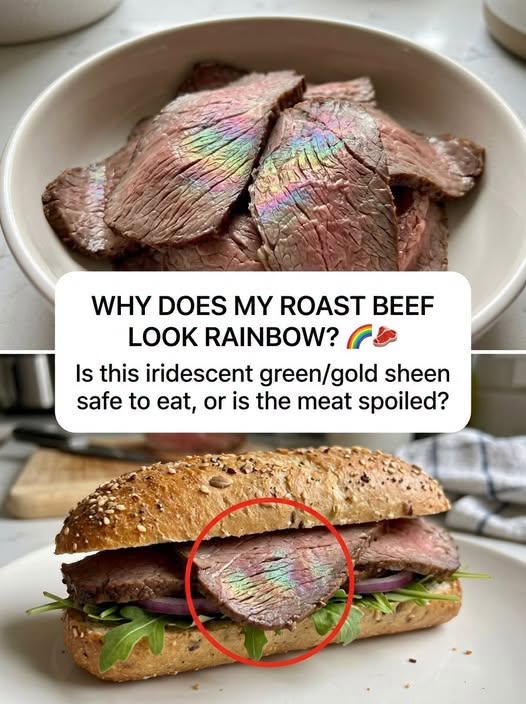
Have you ever opened a package of sliced deli meat and noticed something unusual?
Instead of looking completely pink, red, brown, or beige, the surface may appear to have a subtle rainbow-colored or metallic shine when you move it under the light.
At first glance, this can be surprising.
Some people immediately wonder whether the meat has spoiled or whether something unusual has happened during processing. In many cases, however, that colorful appearance can be explained by a normal optical effect involving light, the structure of the meat, and the way its surface reflects light.
Understanding what causes the effect can make it easier to distinguish an unusual-looking but otherwise normal slice of meat from food that shows genuine signs of spoilage.
What Causes the Rainbow-Like Appearance?
The colorful shine sometimes seen on deli meat is generally related to the way light interacts with the meat’s surface and internal structure.
Meat contains muscle fibers arranged in organized structures. When a slice is cut, those structures can create surfaces that interact with light in particular ways.
Under certain lighting conditions, light can reflect from these structures and produce colors that resemble the appearance of a rainbow.
This is an optical phenomenon rather than necessarily an indication that the meat contains unusual colors.
You may notice that the colors change as you move the slice or change the angle of the light. That’s an important clue.
The appearance can look green, blue, purple, gold, or other shades depending on the viewing angle and the lighting.
This is similar to other everyday optical effects in which a surface appears to change color when viewed from different directions.
Why Does the Color Change When You Move the Meat?
One of the most interesting things about this phenomenon is that the colors may shift when the angle changes.
That’s because the way light reflects from a surface depends partly on the position of the light source, the viewer, and the object.
A slice of meat can contain many microscopic structures and relatively smooth surfaces created during cutting. When light encounters these structures, certain wavelengths can be reflected more strongly toward your eyes.
As you move the slice, the relationship between the light and the surface changes.
The result can be a shifting, rainbow-like appearance.
This is why a slice may look completely ordinary from one angle and slightly iridescent from another.
Is Rainbow-Colored Deli Meat Automatically Spoiled?
Not necessarily.
A rainbow or iridescent appearance by itself does not automatically mean that deli meat has spoiled.
The visual effect can occur in fresh or properly stored meat products because of the physical structure of the meat and the way it reflects light.
However, appearance is only one factor to consider when evaluating food.
You should not assume that food is safe simply because it looks normal, either.
Some foodborne hazards cannot be detected reliably by sight, smell, or taste. Proper refrigeration, storage time, handling, and packaging are important parts of food safety.
Therefore, the rainbow effect itself should not be used as a definitive test of whether deli meat is safe to eat.
What Does Spoiled Deli Meat Usually Look Like?
Although the rainbow effect can be harmless, there are other changes that may indicate that deli meat should not be eaten.
Potential warning signs include noticeable spoilage odors, an unusually sticky or slimy surface, significant discoloration, damaged packaging, or storage conditions that have not been appropriate.
It’s important to consider the entire situation rather than focusing on one visual characteristic.
For example, if meat has a mild rainbow sheen but has been properly refrigerated, is within its recommended storage period, and otherwise appears normal, the color effect may simply be related to light reflection.
On the other hand, if the product has an unpleasant odor, an unusual texture, or has been stored improperly, it is safer not to eat it.
When in doubt, follow food-safety guidance and the manufacturer’s storage instructions.
Why Does Sliced Meat Show the Effect More Clearly?
You may notice the rainbow effect more often on thinly sliced deli meat than on larger pieces.
One reason is that slicing creates a relatively smooth surface that can reflect light in a more noticeable way.
The orientation of muscle fibers can also contribute to the effect.
Deli meat is often sliced very thinly, which makes subtle changes in color easier to see. Bright kitchen lighting can make the effect particularly noticeable.
If you place the same slice under different types of lighting, you may find that the appearance changes significantly.
Natural daylight, fluorescent lighting, LED lighting, and warmer indoor bulbs can all make colors appear somewhat different.
Does the Processing Method Matter?
The way meat is processed and sliced can influence how its surface looks.
Deli meats can be cooked, cured, smoked, pressed, sliced, or prepared using various combinations of techniques. These processes can affect the texture and structure of the final product.
The arrangement of muscle fibers and the smoothness of the cut surface can influence how light interacts with the meat.
This doesn’t mean that a rainbow appearance tells you exactly how the meat was processed. Rather, processing and slicing can contribute to the physical characteristics that make optical effects more noticeable.
Why Does It Sometimes Look Metallic?
Some people describe the appearance as looking almost metallic.
That’s because iridescent surfaces can produce colors that resemble the reflective appearance of metal.
The effect is especially noticeable when a bright light source is positioned above or beside the meat.
The surface can appear glossy while displaying several colors at once.
This doesn’t necessarily mean that the meat has been contaminated with a foreign substance.
Instead, the appearance can result from the interaction of light with microscopic structures.
How Is This Different From Mold?
Mold and an optical rainbow effect are very different things.
A rainbow-like sheen often changes with viewing angle and may disappear when the lighting changes.
Mold, by contrast, can produce visible growth or patches that don’t behave like reflected light. Mold may appear fuzzy, powdery, or irregular, depending on the type.
If you see obvious mold on a meat product, don’t simply assume it is an optical effect.
For perishable foods such as sliced deli meat, visible mold is a reason to discard the product rather than trying to remove the affected portion.
What About Green or Gray Discoloration?
Color changes can have many causes, so it is important not to interpret every unusual shade in exactly the same way.
An iridescent green or blue reflection that shifts as you move the meat can be different from a persistent green, gray, brown, or otherwise unusual discoloration.
The context matters.
If you’re uncertain whether what you’re seeing is an optical effect or an actual change in the food, consider the product’s smell, texture, packaging, storage history, and recommended use period.
When food appears questionable, the safest approach is to avoid consuming it.
Does Smell Provide a Reliable Safety Test?
Smell can sometimes help identify obvious spoilage, but it should not be considered a complete food-safety test.
Some harmful microorganisms do not necessarily produce a noticeable smell or visible change.
This is why safe storage and proper handling are more important than relying entirely on your senses.
Keep perishable foods refrigerated according to food-safety recommendations and avoid leaving them at room temperature for extended periods.
When storing opened deli meat, follow the package instructions and general food-safety guidance.
Why You May Notice the Effect More at Home
You may have seen this effect in a brightly lit kitchen without realizing what caused it.
Modern LED lighting can be quite bright and directional. If a slice of meat is placed beneath such a light, the reflected colors may become easier to notice.
The effect can also become more obvious when the meat is slightly moist or glossy.
Changing the angle of the package or moving it closer to the light may make the colors appear stronger or weaker.
This is another reason why a photograph of the meat may not accurately represent what you see in person.
Cameras can process color and reflections differently from the human eye.
Should You Be Concerned?
Seeing a rainbow-like shine on deli meat is not automatically a reason to panic.
In many cases, it can be explained by ordinary optical properties of the meat.
However, food safety should always take priority over appearance.
If the product has been stored improperly, is past its recommended storage period, has a damaged package, or has clear signs of spoilage, it is better to discard it.
You should also follow the manufacturer’s storage instructions and local food-safety recommendations.
The Interesting Science Behind an Ordinary Slice of Meat
What seems like an unusual change in color can actually be a small demonstration of how light interacts with matter.
The same basic idea can be observed in many other places.
Oil films can create colorful patterns on water. Certain shells and feathers can appear to change color as they move. CDs and DVDs can produce rainbow patterns when exposed to light.
These effects demonstrate that color isn’t always simply a property of the material itself.
Sometimes, what we see depends on how light interacts with microscopic structures and how that reflected light reaches our eyes.
Deli meat can provide another everyday example of this principle.
Final Thoughts
The next time you notice a subtle rainbow or metallic-looking shine on a slice of deli meat, there’s no need to immediately assume that something is wrong.
The effect can occur because of the structure of the meat and the way its surface reflects light. Changes in viewing angle and lighting can make the colors appear to shift, creating the familiar iridescent appearance.
However, the rainbow effect should not be treated as a guarantee that a product is safe to eat.
Good food-safety habits still matter. Pay attention to storage conditions, package instructions, texture, odor, visible spoilage, and the recommended storage period.
When a food product seems questionable for any reason, choosing not to eat it is the safest option.
So that colorful shine isn’t necessarily a strange chemical change or a sign that your deli meat has suddenly become unsafe. Sometimes, it’s simply an interesting example of everyday food science happening right in your kitchen.