I had lived in my apartment building for eleven years.
In all that time, I had learned one important rule about shared buildings:
You have to be patient.
Walls are thin.
People have different schedules.
Someone will occasionally vacuum at an inconvenient hour.
A child might run down the hallway.
A neighbor might accidentally leave something outside your door.
Most of those things aren’t worth an argument.
I’ve always tried to be the kind of neighbor who lets small things go.
I don’t complain about every noise.
I don’t keep track of who parks where.
I don’t knock on doors unless something genuinely needs to be addressed.
Then my upstairs neighbor developed a habit that became impossible to ignore.
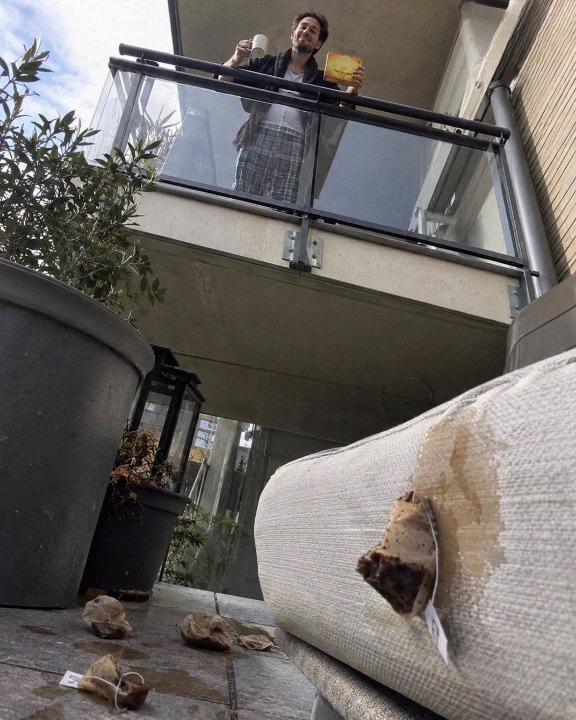
He started throwing used tea bags over his balcony.
And they kept landing on mine.
It Happened Like Clockwork
The first one landed on my balcony early one morning.
It was around seven.
I was making coffee when I noticed something dark near one of my plant pots.
I looked down.
A wet tea bag.
At first, I assumed it had fallen accidentally.
Perhaps someone upstairs had been cleaning the balcony.
Perhaps the wind had carried it.
I picked it up, put it in the trash, and forgot about it.
A few days later, another one appeared.
Then another.
Soon, I realized there was a pattern.
Every morning at approximately seven o’clock, a used tea bag would come over the railing.
Then, around nine in the evening, another one would appear.
It was almost as reliable as an alarm clock.
I began joking with myself that I could tell the time by the tea bags.
Seven in the morning?
Time for tea.
Nine at night?
Apparently, time for another tea bag.
It might have been funny if the bags had stayed on the balcony floor.
Unfortunately, they didn’t always land there.
The First Real Problem
One morning, I had washed several white towels and hung them outside to dry.
I went back inside.
When I returned later, I found a used tea bag lying on one of the towels.
The tea had soaked into the fabric.
There was a large brown stain right in the middle.
I stared at it for several seconds.
That was the moment I decided I needed to say something.
I went upstairs and knocked on apartment 4B.
The neighbor opened the door.
“Hi,” I said. “I think one of your tea bags landed on my balcony again.”
He looked surprised.
“Oh, no. Was that me?”
“It’s been happening several times.”
He seemed genuinely embarrassed.
“I’m sorry. I’m half asleep in the morning sometimes. I just flick it over the railing without thinking.”
I explained that one had landed on a towel.
He apologized again.
“It won’t happen anymore.”
I thanked him and went back downstairs.
I remember feeling slightly embarrassed myself.
I wondered whether I had made too much of it.
After all, it was just a tea bag.
Surely the problem was solved.
It wasn’t.
The Habit Continued
The next morning, another tea bag landed on my balcony.
I stared at it.
I couldn’t believe it.
I decided not to say anything immediately.
Maybe he had forgotten.
Maybe it was an accident.
I waited.
Another one appeared that evening.
Then another the following morning.
Over the next few weeks, I tried to ignore it.
I told myself it wasn’t worth creating tension with someone who lived directly above me.
I’d lived in the building for eleven years.
I liked most of my neighbors.
I had no interest in becoming known as the person who complained about everything.
But then another tea bag landed on the cushion of my outdoor chair.
It stayed there long enough for the moisture and tea residue to soak into the fabric.
The stain was obvious.
That was the second time I went upstairs.
The Second Conversation
I knocked on his door.
When he opened it, I said, “You’re still throwing them over.”
He looked at me.
“It’s a tea bag.”
“I know.”
“Then what’s the problem?”
I explained that they were staining things.
I’d already had to throw away one towel, and now the chair cushion cover was damaged.
He leaned against the door frame.
For a moment, he didn’t say anything.
Then he shrugged.
“You live underneath. That’s how buildings work.”
I stared at him.
“That’s not really how balconies work.”
He laughed.
“You should be glad it’s tea.”
I wasn’t sure whether he was joking.
“Excuse me?”
He smiled.
“I’m just saying. It could be worse.”
Then he closed the door.
I stood there for a moment.
I wasn’t angry because someone had disagreed with me.
I was frustrated because I had tried to handle the problem politely.
Twice.
And nothing had changed.
I Decided Not to Argue
I could have started shouting.
I could have banged on his door.
I could have complained to every neighbor in the building.
But I knew that would only make the situation worse.
Instead, I went downstairs.
I made coffee.
I sat on my balcony.
And I thought about what to do next.
Then I realized something.
He probably expected me to lose my temper.
If I became angry, he could dismiss the entire issue as a personality conflict.
I didn’t want that.
I wanted the behavior to stop.
So I decided to handle the situation differently.
I would document what was happening and use the proper building procedures.
I took photographs of the stained towel.
I photographed the chair cushion.
I kept a simple record of the dates and times when the tea bags appeared.
I didn’t exaggerate.
I didn’t add anything that hadn’t happened.
I simply recorded the facts.
One More Chance
I decided to give him one final opportunity.
If nothing happened the following morning, I would let the issue go.
Maybe the previous conversation had finally made him think about it.
Maybe he would stop.
At exactly 7:04 the next morning, I heard something land on the balcony.
I didn’t even have to look.
I knew what it was.
I walked outside.
There it was.
Another used tea bag.
It had landed beside my plant pots.
I stood there in my robe, looking at it.
For a moment, I felt exhausted.
Then I went inside and finished my coffee.
By the time I put the cup down, I knew exactly what I was going to do.
A Different Approach
That afternoon, I contacted the building manager.
I explained the situation calmly.
I showed the photographs.
I showed the damaged fabric.
I explained that I had already spoken to my upstairs neighbor twice.
The manager asked me whether I wanted to make a formal complaint.
I hesitated.
I didn’t want to create unnecessary drama.
But I also didn’t think I should have to replace my belongings because someone couldn’t use a trash bin.
So I agreed.
The building manager explained that throwing objects from balconies wasn’t permitted and that residents were expected to dispose of waste properly.
The manager said they would speak to the resident.
I left it there.
No shouting.
No confrontation.
No revenge.
Just documentation and the proper process.
The Next Morning
I woke up early.
I made coffee.
Then I sat quietly on my balcony.
At a few minutes before seven, I heard movement upstairs.
The balcony door opened.
My neighbor stepped outside with his tea.
He looked down.
Then he looked at me.
We made eye contact.
He paused.
For a second, neither of us said anything.
Then he looked at the cup in his hand.
He looked toward the railing.
Then he looked back at me.
He didn’t throw anything.
Instead, he turned around and went back inside.
A few minutes later, I heard his apartment door close.
I smiled.
Not because I had defeated him.
Not because I wanted to embarrass him.
I smiled because the problem appeared to be over.
An Unexpected Knock
Later that morning, there was a knock at my door.
I opened it.
It was him.
He looked uncomfortable.
“I got a message from the building manager.”
I nodded.
“I figured.”
He sighed.
“I didn’t realize you had actually had to replace things.”
I explained that the stains had damaged several items.
He looked down.
“I should have stopped when you asked.”
I didn’t argue.
He continued.
“I thought you were making a big deal out of nothing.”
“I understand,” I said. “But it wasn’t nothing to me when my things were being damaged.”
He nodded.
“Fair enough.”
Then he surprised me.
“I’ll stop.”
“Thank you.”
He walked away.
That was the end of the conversation.
No dramatic argument.
No insults.
No grand speech.
Just a simple acknowledgment.
The Balcony Became Quiet Again
The next morning, I waited.
Seven o’clock came.
Nothing.
Seven fifteen.
Nothing.
Seven thirty.
Still nothing.
That evening, I sat outside again.
Nine o’clock came.
No tea bag.
For the first time in months, my balcony was quiet.
I looked at the clean chair cushion.
My plants were still there.
The towels were hanging peacefully.
It felt strangely satisfying.
Not because my neighbor had been punished.
Because I had finally been able to enjoy my own balcony without wondering what would land on it next.
What the Experience Taught Me
The whole situation taught me something about dealing with difficult people.
Sometimes, the strongest response isn’t the loudest one.
I could have shouted at my neighbor.
I could have retaliated.
I could have tried to embarrass him.
But none of those things would have solved the actual problem.
Instead, I stayed calm, documented what happened, and used the appropriate process.
That approach gave me something much more useful than an argument.
It gave me a solution.
My neighbor and I aren’t close friends now.
We probably never will be.
But we can pass each other in the hallway without hostility.
Sometimes he nods.
Sometimes I say hello.
That’s enough.
The Tea Bags Finally Stopped
Months later, I was sitting on my balcony with my morning coffee.
The sun was coming up.
My plants were beginning to bloom.
The building was quiet.
I looked at the railing and smiled.
There was no tea bag on the floor.
There hadn’t been one in a long time.
I realized that the whole situation had never really been about tea.
It was about respect.
It was about recognizing that shared spaces still belong to people who deserve consideration.
And it was about understanding that when a simple request doesn’t work, you don’t necessarily need to become aggressive.
Sometimes you simply need to choose a better method.
I finished my coffee and went inside.
For the first time in months, I didn’t check the balcony before closing the door.
I didn’t have to.
I already knew it would be clean.
And that was the best “lesson” I could have hoped for.