Two years ago, my daughter Mia was the most energetic child I had ever known.
She loved racing me to the mailbox.
She rode her bicycle around the driveway.
She danced whenever she heard music.
And whenever we went somewhere, she was usually the first person through the door.
Then one winter afternoon, everything changed.
Our car was involved in a serious road accident after another vehicle lost control on an icy street.
I was fortunate to escape with relatively minor injuries.
Mia wasn’t so lucky.
She suffered a spinal injury that left her unable to walk.
The doctors explained that her recovery would be complicated and that we would have to make many adjustments to our lives.
But the physical changes were only part of what Mia had to face.
The emotional adjustment was even harder.
Learning a New Way of Living
Before the accident, Mia had never thought twice about walking.
She ran.
She jumped.
She climbed stairs.
She played outside with her friends.
Suddenly, ordinary activities required planning and assistance.
At first, she refused to use her wheelchair.
She didn’t want anyone to see her.
She didn’t want to go to school events.
She didn’t want to visit crowded places.
And she especially didn’t want people staring at her.
One evening, I found her sitting quietly in her room.
“What’s wrong?” I asked.
She looked down.
“I don’t want people to see me like this.”
My heart broke.
I sat beside her.
“You are still Mia.”
She shook her head.
“I’m different now.”
I told her that being different wasn’t something she needed to be ashamed of.
But I knew words alone wouldn’t solve everything.
She needed time.
She needed support.
And most importantly, she needed to rediscover the things that made her feel like herself.
Then something unexpected happened.
My cousin Claire announced that she was getting married.
A Wedding Invitation Changes Everything
Mia adored Claire.
Claire had always treated her like a little sister.
After the accident, she visited often.
She never acted uncomfortable around Mia’s wheelchair.
She never spoke to her with pity.
Instead, she treated her exactly as she always had.
So when Claire’s wedding was announced, Mia was thrilled.
“Mom, can we go?”
I smiled.
“Of course.”
Mia immediately began planning what she would wear.
She wanted a special dress.
She wanted her hair styled.
She wanted to take photographs.
For the first time in months, I saw the excitement return to her face.
Claire was delighted that Mia would attend.
She even told me privately that she had a special idea.
“I want Mia to catch the bouquet,” she said.
I laughed.
“Are you sure?”
“Absolutely.”
Claire knew how much the moment would mean to her.
It wasn’t about predicting the future.
It was simply a playful wedding tradition and a way to make Mia feel included.
Claire told me she planned to make sure the bouquet landed where Mia could easily reach it.
Mia didn’t know.
That made it even more special.
The Wedding Reception
The wedding day was beautiful.
There were flowers everywhere.
The reception hall was decorated with lights and elegant table settings.
Music played in the background as family members and friends celebrated.
Mia looked happier than I had seen her in a long time.
She spent much of the evening talking with relatives and enjoying the music.
At one point, she even danced with me from her chair.
She laughed.
She took photographs.
She smiled for the camera.
For a few hours, the accident felt like something far away.
Then the DJ announced the bouquet tradition.
Several guests laughed and moved toward the dance floor.
Claire looked across the room.
She saw Mia.
Then she winked.
Mia smiled.
I could tell she was beginning to understand what was about to happen.
The guests made room for her wheelchair.
Claire turned around.
She held the bouquet behind her.
Then she gently tossed it over her shoulder.
The flowers flew through the air.
Everyone watched.
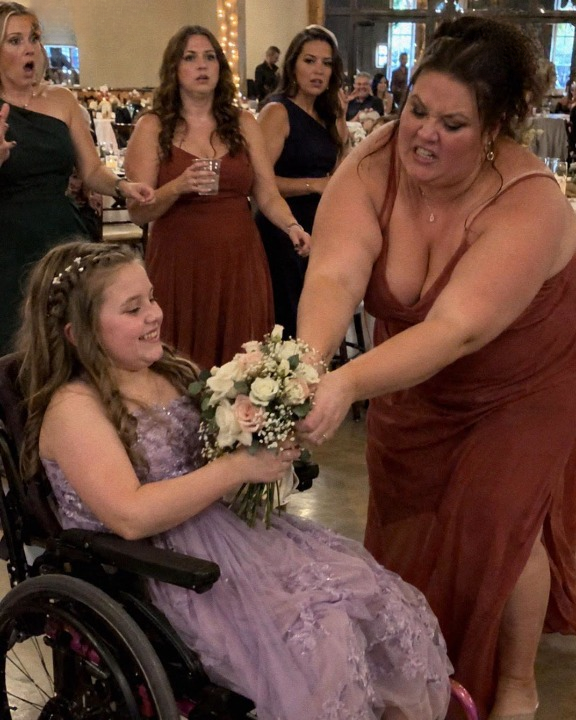
And somehow, they landed perfectly in Mia’s lap.
Mia’s face lit up.
She looked down at the bouquet as though it were the greatest gift she had ever received.
She reached toward the flowers.
But before her fingers could touch them, someone moved through the crowd.
It was my sister Donna.
The Moment Everything Changed
Donna reached toward Mia and took the bouquet from her.
The movement was so sudden that I didn’t understand what had happened at first.
Mia’s chair shifted slightly.
I immediately reached for the handles to make sure she was steady.
Donna held the bouquet above her head.
“Looks like I won!” she joked.
The laughter disappeared.
People stared at her.
Claire looked shocked.
I walked toward my sister.
“Donna, give it back.”
She rolled her eyes.
“Oh, come on.”
I looked at the bouquet.
“Claire threw that to Mia.”
Donna shrugged.
“It’s just a bouquet.”
I couldn’t believe she was saying that.
It wasn’t about the flowers.
It was about what the moment meant to Mia.
But Donna wasn’t finished.
She made a comment suggesting that Mia shouldn’t be concerned about wedding traditions because she was still a child and her future shouldn’t be defined by whether she could participate in a traditional ceremony.
The room became uncomfortable.
I saw Mia’s expression change.
The happiness that had been on her face only moments earlier disappeared.
Her eyes filled with tears.
For a second, I thought she was going to cry.
I moved toward her.
But then something surprised me.
Mia wiped her eyes.
She straightened her shoulders.
Then she looked toward the DJ.
Mia Asks for the Microphone
“Could I borrow the microphone?” she asked.
The DJ looked at Claire.
Claire nodded.
He handed Mia the microphone.
The room became completely quiet.
Mia held it with both hands.
They were trembling slightly.
She looked toward Donna.
Then she smiled.
“Dear Aunt Donna,” she began.
Everyone listened.
“I think you forgot something.”
Donna looked confused.
Mia continued.
“My future isn’t decided by whether I can walk.”
Several guests looked at one another.
Mia took a breath.
“My future isn’t decided by whether I catch a bouquet.”
She looked down at the flowers.
“And it definitely isn’t decided by what somebody else thinks I can or can’t do.”
The room remained silent.
Mia continued.
“I used to think being different meant I couldn’t have the same dreams as everyone else.”
Her voice became stronger.
“But then Mom told me something.”
She looked toward me.
“She told me that I don’t have to become someone else to have a wonderful life.”
I felt tears forming in my eyes.
Mia turned back toward the room.
“So I’m going to keep learning.”
“I’m going to keep making friends.”
“I’m going to keep laughing.”
“I’m going to keep going to weddings.”
“And if someday I want to get married, I’ll decide that for myself.”
The first person to applaud was Claire.
Then someone at the nearest table joined.
Then another.
Within seconds, the entire room erupted in applause.
Mia smiled.
Donna Finally Understands
Donna stood completely still.
The bouquet was still in her hands.
She looked around the room.
Nobody was laughing anymore.
Nobody was supporting her joke.
Instead, everyone was looking at Mia.
Claire walked over and gently took the bouquet back.
Then she placed it in Mia’s hands.
“This was always yours,” Claire said.
Mia smiled.
“Thank you.”
Claire hugged her.
The applause began again.
I looked at Donna.
For once, she had nothing to say.
She looked embarrassed.
But Mia didn’t use the moment to humiliate her.
That was what impressed me most.
My daughter could have said something cruel.
She could have embarrassed her aunt in front of everyone.
Instead, she simply explained that her future belonged to her.
A Conversation After the Reception
Later that evening, Donna approached us.
She looked uncomfortable.
“I shouldn’t have said those things,” she admitted.
Mia looked at her.
“No, you shouldn’t have.”
Donna nodded.
“I’m sorry.”
Mia was quiet for a moment.
Then she said, “I accept your apology.”
I was surprised.
Donna looked at the bouquet.
“I didn’t realize how much that moment meant to you.”
Mia smiled slightly.
“It wasn’t really about the flowers.”
Donna nodded.
“I understand now.”
It wasn’t a perfect resolution.
One apology couldn’t erase the hurtful comment.
But it was a beginning.
What the Bouquet Came to Mean
That night, Mia kept the bouquet beside her.
She didn’t care about the old tradition that supposedly said whoever caught the flowers would be the next person to marry.
To her, the bouquet had come to represent something else.
It represented choice.
It represented hope.
It represented the idea that her future didn’t have to be defined by someone else’s expectations.
A few days later, we dried some of the flowers and preserved them.
Mia put them in a small frame in her bedroom.
Underneath them, she wrote a simple sentence:
“My future is mine to choose.”
Whenever I look at that frame, I think about how much my daughter has changed.
Not because she stopped facing challenges.
Not because everything suddenly became easy.
But because she learned that confidence doesn’t mean never being hurt.
Sometimes confidence means being hurt and still finding your voice.
Mia’s Life Continued to Grow
The years after the accident weren’t always easy.
There were physical challenges.
There were frustrating days.
There were moments when Mia wished things could return to the way they were before.
But she also discovered new strengths.
She became involved in activities she had never considered before.
She made new friends.
She became more comfortable speaking openly about accessibility and inclusion.
She learned how to advocate for herself.
And she stopped apologizing for needing help.
One afternoon, several months after the wedding, we were driving past a bridal store.
Mia looked through the window.
“Mom?”
“Yes?”
“I think I’d like to design my own wedding dress someday.”
I smiled.
“You absolutely can.”
She laughed.
“And I want a really big bouquet.”
“How big?”
She spread her arms as wide as possible.
“This big.”
We both laughed.
The Lesson I Will Never Forget
That wedding taught me something I wish every parent could teach their child.
Other people’s assumptions do not determine your future.
Someone may look at your circumstances and decide what they think you can accomplish.
They may see a challenge and mistake it for a limitation.
They may believe they know what your life will look like.
But they don’t.
Mia’s life belongs to her.
Her dreams belong to her.
Her choices belong to her.
And whether she eventually gets married, travels the world, pursues a career, remains single, or chooses an entirely different path, none of those possibilities are determined by a wedding tradition or someone else’s opinion.
That bouquet wasn’t a prediction.
It was simply a handful of flowers.
But when my ten-year-old daughter held it in her hands that evening, she reminded an entire room that dignity, hope, and ambition don’t belong to only one kind of person.
She reminded us that a person’s future cannot be measured by what they can physically do today.
And most importantly, she reminded me that sometimes children have more courage than the adults around them.
I will never forget the sound of that ballroom rising to its feet.
Not because everyone agreed with Mia.
Not because the moment was perfect.
But because, for those few minutes, everyone understood exactly what she was trying to say:
Her future was hers to write.
And nobody else was going to write it for her.