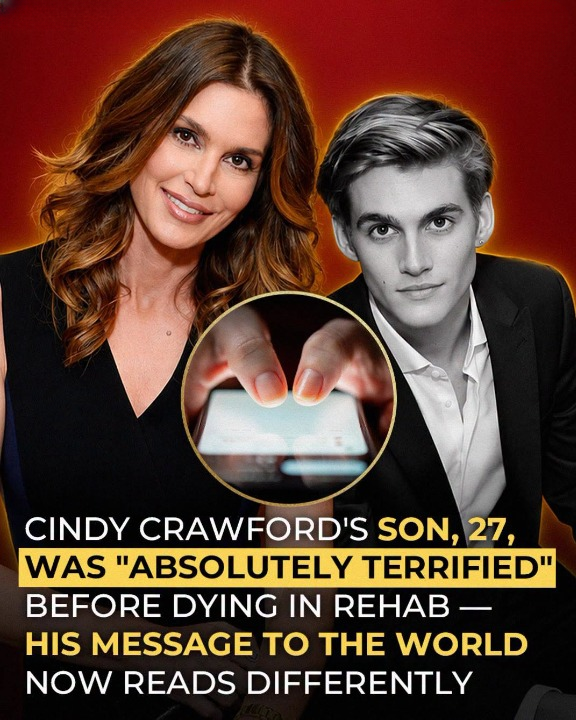
The news of Presley Gerber’s death has left many people reflecting on a young life that was lived partly in the public eye and partly away from it.
Presley Gerber, the son of supermodel Cindy Crawford and businessman Rande Gerber, died on September 20, 2026, at the age of 27. His death was confirmed by his family, who have asked for privacy during this difficult time. The official cause of death has not been publicly disclosed.
His death has also brought renewed attention to the subjects Presley had chosen to discuss publicly during the later years of his life.
Mental health.
Recovery.
Personal struggles.
And the importance of having honest conversations about experiences that many people prefer to keep hidden.
Those conversations now carry a different meaning.
But Presley’s story should not be reduced to the circumstances surrounding his death.
He was much more than a headline.
He was a son, a brother, a model, a creative person, and a young man who spent much of his life growing up under an extraordinary amount of public attention.
Born in California in 1999, Presley was the only son of Cindy Crawford and Rande Gerber. His younger sister, Kaia Gerber, also became a successful model and public figure.
Presley entered the modeling industry at a young age.
He was signed by IMG Models when he was 15 and later worked with several major fashion brands. His career included runway appearances, advertising campaigns, magazine features, and other projects that placed him in front of international audiences.
He also appeared alongside his mother in a Pepsi commercial during the 2018 Super Bowl period.
From the outside, his life seemed to contain many of the things people associate with success.
He had famous parents.
He had a modeling career.
He attended major events.
He traveled.
He worked in an industry that attracted enormous attention.
Yet behind those photographs was a much more complicated personal story.
As Presley grew older, he began talking more openly about mental health and addiction.
Rather than presenting his life as perfect, he acknowledged that he had faced difficult periods.
In 2025, he launched a social-media series called “Mental Health Mondays,” where he attempted to encourage more open conversations about subjects that people often find difficult to discuss.
That decision was significant.
For someone who had grown up surrounded by cameras and public attention, choosing to discuss personal difficulties required a different kind of openness.
Presley could have kept those experiences private.
Instead, he used his platform to talk about them.
He discussed depression and mental health in public conversations and spoke about mistakes he had made and lessons he had learned.
His goal appeared to be more than simply telling his own story.
He wanted other people to understand that struggling did not mean they had to remain silent.
That message became an important part of the public image he developed later in life.
Of course, talking openly about personal difficulties does not mean that those difficulties disappear.
Recovery is rarely a straight line.
People can make progress and still experience setbacks.
They can ask for help and still have difficult days.
They can have supportive families and still face challenges that are deeply personal.
Presley’s life reflected some of those complicated realities.
Reports in recent years documented his efforts to address substance use and seek treatment. His sister Kaia also spoke about the challenges experienced by their family and the impact those struggles had on the people closest to him.
In 2026, Presley publicly discussed receiving treatment and attempting to make changes in his life.
His family supported him.
His mother and sister expressed their love for him.
And for a period, there were signs that he was trying to move toward a healthier and more stable future.
That makes his death especially difficult for those who knew him.
It also reminds us why it is dangerous to assume that we understand someone’s entire life from what we see online.
A photograph captures one moment.
A magazine cover captures another.
A social-media post may show only the part of a person’s life they have chosen to share.
None of those things tells us everything.
Presley’s public image was shaped by fashion, celebrity, and his famous family.
But his personal experiences were much more complicated.
He was a young man trying to find his own identity while carrying expectations that came with being the son of one of the world’s most recognizable models.
Growing up in a famous family can provide extraordinary opportunities.
It can also bring enormous public attention.
Every mistake can become a story.
Every photograph can be analyzed.
Every personal decision can attract strangers’ opinions.
Presley experienced that attention from a young age.
Yet as he became an adult, he increasingly appeared interested in discussing issues that existed beyond celebrity culture.
He talked about mental health.
He talked about recovery.
He talked about learning from difficult experiences.
And he encouraged people to have conversations that might otherwise never happen.
Those conversations may become one of the most meaningful parts of his legacy.
His story also highlights the importance of compassion.
When someone is struggling with addiction or mental health difficulties, it can be easy for outsiders to make assumptions.
People may see a headline and believe they understand the situation.
But the reality is usually much more complicated.
Behind every struggle is a person.
There may be family members trying to help.
There may be friends offering support.
There may be professionals providing treatment.
There may be periods of progress followed by difficult setbacks.
And there may be countless private moments that the public will never know about.
Presley’s family experienced those realities away from the cameras.
His mother, Cindy Crawford, had spent decades in the public eye, but when it came to her children, she often spoke about the importance of family and the challenges of watching someone you love struggle.
In July 2026, Crawford shared a birthday tribute to Presley, celebrating her son and expressing how proud she was of him.
At the time, it was simply a mother’s message to her son.
After his death, people naturally look back at such moments differently.
But perhaps the most important thing is not to reinterpret every previous message as a hidden warning or final sign.
Sometimes a birthday message is simply what it was.
A mother celebrating her child.
That distinction matters.
Grief can make people search for clues.
It can make ordinary photographs suddenly seem significant.
It can make old interviews feel like they contain answers.
But not everything needs to be turned into a mystery.
Sometimes a person’s life is simply a collection of experiences, relationships, successes, mistakes, hopes, and challenges.
Presley’s life was no different.
His death at 27 was unexpected and heartbreaking for many people.
Yet his story was already much bigger than the final chapter.
He had built a career.
He had explored creative interests.
He had relationships with his family and friends.
He had spoken about issues that mattered to him.
He had experienced both achievements and setbacks.
And he had tried to use his public platform to encourage conversations about mental health.
That effort deserves to be remembered.
One of the most important things people can learn from his story is that asking for help should never be viewed as a weakness.
Mental health struggles can affect people from every background.
Addiction can affect families regardless of wealth, social status, or public image.
And having opportunities does not automatically protect someone from emotional or personal difficulties.
Presley’s life illustrated that reality in a very public way.
He came from a famous and financially successful family, yet he still faced struggles that required support and treatment.
That does not make his family unusual.
It makes the situation human.
People can have loving parents and still struggle.
They can have successful careers and still struggle.
They can have friends, opportunities, and financial security and still need professional help.
There is no single appearance that mental health difficulties have.
There is no particular background that makes someone immune.
And there is no shame in seeking support.
Presley appeared to understand the importance of that message.
His “Mental Health Mondays” project was an attempt to make those conversations more normal.
He spoke about subjects that many people might otherwise avoid.
He shared experiences that were personal.
And he encouraged people to think about mental health in a more open and honest way.
That may be one of the most lasting aspects of his public life.
His death has understandably brought renewed attention to those conversations.
But his story should not become a source of speculation.
The cause of his death has not been publicly established, and his family has requested privacy. Reports indicate that the circumstances surrounding his death remain under official review.
Until more verified information is available, it is important to avoid assumptions.
There is no need to fill gaps in the story with rumors.
There is no need to turn an uncertain detail into a dramatic claim.
And there is no need to sensationalize the loss of a young person.
What we do know is enough.
Presley Gerber was 27.
He was the son of Cindy Crawford and Rande Gerber.
He was the brother of Kaia Gerber.
He worked as a model.
He had spoken publicly about mental health and addiction.
He had sought treatment.
He had people who loved and supported him.
And he died far too young.
Those facts tell a powerful story on their own.
Perhaps the most meaningful way to remember him is not by focusing only on the sadness surrounding his final days, but by remembering the conversations he tried to create while he was alive.
He wanted people to talk.
He wanted difficult subjects to become less difficult to discuss.
He wanted people to recognize that personal struggles are not something that should automatically be hidden.
And he showed that even someone who appears to have an extraordinary life can experience challenges that the public cannot see.
That is a message worth remembering.
For families dealing with mental health or addiction, compassion matters.
For people struggling privately, support matters.
For friends who notice that someone is having a difficult time, listening can matter.
And for anyone who believes they have to hide their struggles because their life looks successful from the outside, Presley’s story offers another perspective.
No one has to be perfect to deserve help.
No one has to wait until things become unbearable before asking for support.
And no family should feel ashamed because someone they love is struggling.
Presley’s life cannot be summarized by one headline.
It cannot be defined solely by his family’s fame.
It cannot be reduced to his career.
And it should not be reduced to the circumstances of his death.
He was a person who experienced happiness, pressure, success, disappointment, love, family, uncertainty, and hope.
He was still young.
There were undoubtedly things he hoped to accomplish and experiences he expected to have in the future.
That is part of what makes his death so painful.
His story ended before anyone expected it to.
For his family, the loss is personal.
For people who followed his career, it is heartbreaking.
And for those who connected with his openness about mental health, his absence may make the conversations he started feel even more important.
The best way to honor those conversations is not through rumors or sensational stories.
It is through understanding.
It is through compassion.
It is through encouraging people to seek appropriate professional help when they need it.
And it is through remembering that the person behind a public image is always more complicated than what we see on a screen.
Presley Gerber’s life contained much more than his final chapter.
He was a son who was deeply loved by his family.
He was a brother.
He was a young model who built a career in an industry he entered as a teenager.
He was someone who openly discussed subjects that many people find difficult.
And he was a person who, like countless others, was trying to navigate the complicated process of growing, changing, and finding his way.
His death at 27 is a heartbreaking loss.
But his story does not have to end with the headline announcing it.
The conversations he started can continue.
The importance of asking for help can continue to be discussed.
And the reminder that nobody’s private struggles should be judged from the outside can remain.
Sometimes the most powerful legacy is not a final statement.
It is the conversation a person leaves behind.
And Presley Gerber had already started one.