After Three Sons, My Husband Put a Baby Girl in My Arms—Then the Doctor Showed Me the DNA Results
For most of my adult life, I had quietly imagined what it would be like to have a daughter.
Not because I loved my sons any less.
I didn’t.
My three boys had filled our home with noise, muddy shoes, school projects, sports equipment, arguments over the television remote, and laughter that could be heard from one end of the house to the other.
They were my world.
But before any of them were born, I had once purchased a tiny pink blanket and folded it carefully into the back of a drawer.
I had imagined using it for a baby girl.
After our third son arrived, I finally accepted that the blanket might never be needed.
I packed it away.
Years passed.
Our family settled into a comfortable rhythm. My husband, David, worked long hours, I managed the household and eventually returned to work, and our sons grew faster than I thought possible.
The baby who had once fit against my chest became a teenager.
Then another.
Then another.
Before I realized it, the house was filled with young men instead of little boys.
By the time our youngest turned seventeen, I was fifty-four.
The pink blanket was still somewhere in a storage box.
I hadn’t thought about it in years.
Then, one morning at exactly 6:20, my phone rang.
It was David.
I almost didn’t answer.
He rarely called that early unless something was wrong.
“David?”
There was silence for a moment.
Then he said, “You need to come to the hospital.”
My heart immediately tightened.
“Are you okay?”
“I’m fine.”
“Are the boys okay?”
“Yes.”
“Then what’s happened?”
His voice sounded strange.
“Just come here.”
“Why?”
Another pause.
“And don’t bring the boys.”
That sentence frightened me more than anything else he could have said.
I grabbed my coat and drove to the hospital.
The entire way there, my mind created possibilities.
An accident.
A family emergency.
Some kind of problem at work.
I called David twice.
He didn’t answer.
When I reached the maternity ward, I saw him standing near the entrance.
He wasn’t alone.
He was holding a newborn baby.
A little girl.
For several seconds, I couldn’t understand what I was seeing.
David looked at me.
His eyes were red.
He looked exhausted and frightened.
And in his arms was a tiny baby wrapped in a white hospital blanket.
“David,” I whispered.
He walked toward me.
I looked at the baby.
Then at him.
“Whose baby is that?”
His face tightened.
“Ours.”
I actually laughed.
Not because it was funny.
Because my brain couldn’t process the words.
“What?”
“Ours,” he repeated.
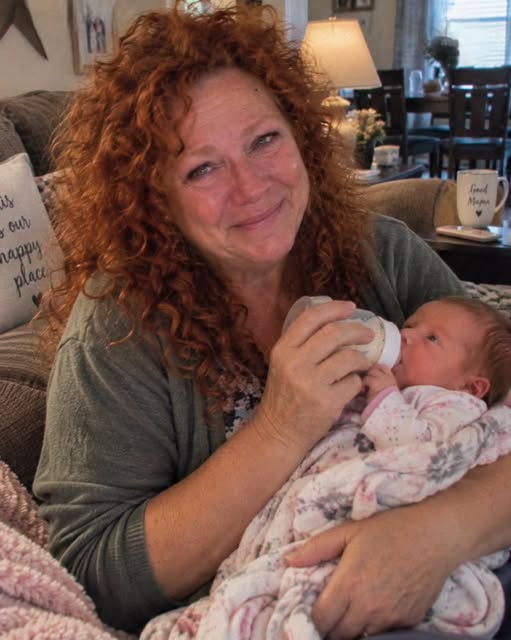
He gently placed the baby into my arms.
She was so small that I instinctively supported her head with both hands.
She had dark hair.
Tiny fingers.
And unusually light gray eyes.
The moment I looked at her face, something inside me broke open.
I began crying.
For years, I had imagined holding a daughter.
And suddenly, somehow, I was.
I looked at David.
“What is happening?”
He touched my shoulder.
“Her name is Grace.”
“Grace?”
He nodded.
I looked back at the baby.
She was sleeping peacefully.
I couldn’t stop the tears.
But beneath the happiness was a growing feeling that something was wrong.
There was no pregnancy.
No phone call.
No explanation.
No nine-month story I had somehow missed.
I was fifty-four years old.
David was standing there as though this were a normal family event.
It wasn’t.
Before I could ask another question, a doctor approached us.
“Mrs. Carter?”
I looked up.
“Yes?”
“I’m Dr. Bennett. Could I speak with you privately for a moment?”
I looked at David.
He immediately shook his head.
“There’s no need.”
The doctor’s expression became serious.
“Mr. Carter, I need to speak with your wife.”
David’s jaw tightened.
“She doesn’t need to know everything right now.”
I stared at him.
“Everything?”
The doctor stepped aside.
“Mrs. Carter, please.”
I handed Grace back to David and followed the doctor into a small office.
He closed the door.
For several seconds, neither of us spoke.
Then he sat down behind his desk.
“Your husband told you how Grace came to be here?”
“No.”
He looked down at the folder in front of him.
“Did he explain why he believed he was the father?”
“No.”
Dr. Bennett took a breath.
“There are some things you need to understand before you make any decisions regarding this child.”
My stomach tightened.
“What decisions?”
He opened the folder.
“I want to make sure you understand that the hospital’s role is to establish the medical facts and make sure the baby is safe.”
I nodded.
He turned a page toward me.
There was a DNA test.
I recognized David’s name.
I read the first result.
Probability of paternity: 0%.
I stared at the page.
Then I looked at the doctor.
“That’s not possible.”
He didn’t answer.
I looked at the result again.
“Then why did my husband tell me she’s ours?”
“We’re still trying to establish the complete history.”
I felt confused.
“Who is the mother?”
The doctor hesitated.
“That’s where this becomes complicated.”
I leaned forward.
“Tell me.”
He turned another page.
My name was printed at the top.
My hands became cold.
The result showed a biological relationship between me and the baby.
Probability of relationship: 99.8%.
I stared at it.
I couldn’t speak.
Finally, I whispered, “What does that mean?”
“It means the testing indicates that you are biologically related to Grace.”
“Related how?”
“We’re conducting additional testing to determine the exact relationship.”
I shook my head.
“No.”
I laughed nervously.
“This is impossible. I’m fifty-four.”
“I understand.”
“No, you don’t.”
I pointed at the report.
“I didn’t have another child.”
“We’re not saying you gave birth to her recently.”
“Then what are you saying?”
Before he could answer, someone suddenly knocked on the office door.
Not a polite knock.
Three hard knocks.
Dr. Bennett looked toward the door.
Another knock followed.
Then a woman’s voice came from the hallway.
“Doctor, please open the door.”
I froze.
I knew that voice.
Or at least I thought I did.
Dr. Bennett stood.
He looked at me.
“Mrs. Carter, before we continue, there’s something else you need to know.”
The woman knocked again.
“Please.”
The doctor opened the door.
A woman stood outside.
She appeared to be in her late twenties.
Her eyes were swollen from crying.
She looked directly at me.
Then at the folder on the desk.
And finally at the empty chair beside me.
“I thought you should meet her,” the woman said.
I didn’t understand.
“Meet who?”
She swallowed.
“Your daughter.”
The room seemed to stop.
I looked at the doctor.
Then back at the woman.
“What did you just say?”
The woman took a trembling breath.
“Grace isn’t my biological daughter.”
She stepped into the room.
“My mother gave birth to her.”
I stared at her.
“Who is your mother?”
She looked at me.
“Your sister.”
I couldn’t move.
I had one sister.
Her name was Rebecca.
And Rebecca had died twenty-nine years earlier.
At least, that was what I had always believed.
I sat down slowly.
“Rebecca died when she was twenty-five.”
The woman nodded.
“That’s what everyone was told.”
My mind raced.
“Who are you?”
“My name is Emily.”
She looked toward the newborn through the small glass window beside the office.
“Grace is my daughter.”
I couldn’t understand.
“Then how am I related to her?”
Emily’s eyes filled with tears.
“Because my mother was your sister.”
Dr. Bennett quietly closed the door.
Emily continued.
“My mother had a baby before she died. A little girl.”
I shook my head.
“Rebecca never had a child.”
“She did.”
“When?”
“She was very young.”
I stared at her.
“Why didn’t I know?”
Emily looked down.
“Because our grandparents raised the baby.”
I felt as though the floor had shifted beneath me.
There had been secrets in my family.
Things nobody talked about.
After Rebecca’s death, our parents had refused to discuss her final years.
They told everyone that she had died without children.
I had accepted that explanation because grief had made questioning everything feel impossible.
“Where was this child?”
Emily answered quietly.
“She grew up believing your parents were her grandparents.”
I couldn’t speak.
Then another thought struck me.
“Why is Grace here?”
Emily looked toward the maternity ward.
“Because my daughter was born yesterday.”
“Who is her father?”
Emily looked at the floor.
“That’s why David is involved.”
My heart sank.
“What does my husband have to do with this?”
She wiped her eyes.
“David knew my mother.”
I looked at the doctor.
He didn’t interrupt.
Emily continued.
“Years ago, before you and David married, he worked with my mother’s employer. They knew each other.”
I stared at her.
“You’re saying David knew Rebecca?”
“Yes.”
“How well?”
Emily hesitated.
“I don’t know.”
The answer made everything more confusing.
I left the office with more questions than answers.
David was still sitting in the waiting area, holding Grace.
When he saw me, he stood.
“Where’s the doctor?”
“Never mind the doctor.”
I walked toward him.
“Who is Rebecca’s daughter?”
His expression changed.
That was when I knew.
He had known.
Maybe not everything.
But something.
“You knew about my sister.”
David looked down.
“I knew she had a child.”
“You knew?”
“I found out years ago.”
“Why didn’t you tell me?”
“Because Rebecca asked me not to.”
I stared at him.
“Rebecca died almost thirty years ago.”
“I know.”
“Then why did you keep it from me?”
He closed his eyes.
“Because I promised her.”
I wanted to be angry.
Instead, I felt completely exhausted.
“Why would she ask you to hide her own child from me?”
David sat down.
“She was afraid.”
“Of what?”
“Of what the family would say.”
He explained that Rebecca had become pregnant when she was young and unmarried. At the time, our family was already dealing with serious financial and personal problems.
Rebecca believed everyone would judge her.
She also believed she wouldn’t be able to provide a stable life for the baby.
So our parents took responsibility for raising the child.
Rebecca stayed away.
David had learned pieces of the story through someone they both knew.
But he had never told me.
Then Emily appeared years later.
And recently, she had discovered the truth about her family.
The connection to Grace came through her.
Grace was not my daughter in the way I had initially believed.
She was my great-niece.
My sister’s granddaughter.
The DNA result made sense.
The 99.8% result didn’t mean I had given birth to Grace.
It meant the genetic relationship was consistent with being a close biological relative.
I looked at the baby again.
She was still sleeping.
And suddenly the pink blanket I had forgotten about for seventeen years came back into my mind.
I had once dreamed about a daughter.
But perhaps life had brought me something different.
Not the daughter I had imagined.
A piece of a family history I never knew existed.
David reached for my hand.
“I should have told you.”
“Yes,” I said quietly.
“You should have.”
“But I didn’t know how.”
I looked at him.
“That’s not an excuse.”
“I know.”
For the next several hours, the hospital staff helped us sort through the information.
Additional testing was arranged.
Records were reviewed.
Emily provided documents relating to her family history.
And slowly, the story became clearer.
Grace’s biological father had not been David.
He had never been.
David had only agreed to help Emily because she was overwhelmed after giving birth and had contacted him after finding his name in old family records.
He had brought Grace to the hospital’s family area because he believed I deserved to know the truth about my sister’s family.
His decision to tell me that Grace was “ours” had been a terrible choice.
He later admitted that he had said it because he was afraid I would walk away if he began the conversation with complicated family history.
He was right about one thing.
The situation was complicated.
But he was wrong to hide the truth.
Several weeks later, Grace came home with Emily.
Not with me.
That distinction mattered.
She was Emily’s daughter.
Emily was her mother.
But I became part of their lives.
I finally learned about Rebecca.
I saw photographs I had never known existed.
I read letters she had written but never sent.
I learned that she had followed my life from a distance.
She had known when I married David.
She had heard about my three sons.
And, according to one letter, she had once wondered whether I would have forgiven her if I knew the truth.
That letter was the hardest thing I had ever read.
I cried for my sister.
For the years we lost.
For the child she had left behind.
And for all the conversations we never had.
But I also realized something important.
Sometimes families carry secrets for so long that people begin believing the secrets are protecting everyone.
Eventually, they only leave people with unanswered questions.
I never got the chance to speak to Rebecca.
But I did get the chance to know Emily.
And I got to watch Grace grow.
The little girl with the gray eyes became a regular part of our family gatherings.
My three sons adored her.
They jokingly called themselves her “three uncles,” even though the family relationship was more complicated than that.
And the pink blanket?
I finally took it out of the storage box.
It was slightly faded after all those years.
I gave it to Emily for Grace.
She held it against the baby and smiled.
“I think she was meant to have this,” she said.
I smiled through my tears.
For seventeen years, I had believed that blanket represented the daughter I never had.
I was wrong.
It represented something else.
A family story that had been hidden for decades.
A relationship that had been lost.
And a little girl who had arrived in our lives not to replace anyone, but to give us a chance to know each other.
I never got the daughter I had imagined.
Instead, I gained a great-niece who reminded me that families aren’t always as simple as the stories we are told.
And sometimes, the most important discoveries aren’t about who a child belongs to.
They’re about the people who finally choose to tell the truth, take responsibility for the past, and make room for a new chapter.