My name is Chloe, I’m 34, and my relationship with my father was never particularly complicated.
We weren’t the kind of family that constantly said emotional things to one another. Dad wasn’t very expressive, and neither was I. Instead, we had developed a quiet understanding over the years.
Most Sundays, I would visit him for coffee.
Sometimes we’d talk for hours about ordinary things—work, the weather, neighbors, old memories, or something we’d seen on television.
Other times, we’d sit together without saying much at all.
I never needed him to constantly tell me that he loved me.
I knew.
There was, however, one complicated part of our family dynamic.
My older brother, Greg, had always seemed to be Dad’s favorite.
Greg was confident, outgoing, and the kind of person Dad admired. He was also protective of our family and had always been a good brother to me.
Because of that, I never resented him.
Whatever complicated feelings I had about Dad’s favoritism, I never blamed Greg for them.
We remained close.
Our mother had passed away years earlier, so after her death, it was mostly the three of us.
Dad, Greg, and me.
Over time, our lives became busy, but we still made an effort to stay connected.
Then, unexpectedly, everything changed.
Dad passed away from a heart attack.
There had been no long warning or opportunity for us to prepare ourselves emotionally.
One day he was there.
Then he wasn’t.
Greg and I were devastated.
We spent the days after his death handling funeral arrangements, sorting through paperwork, contacting relatives, and trying to make decisions while we were still struggling to understand what had happened.
During those difficult days, one strange detail kept coming back to me.
Dad’s garage.
It had always been there behind the house.
When we were children, Greg and I used to play around it.
Dad kept his tools there, along with old equipment, boxes, gardening supplies, and whatever else he didn’t want taking up space inside the house.
But about five years before his death, everything changed.
Dad suddenly locked the garage.
Not just locked it.
He made sure nobody could see inside.
He covered the windows with wooden boards and kept the only key with him.
Whenever one of us asked what he was keeping inside, his answer was always the same.
“Nothing you need to worry about.”
That only made us more curious.
Greg asked him several times.
So did I.
Dad never explained.
Eventually, we stopped asking.
Life continued.
But the locked garage became one of those strange family mysteries that everyone occasionally mentioned.
Naturally, after Dad died, the question returned.
What was inside?
Greg assumed that whatever was stored there would eventually become part of the estate.
I assumed the same.
There was no reason to believe otherwise.
Then, a few days after the funeral, Dad’s lawyer contacted us.
He asked us to come to his office.
When Greg and I arrived, several relatives were already there.
I assumed we were going to discuss Dad’s will.
Instead, the lawyer told us that there was a specific instruction Dad had left behind.
He explained that before the family could proceed with certain parts of the estate, Dad wanted something very specific to happen.
The garage had to be opened.
In front of everyone.
I thought I had misunderstood.
“The garage?”
The lawyer nodded.
“Yes.”
“Why?”
He shook his head.
“Your father didn’t provide an explanation.”
Then he handed me a written instruction.
I read it twice.
Dad had specifically requested that I be the one to unlock the garage.
He also wanted Greg and our close relatives to be present.
I looked at my brother.
He seemed just as confused as I was.
“Why does Chloe have to do it?” he asked.
The lawyer simply said, “That was your father’s request.”
For the next several days, I couldn’t stop thinking about it.
Why me?
Why did Dad want the entire family there?
And what could possibly be inside that garage that required such a dramatic reveal?
Greg had his own theories.
Maybe Dad had kept old family belongings inside.
Maybe there was valuable equipment.
Maybe he had collected something unusual.
Or perhaps the whole thing was simply less interesting than we imagined.
Dad had always been private.
Maybe he had been storing paperwork or old furniture.
Still, something about his instructions bothered me.
If the garage contained nothing important, why make the family gather to see it opened?
There had to be a reason.
The day finally arrived.
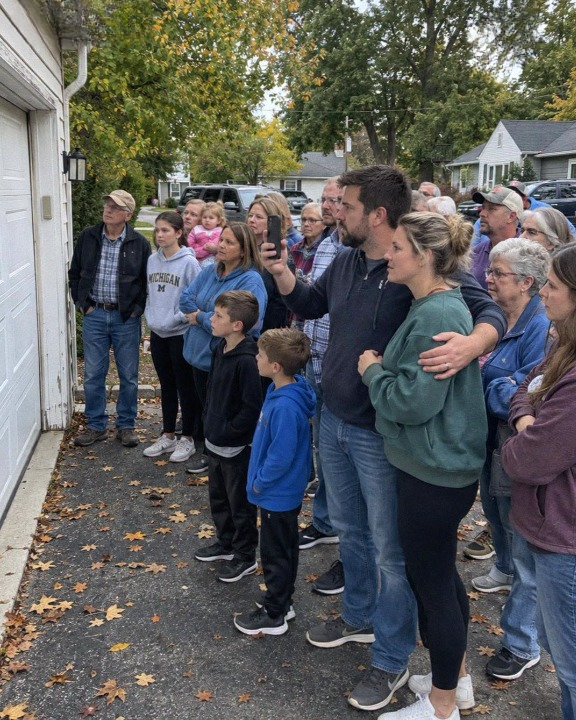
Nearly twenty relatives gathered at our childhood home.
The driveway was filled with cars.
People stood in small groups, speaking quietly.
Some were curious.
Others seemed uncomfortable.
I could tell everyone was wondering the same thing.
What had Dad been hiding?
Greg stood beside me.
Despite everything, he tried to lighten the mood.
“Well,” he said, “I guess we’re finally going to solve the mystery.”
He even held up his phone.
“I want to record this.”
I laughed nervously.
“You’re really recording?”
“Absolutely.”
The lawyer arrived carrying a small folder.
He greeted everyone and reminded us that this was simply a family gathering to follow our father’s final instructions.
Then he handed me the key.
I stared at it.
It was an old metal key.
For years, I had wondered what was behind that locked door.
Now I was about to find out.
My hands were shaking.
I walked toward the garage.
Everyone became quiet.
The old padlock was still attached to the door.
I inserted the key.
For a moment, it wouldn’t turn.
I tried again.
Click.
The lock opened.
A few relatives moved closer.
I removed the padlock and placed it on the ground.
Then I reached for the garage door.
The metal was heavier than I remembered.
I pulled.
The door slowly began to rise.
At first, I couldn’t see much.
The interior was dark.
There were several large objects covered with sheets.
Boxes were stacked along the walls.
I heard Greg inhale sharply behind me.
Then everything changed.
His phone slipped from his hand.
It struck the concrete with a loud crack.
I turned around.
Greg was staring into the garage.
His face had completely changed.
He looked pale.
“Greg?”
He didn’t answer.
I followed his gaze.
Then I looked inside again.
My heart began beating faster.
I couldn’t immediately understand what I was seeing.
There were photographs.
Hundreds of them.
They covered an entire wall.
Family photographs.
Pictures of our mother.
Pictures of Greg and me as children.
Pictures of Dad when he was younger.
There were photographs from birthdays, holidays, school events, vacations, and ordinary Sunday afternoons.
But there was something else.
A large wooden workbench stood against the back wall.
On it were several neatly labeled boxes.
Each box had a name written across the front.
One said Greg.
Another said Chloe.
There was one marked Mom.
I walked closer.
The lawyer followed.
“Your father prepared these?” I asked.
He nodded slowly.
“I was aware that he had left some instructions, but I wasn’t told what he had stored here.”
I opened the box with my name on it.
Inside were letters.
Dozens of them.
Some were addressed to me as a child.
Others were addressed to me as an adult.
I picked up the first envelope.
My name was written in Dad’s handwriting.
My hands began trembling again.
I opened it.
The letter explained why the garage had remained locked.
Dad had been afraid that after he died, the family would argue over his belongings and memories.
He wanted us to see that the things inside weren’t valuable because of their monetary worth.
They were valuable because they represented our family.
Then I found something unexpected.
There was a second letter.
This one was addressed to both Greg and me.
Dad wrote that he knew we had noticed how differently he sometimes treated us.
He admitted that he had not always been fair.
Greg stood silently beside me.
I could hear him breathing.
I continued reading.
Dad explained that Greg had often needed more visible encouragement because of difficulties he had experienced when he was younger.
But that didn’t mean Dad loved me less.
He admitted that he had failed to communicate that properly.
The letter ended with something simple.
He wanted Greg and me to understand that neither of us had to compete for his love.
By the time I finished reading, several family members were crying.
Greg wiped his eyes.
“I never knew he thought about this,” he whispered.
I looked at him.
“Neither did I.”
Then he opened his own box.
Inside were old drawings, school projects, photographs, awards, and even a small toy he had owned as a child.
Dad had kept everything.
Not just important milestones.
Ordinary things.
The things most parents eventually throw away.
There was one more surprise.
At the back of the garage was a small wooden cabinet.
Inside were several videotapes and audio recordings.
Dad had apparently spent years preserving memories that he feared would otherwise disappear.
The garage wasn’t a storage room.
It was an archive of our family’s life.
Suddenly, the reason for his strange final request became clear.
Dad hadn’t wanted the garage opened because of money.
He wanted it opened because he wanted us to see what he had spent years preserving.
Our memories.
Our childhood.
Our mother’s memory.
And the relationship between his children.
Greg stood next to me.
For a long time, neither of us spoke.
Then he put his arm around my shoulders.
“You know,” he said quietly, “I think Dad knew we would eventually need this.”
I nodded.
Maybe he did.
We spent the rest of the afternoon going through the boxes.
There were old letters, photographs, school certificates, birthday cards, handwritten notes, and objects we had completely forgotten existed.
Some made us laugh.
Others made us cry.
But none of them felt meaningless anymore.
By sunset, the garage no longer seemed mysterious.
It felt like a room full of memories.
A place where Dad had preserved pieces of our family history because he knew that someday, we might need to remember where we came from.
Before everyone left, the lawyer gave us one final envelope.
It contained Dad’s last message.
It wasn’t long.
He simply asked us to take care of one another.
He wrote that families don’t always understand each other perfectly.
People make mistakes.
Parents sometimes show love imperfectly.
Children sometimes carry old misunderstandings for years.
But he hoped that after seeing everything inside the garage, Greg and I would understand that our family mattered more to him than any inheritance.
I looked at my brother.
He looked back at me.
Neither of us needed to say much.
We understood.
The garage had been locked for five years.
But perhaps Dad wasn’t really hiding something from us.
Maybe he had been protecting something for us.
Memories.
Letters.
Photographs.
Pieces of a family history that could never be replaced.
And when he finally asked us to open that door together, he wasn’t trying to create a dramatic final surprise.
He was giving us one last opportunity to understand him.
For years, I had wondered whether Dad loved Greg more than me.
After that day, I stopped asking myself that question.
Because inside that garage, I found something more important than an answer.
I found proof that Dad had remembered the little things.
He had remembered my drawings.
My childhood letters.
My school projects.
My mother’s photographs.
My brother’s old belongings.
He had remembered us.
And sometimes, being remembered is one of the greatest gifts a parent can leave behind.
That evening, Greg and I locked the garage together.
But this time, neither of us felt like we were closing a secret away.
We were simply protecting a part of our family’s story.
And for the first time in years, the two of us walked back toward the house without wondering which child Dad had loved more.
We knew that whatever his mistakes had been, he had loved us both.
And perhaps that was the real reason he wanted me to open that garage in front of everyone.
He wanted his final message to be something none of us could misunderstand.