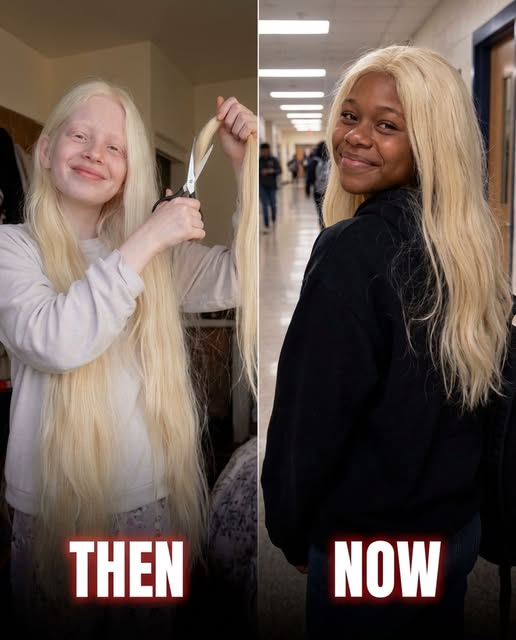
My 12-Year-Old Daughter Cut Off Her Long Hair to Help a Classmate Who Had Lost Hers During Cancer Treatment — The Next Morning, Her Principal Asked Me to Come to School Immediately
It had been only three months since cancer took my husband from us.
For our family, those three months had felt much longer.
Every day seemed to remind us of him.
His coffee mug was still in the kitchen cabinet.
His favorite chair was still beside the window.
There were photographs of him throughout the house, and sometimes I would catch myself expecting to hear his voice from another room.
My 12-year-old daughter, Letty, was struggling especially hard.
She had always been her father’s little girl.
He was the one who taught her how to ride a bicycle, helped her with difficult homework, and listened to her stories about school even when she took twenty minutes to explain something that could have been said in two.
During his illness, she had watched him go through treatment.
She had seen the difficult days, the hospital visits, and the changes that came with his illness.
She had also seen him try to remain positive for her.
Even when he wasn’t feeling well, he would smile when she walked into the room.
After he passed away, Letty became quieter.
She still went to school.
She still did her homework.
She still laughed with her friends.
But I could tell that something inside her had changed.
One evening, something unusual happened.
Letty went into the bathroom after dinner and closed the door.
At first, I didn’t think anything of it.
But after several minutes, I realized she was still in there.
Then I heard a strange sound.
It sounded like scissors.
I walked toward the bathroom door.
“Sweetheart?” I called gently.
There was no answer.
I knocked.
“Are you okay?”
A few seconds later, the door opened.
I looked inside and froze.
Long strands of blond hair were scattered across the bathroom floor.
My daughter stood in front of the mirror.
Her once-long hair had been cut to around shoulder length.
The haircut was uneven in places, and it was obvious that she hadn’t gone through the process with a professional stylist.
For a moment, I didn’t know what to say.
“Letty… what happened?”
She looked at me.
Her eyes were filled with tears.
“I’m sorry, Mom.”
I immediately became concerned.
“Why are you apologizing?”
She pointed toward the hair on the floor.
“I wanted to give it to Millie.”
I had heard the name before.
Millie was a girl in Letty’s class.
I knew she had been receiving treatment for cancer, although I didn’t know all the details.
“What happened?” I asked.
Letty took a deep breath.
“She lost most of her hair.”
Then she explained what had happened at school that day.
Some students had noticed Millie’s hair loss.
Instead of showing compassion, a few children had made insensitive comments.
Millie became upset and went to the bathroom to cry.
Letty had followed her later and found out how embarrassed and hurt she felt.
That evening, Letty decided she wanted to help.
“I heard that some wigs can be made with donated hair,” she said.
Then she looked down at the long strands she had carefully gathered.
“I thought maybe mine could be useful.”
My heart tightened.
I understood immediately why she had made the connection.
She had watched her father lose his hair during treatment.
She remembered how difficult that period had been.
She remembered one particular day when he asked me to cut what remained of his hair.
He had tried to make the moment lighter by smiling and joking with her.
But I knew how difficult it had been for all of us.
Now, my daughter was looking at her own hair and thinking about another child going through something similar.
I knelt beside her.
“You wanted to do something kind for your friend,” I said.
She nodded.
“I didn’t know what else to do.”
I pulled her into my arms.
“You don’t have to apologize for wanting to help someone.”
She began crying.
I held her tightly.
Then I told her something I knew she needed to hear.
“Your dad would be very proud of the compassion you’re showing.”
That made her cry even harder.
We spent the rest of the evening talking about what she had done.
I also explained that donating hair usually involves specific requirements, such as minimum length and how the hair is prepared, depending on the organization receiving it.
Because she had already cut it, we decided to find a reputable salon and ask about the best way to prepare and donate it.
The following day, we visited a salon.
The stylist listened to Letty’s story and helped us properly prepare the hair.
Letty was nervous at first.
She kept touching her shorter hairstyle.
“I look different,” she said.
“You do,” I replied honestly.
She looked worried.
“But different isn’t necessarily bad.”
She smiled.
By the time we left, she seemed much more comfortable with her new haircut.
More importantly, she knew she had made the decision because she wanted to help someone else.
When she eventually brought the prepared donation to school, she was excited.
She didn’t expect praise.
She didn’t ask anyone to make a big announcement.
She simply wanted Millie to know that someone cared about what she was going through.
When Letty came home that afternoon, she was smiling.
“How did it go?” I asked.
She shrugged at first.
“Good.”
Then she couldn’t contain her excitement.
“She was really happy.”
I smiled.
“I’m glad.”
Letty sat beside me.
“She hugged me.”
That simple sentence meant more to me than she probably realized.
For the first time in weeks, I saw something in my daughter’s expression that I hadn’t