Some of life’s greatest discoveries happen when we least expect them.
Sometimes they arrive through an old photograph tucked inside a book. Sometimes through a forgotten letter hidden in a drawer. And occasionally, they appear because a loyal pet refuses to let go of a place filled with cherished memories.
That was exactly what happened to me.
When my grandmother passed away at the age of eighty-four, it felt as though an entire chapter of our family’s history had quietly come to an end.
She wasn’t famous.
She didn’t live in a mansion or leave behind extraordinary wealth.
But she possessed something much more valuable.
She made every person who walked through her front door feel like they belonged.
Her little cottage was always warm.
The kitchen nearly always smelled like fresh bread, cinnamon, or homemade soup.
A kettle was constantly simmering on the stove, ready for unexpected visitors.
Even on difficult days, she somehow found reasons to smile.
As a child, I spent countless weekends in that house.
She taught me how to plant tomatoes in the backyard.
She showed me how to sew buttons back onto shirts.
She insisted every birthday cake should be homemade because “love is the secret ingredient.”
Most importantly, she taught me that family wasn’t measured by expensive gifts.
It was measured by time spent together.
One piece of furniture seemed almost as much a part of her as her gentle smile.
An old yellow armchair sat beside the living room window.
The fabric had faded after decades in the afternoon sunlight.
The wooden arms showed countless scratches from years of use.
The cushions had become soft enough to sink into almost completely.
Objectively, it probably should have been replaced years earlier.
Yet Grandma adored that chair.
Every afternoon she settled into it with a cup of tea and whatever novel she happened to be reading.
Curled beside her almost every single day was Daisy.
Daisy wasn’t an ordinary house cat.
She had been rescued years earlier after wandering into Grandma’s garden as a tiny kitten during a rainstorm.
From that day forward, the two became inseparable.
If Grandma was baking, Daisy watched from the kitchen doorway.
If Grandma gardened, Daisy rested nearby beneath the flowers.
If Grandma sat in her favorite chair, Daisy was almost always sleeping peacefully beside her.
Seeing one without the other became nearly impossible.
After the funeral, reality arrived quickly.
The family gathered to organize the house.
Everyone agreed that sorting through decades of belongings would take time.
At least, that’s what I expected.
Instead, relatives quietly selected the keepsakes they wished to remember her by.
One chose a jewelry box.
Another carefully wrapped the china set used during holiday dinners.
Someone else requested framed family photographs.
Within a few hours, the rooms looked surprisingly empty.
Before leaving, one of my relatives smiled sympathetically.
“Everything that’s left can probably be donated.”
I nodded.
I understood.
There simply wasn’t enough space for every belonging someone accumulates over an entire lifetime.
Still, walking through the quiet house alone felt different.
Every room held memories.
The hallway where she measured my height every birthday.
The kitchen where we baked cookies together.
The porch where we’d watch thunderstorms while drinking hot chocolate.
Each object seemed connected to a story.
I packed carefully.
Books.
Kitchen utensils.
Blankets.
Old recipe cards.
Boxes slowly filled the hallway.
Only one thing remained untouched.
The yellow armchair.
Every time I approached it, I hesitated.
It somehow felt wrong.
Almost as though moving it meant accepting that Grandma truly wasn’t coming back.
Meanwhile Daisy behaved differently than usual.
She rarely left the chair.
If I entered the room, she climbed onto the seat.
If I vacuumed nearby, she watched nervously.
Whenever I moved boxes around it, she quietly repositioned herself directly on the cushion.
I assumed she simply missed Grandma.
Animals grieve too.
Several days passed.
Eventually the house stood nearly empty.
Only a handful of items remained.
The armchair was one of them.
I finally accepted reality.
As sentimental as it was, the chair had become too worn to keep.
Its springs squeaked.
The upholstery had faded unevenly.
Several seams had begun separating.
I convinced myself that preserving memories didn’t require keeping every piece of furniture.
Taking a deep breath, I wrapped my hands around the wooden frame and slowly pulled it away from the wall.
Immediately Daisy reacted.
She jumped onto the seat before I had moved it more than a few inches.
She looked directly at me and let out a loud, insistent meow.
“I’m sorry, Daisy,” I whispered.
“We have to finish.”
She refused to move.
Gently lifting her aside accomplished nothing.
The moment I stepped away, she climbed right back.
I tried once more.
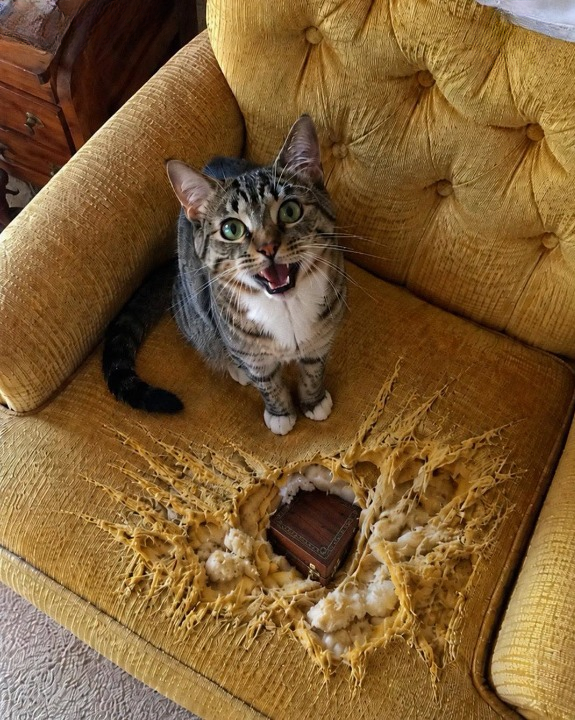
This time she began pawing frantically at one corner of the seat cushion.
Her claws caught the old fabric.
A small tear appeared.
“Daisy!”
I hurried toward her, hoping to prevent further damage.
But before I reached the chair, the worn upholstery gave way.
The opening widened.
Foam peeked through the torn fabric.
At first I sighed, assuming the chair had simply become even more difficult to dispose of.
Then something unexpected caught my attention.
Beneath the cushion, partially hidden inside the chair itself, sat a small wooden box.
I blinked.
Had that always been there?
Carefully reaching inside, I lifted it free.
It wasn’t large.
Perhaps the size of a hardcover book.
The wood showed signs of age, and delicate carved flowers decorated the lid.
There was no lock.
Only a tiny brass latch.
For several moments I simply stared.
Grandma had never mentioned hiding anything inside her favorite chair.
With Daisy now sitting quietly beside me, I slowly opened the box.
Inside lay several neatly organized envelopes tied together with faded blue ribbon.
Beneath them rested a collection of black-and-white photographs I had never seen before.
There was also a small journal.
Curious, I unfolded the first letter.
It had been written by my grandfather decades earlier while traveling for work.
His handwriting filled every page with stories about ordinary life.
He wrote about missing home.
About counting the days until he could return.
About how proud he was of the family they were building together.
As I continued reading, tears quietly filled my eyes.
Growing up, I had heard stories about my grandfather, but he had passed away long before I was born.
These letters allowed me to hear his voice for the very first time.
The journal belonged to Grandma.
Rather than recording dramatic events, it documented everyday moments.
Recipes she hoped future generations would enjoy.
Gardening tips.
Birthday memories.
Funny things grandchildren had said.
Small reflections about gratitude.
One entry especially caught my attention.
“If you’re reading this, then somehow you’ve found the little box. I tucked it away because I wanted these memories to stay together until someone truly wanted to know our family’s story.”
I smiled through tears.
She had intentionally preserved these memories.
Not to keep secrets.
To protect them.
Beneath the journal rested one final envelope addressed simply:
“To whoever finds this.”
Inside was another handwritten note.
“Objects eventually wear out. Furniture fades. Houses change owners. But kindness, family stories, and shared memories continue only if someone chooses to carry them forward.”
“If you’ve opened this box, I’d like you to become that person.”
I sat quietly for a long time.
The afternoon sunlight streamed through the same living room window where Grandma had spent countless peaceful afternoons reading with Daisy asleep beside her.
Suddenly I understood why that old chair had always mattered so much.
It wasn’t because of its comfort.
It had quietly become the guardian of our family’s history.
Whether Daisy somehow remembered the hidden compartment or simply refused to let the chair disappear, I’ll never know.
Animals often notice things people overlook.
Perhaps she sensed that one final chapter remained unfinished.
Instead of donating the chair immediately, I contacted a local furniture restoration workshop.
The craftsman examined it carefully.
“The frame is still solid,” he smiled.
“With some patience, this can look wonderful again.”
Several weeks later, the chair returned looking refreshed while still preserving its vintage character.
The faded yellow fabric had been replaced with similar material.
The wooden arms were polished.
The cushions rebuilt.
Most importantly, the hidden compartment remained exactly where Grandma had left it.
Today, that chair sits in the reading corner of my own home.
The wooden memory box now rests safely on a nearby bookshelf instead of hidden inside.
Every few months I reread one of the letters.
Sometimes I try one of Grandma’s recipes.
Other times I simply smile at the old family photographs that might otherwise have been lost forever.
Friends occasionally ask why I keep such an old-fashioned chair.
I simply smile.
Because they see an antique piece of furniture.
I see afternoon conversations.
Fresh cookies.
Stories told beside the window.
A faithful cat keeping watch.
And a grandmother who found one last thoughtful way to remind her family that the greatest inheritance isn’t measured in money or possessions.
It’s measured in memories, traditions, and the love we choose to pass from one generation to the next.
Looking back, I often think about how close I came to letting that chair leave the house forever.
Had Daisy not insisted on protecting it, I might never have discovered the remarkable collection hidden inside.
Sometimes the most meaningful treasures aren’t the ones displayed in plain sight.
Sometimes they’re quietly waiting inside the ordinary things we almost overlook, reminding us that every family has stories worth preserving—and every memory deserves someone willing to keep it alive.