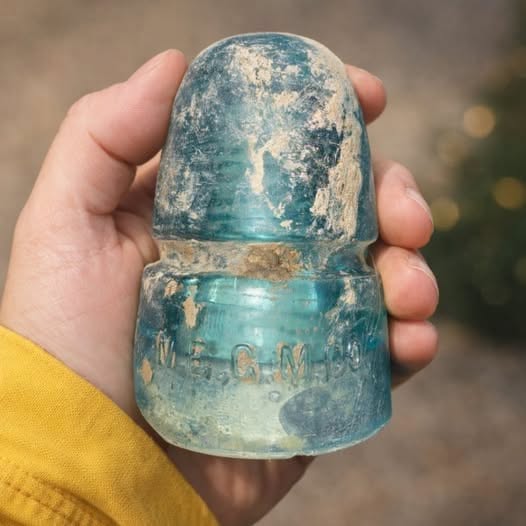
What Are Those Glass Objects on Old Telephone Poles? The History and Purpose of Insulators
If you’ve ever walked through an older neighborhood and looked up at the telephone poles, you may have noticed something unusual.
Attached near the top of some wooden poles are small glass or porcelain objects that can look like rounded knobs, bells, mushrooms, or even decorative pieces.
They are usually easy to overlook.
For many people, they are simply part of the background of an older street.
But once you notice them, they can be surprisingly difficult to identify.
Why are they there?
Were they part of the telephone system?
Did they have something to do with electricity?
Why were some made from glass while others were made from porcelain?
And why can they still be found on poles even though much of the communication infrastructure around them has changed?
The answer goes back to an important period in the development of long-distance communication.
Those objects are generally called insulators, and they played an essential role in overhead telephone and electrical networks.
Their simple appearance hides an interesting piece of engineering history.
The Basic Purpose of an Insulator
To understand why these objects were needed, it helps to think about how early telephone and telegraph networks were constructed.
Modern communication systems rely heavily on underground cables, fiber-optic networks, wireless connections, and sophisticated electronic equipment.
Older systems were much more visible.
Telephone and telegraph wires were commonly suspended above streets and across long distances using wooden poles.
The wire itself had to travel from one location to another while remaining electrically separated from the pole and the hardware supporting it.
That was the job of the insulator.
An insulator is a material that resists the movement of electric current.
Glass and porcelain were particularly useful because they provided a durable barrier between the conductive wire and the supporting structure.
Without proper insulation, electricity could travel from a wire into a pole, into metal hardware, or toward the ground.
For telephone lines, insulation was also important for maintaining the quality of the electrical signal.
The telephone systems of earlier generations operated using electrical signals that traveled through wires.
Those signals needed a controlled path.
The insulator helped keep the conductor separated from the pole.
It was a relatively simple solution to an important engineering problem.
Why Were Glass Insulators Used?
Glass became a popular material for insulators for several reasons.
First, glass is naturally resistant to electrical conduction.
Second, it can be molded or pressed into useful shapes.
Third, properly manufactured glass can withstand outdoor conditions for many years.
The transparency of glass was not the reason it was selected.
Its electrical and physical properties were much more important.
Early utility companies and communication companies experimented with different materials and designs.
Eventually, various glass shapes became common on overhead lines.
Some were relatively small.
Others were large and thick, particularly on systems carrying higher voltages.
The shape wasn’t simply decorative.
The curves, ridges, grooves, and overall profile were designed to improve performance.
Why Do Insulators Have Ridges and Grooves?
If you examine an old glass insulator closely, you may notice that it isn’t simply a smooth glass ball.
Many designs contain ridges, skirts, grooves, or multiple layers.
These features served practical purposes.
One important consideration was moisture.
Outdoor electrical equipment has to operate in rain, fog, snow, and other conditions.
Water can create a path across a surface.
An insulator’s shape can increase the distance that moisture would have to travel between the energized conductor and the supporting hardware.
This is sometimes described in terms of creepage distance.
Instead of allowing water to form a relatively direct path across a smooth surface, the contours of an insulator create a longer route.
That makes it more difficult for electrical leakage to occur.
The exact design depended on the intended application.
A telephone line carrying relatively low electrical energy did not necessarily require the same type of insulator used on a high-voltage power transmission system.
Telephone Insulators Were Not All the Same
Another reason these objects can be confusing today is that there was no single universal design.
Different companies manufactured different insulators.
Different utilities used different models.
Different regions also had their own infrastructure preferences.
Some insulators were designed for telephone wires.
Others were used for telegraph systems.
Still others were developed for electrical distribution.
As a result, two objects that look similar may have been used for completely different purposes.
Collectors and historians sometimes identify individual insulators by their shape, markings, dimensions, and manufacturing characteristics.
A particular design can reveal information about the company that produced it and sometimes the approximate period when it was made.
The Importance of the Insulator’s Shape
The shape of an insulator was closely related to the job it had to perform.
The supporting structure had to hold the wire securely while maintaining electrical separation.
The insulator also had to withstand mechanical stress.
Wires are not weightless.
Long stretches of wire can put considerable tension on supporting hardware.
Wind and ice can add additional forces.
Temperature changes can cause wires to expand and contract.
The insulator therefore had to do more than simply prevent electricity from reaching the pole.
It had to remain mechanically reliable while exposed to the environment.
This is why historical insulators can have surprisingly substantial construction.
Glass Versus Porcelain
Glass wasn’t the only material used.
Porcelain became another major material for electrical and communication insulators.
Porcelain has several advantages.
It is strong, electrically resistant, and well suited to outdoor use.
It can also be manufactured in a variety of shapes.
Porcelain insulators are often recognizable because they are opaque rather than transparent.
Many are white or light-colored, although other finishes and colors have also been used.
Both glass and porcelain could perform the same fundamental task: keeping the conductor electrically separated from the supporting structure.
The choice depended on factors including design, manufacturing practices, cost, strength, and the particular application.
Why Are Some Insulators Still on Old Poles?
One of the most interesting things about these objects is that many remain visible long after the original communication system has changed.
A telephone pole may have been installed decades ago.
The wires connected to it may have been replaced.
Some lines may have been removed.
New equipment may have been installed.
Yet an old insulator may remain attached to the pole.
There are several reasons for this.
Removing every piece of old infrastructure can take time and money.
If a component no longer interferes with current operations, a utility may leave it in place.
In other situations, an old pole may continue to support newer lines while retaining some historical hardware.
That’s why a modern-looking neighborhood can occasionally contain pieces of much older utility infrastructure.
The Rise of the Telephone Pole
The widespread use of overhead telephone lines transformed communities.
Before telephones became common, communication over long distances could be slow.
Telegraph networks had already demonstrated the usefulness of electrical communication.
The telephone expanded that concept by allowing people to communicate using speech.
But a telephone network required physical infrastructure.
Lines had to connect homes, businesses, exchanges, and other facilities.
In many places, overhead poles provided a practical way to construct these networks.
Instead of digging underground trenches for every cable, companies could install wooden poles and string wires between them.
The result was a visible network stretching along roads and through neighborhoods.
Insulators were a small but essential component of that system.
Telegraphs Came Before Telephones
The history of these objects also connects to the telegraph.
Telegraph systems became important during the nineteenth century.
They allowed coded electrical signals to travel over long distances.
Operators could send messages much faster than a person could physically transport written correspondence.
Telegraph wires were often installed on poles.
Like later telephone systems, they needed electrical isolation.
Insulators therefore became an important part of the telegraph infrastructure as well.
Some designs that people see today may have been associated with telegraph lines rather than telephone lines.
This is one reason it isn’t always possible to identify an old insulator simply by looking at it.
Historical context matters.
Why Were Wooden Poles So Common?
Wood was widely used for utility poles because it offered several practical advantages.
It was relatively available.
It was workable.
It could be treated to improve its resistance to weather and decay.
And it provided a strong vertical structure for supporting wires.
But wood itself can conduct electricity under certain conditions, especially when moisture is present.
That made electrical separation especially important.
The insulator provided the necessary barrier.
The wire could remain physically attached to the pole while electrically isolated from it.
This combination of wood, metal hardware, and insulating material became a standard feature of overhead utility construction.
What Does an Insulator Actually Connect To?
A typical overhead system could involve several components.
There might be a wooden pole.
Attached to the pole could be a metal crossarm or bracket.
The insulator would sit on that supporting hardware.
The wire would then be secured to the insulator.
The exact arrangement varied considerably depending on the system.
Some telephone lines used relatively simple mounting arrangements.
Power distribution systems could use larger crossarms with multiple insulators.
The position of an insulator can therefore provide clues about what kind of line it supported.
However, identifying the original purpose with certainty often requires more information.
Why Do Some Look Like Mushrooms?
The mushroom-like appearance is largely the result of engineering.
A broad upper section could help support the conductor.
Lower skirts could increase the distance between the conductive portion and the supporting hardware.
The curves could also help manage moisture.
To a modern observer, the shape may look decorative.
But utility hardware was designed around practical requirements.
The unusual shapes were created because engineers needed a combination of electrical insulation, mechanical strength, weather resistance, and reliable wire support.
The fact that some designs look attractive is simply a pleasant side effect.
Why Are Old Glass Insulators Sometimes Blue or Green?
Color is another feature that attracts attention.
Although many utility insulators were clear or relatively neutral in appearance, some glass examples can have blue, green, amber, or other shades.
There are several possible reasons.
The color may be related to the glass composition.
It may also be associated with manufacturing processes or impurities in the material.
Certain metals and minerals can influence the color of glass.
In addition, manufacturers produced insulators in different formulations over the years.
Collectors often pay close attention to color because it can help distinguish between different examples.
However, color alone isn’t enough to determine an insulator’s age, manufacturer, or original use.
Other characteristics need to be considered.
Are Old Glass Insulators Valuable?
Some people become interested in these objects after discovering that collectors buy and trade historical