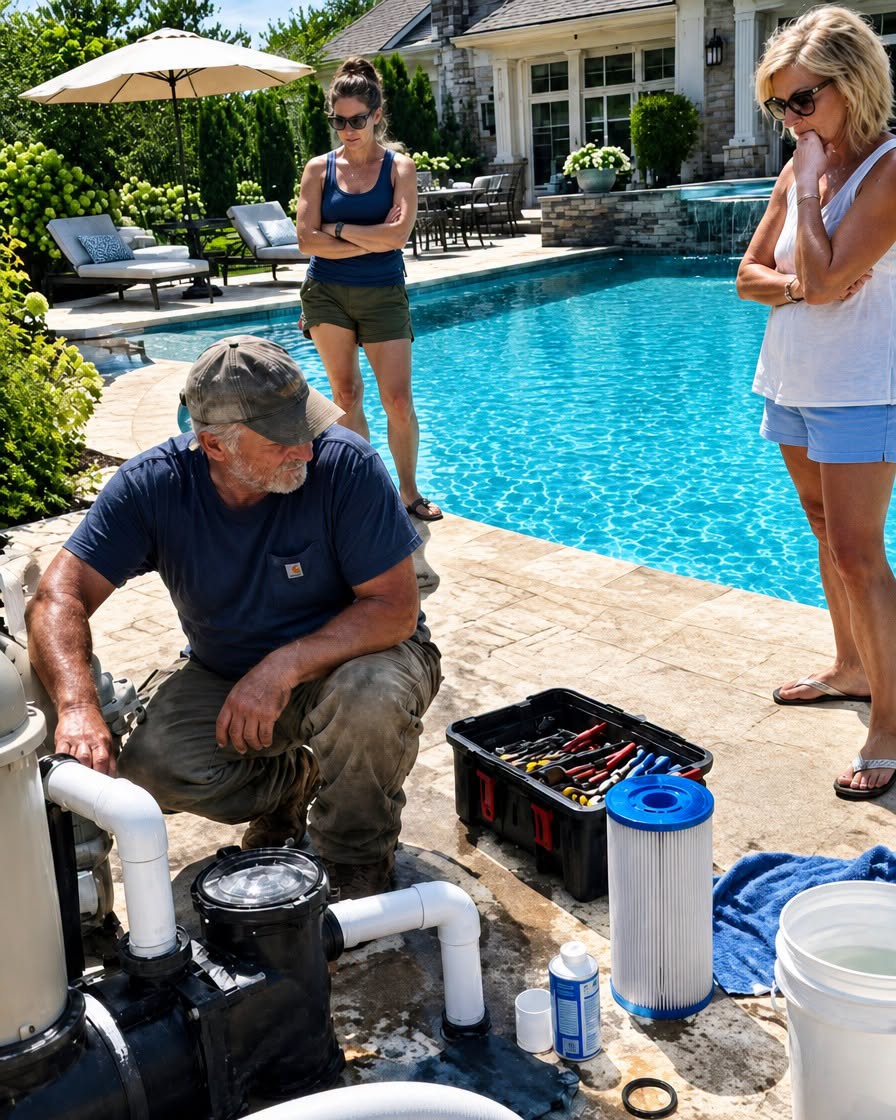
My Boss Refused to Pay My Father for His Pool Repairs — Then an Unexpected Discovery Changed Everything
For almost thirty years, my father had made a living repairing swimming pools.
He had never been the kind of person who looked for arguments. If a customer complained about a price, he explained the work. If someone misunderstood an estimate, he went over the paperwork. And if a customer decided they no longer wanted a particular service, he usually preferred to walk away rather than turn a disagreement into something personal.
That was why I was surprised when he smiled after my boss’s wife refused to pay him nearly eight thousand dollars.
At the time, I thought he was simply trying to stay calm.
I didn’t realize he already knew that the paperwork he had carefully prepared before starting the job would become important for an entirely different reason.
My boss was named Richard.
He owned a large house on the edge of town with a swimming pool that had clearly seen better days. The property was beautiful, but the pool had been neglected for quite some time.
The water had turned dark and cloudy. The filtration system was unreliable, the pump was making unusual noises, and one section of the plumbing was leaking.
Richard mentioned the problem to me at work one afternoon.
“You said your dad works on pools, right?”
I nodded.
“He does.”
“Could he take a look at mine?”
I told him I’d ask.
That evening, I called Dad.
He agreed to inspect the pool the following Saturday.
He always approached jobs the same way.
He didn’t walk onto someone’s property and immediately start talking about prices. He inspected the equipment, checked the plumbing, examined the filtration system, and tried to determine what had caused the problems in the first place.
After spending nearly two hours at Richard’s house, Dad prepared a detailed estimate.
The total was $7,800.
It included replacement of the damaged pump, repairs to several sections of pipe, installation of a new filtration system, labor, water treatment, testing, and cleanup.
Dad gave Richard a written estimate.
Richard read through it.
“Looks reasonable,” he said.
Dad pointed to the bottom of the page.
“If you’re comfortable with everything, sign here. I’ll schedule the work.”
Richard signed.
Dad also asked Melissa, Richard’s wife, to sign because she had been involved in the discussion about the renovation.
She signed as well.
Dad kept a copy.
He always did.
Nine days later, the pool looked completely different.
The old pump had been removed and replaced.
Several damaged sections of pipe had been repaired.
The filtration system was operating properly.
The water had gradually gone from cloudy and discolored to clear.
Dad tested the circulation several times and spent extra time making sure everything was functioning correctly.
On the final afternoon, Richard came outside and looked at the pool.
“This looks great,” he said.
Dad smiled.
“Everything is running the way it should.”
Richard thanked him and said he’d take care of the invoice.
Dad packed his equipment and left.
The next morning, Dad returned to collect the payment.
That’s when the situation changed.
I happened to be working from home that morning, and Dad called me afterward.
His voice sounded completely normal.
“Everything okay?” I asked.
“Not exactly.”
“What happened?”
“Melissa doesn’t want to pay the invoice.”
I sat up.
“What?”
Dad explained.
Melissa had looked at the $7,800 invoice and said she believed the price was too high.
Dad reminded her that the estimate had been provided before the work began.
He showed her the signed authorization.
He showed her the itemized estimate.
He showed her the invoice.
According to Dad, Melissa barely looked at any of it.
Instead, she said something that bothered me immediately.
“My husband employs your daughter.”
Dad told me that she had suggested I should think carefully about making the situation “more difficult.”
In other words, my job was being used as leverage against him.
I was angry.
“Did Richard say anything?”
“He wasn’t there when she said it.”
“Did she refuse to pay the entire amount?”
“Yes.”
I wanted to call Richard immediately.
Dad stopped me.
“Don’t.”
“But she can’t do that.”
“Let me handle it.”
I asked him what he planned to do.
He didn’t answer immediately.
Instead, he told me something that made even less sense.
“I want you to remember something.”
“What?”
“Both of them signed the original paperwork.”
“I know.”
“That’s important.”
“Because you can prove they agreed to the price?”
“Exactly.”
Then he paused.
“And there’s something else.”
“What?”
Dad looked toward the window.
“When I was working near the pool equipment, I noticed something unusual.”
I expected him to tell me about another plumbing problem.
Instead, he said:
“I think there’s something underneath part of that property that Richard doesn’t know about.”
I laughed nervously.
“What do you mean?”
“I’m not sure yet.”
“Like what?”
“I don’t know.”
He wouldn’t say anything else.
Before leaving, Melissa had apparently told him that she expected him to accept the lower amount.
Dad simply looked at the pool.
Then he smiled.
“Call me tomorrow morning,” he told her.
She seemed pleased, apparently believing that he had decided to back down.
But Dad hadn’t.
He had decided to wait.
That evening, I asked him about the strange comment concerning the property.
He explained that while repairing the pool, he had noticed that one area beneath the equipment platform seemed different from the surrounding ground.
The concrete wasn’t original.
There appeared to be an older layer underneath it.
He had also found an old piece of metal while working near one of the drainage lines.
It looked like part of an old boundary marker.
Dad didn’t know what it meant.
And he wasn’t interested in guessing.
That’s one thing I always respected about him.
He preferred evidence over assumptions.
“Then why are you smiling?” I asked.
“I’m not smiling because I found something valuable.”
“Then why?”
“Because if there’s an issue involving the property, the signed paperwork protects me.”
I still didn’t understand.
The following morning, at exactly 7:46, my phone rang.
It was Dad.
“Get over here.”
“Where?”
“Richard’s house.”
I immediately knew something had happened.
“Why?”
He paused.
“Because someone found the old property records.”
“What records?”
“Just come here.”
Twenty minutes later, I turned onto Richard’s street.
There were two police vehicles outside the house.
I immediately became concerned.
Richard was standing in the driveway, talking to one of the officers.
Melissa stood several feet away.
She looked upset.
Dad was near the pool gate.
And next to him was an elderly woman I had never seen before.
She was holding a thick folder.
I parked and walked toward them.
Dad looked at me.
“You’re here.”
“What’s happening?”
Before he could answer, the elderly woman stepped forward.
“You’re his daughter?”
I nodded.
“Yes.”
She looked at the house.
“Then you should know why your father was so careful with his records.”
I glanced at Dad.
He gave me a small nod.
The woman introduced herself as Eleanor.
She explained that her family had owned part of the property many decades earlier.
Not the entire modern property.
The land had changed hands several times over the years.
Boundaries had been adjusted.
Parcels had been combined.
Some sections had been sold.
Others had been transferred to neighboring owners.
Eventually, the current property was created from several older parcels.
Eleanor’s family had recently been reviewing old records because of a separate property matter.
During that research, they discovered something unusual.
An old structure had once existed on the land.
It wasn’t a house.
It wasn’t a swimming pool.
It was an underground storage structure associated with a small agricultural property that had existed there decades earlier.
According to the old documents, the structure had been covered during later construction.
Eleanor didn’t know whether anything remained beneath the modern pool area.
That was where Dad’s observations became important.
He had noticed unusual construction beneath the pool equipment area.
But Dad hadn’t opened anything.
He hadn’t excavated anything.
He hadn’t removed anything.
He had simply documented what he saw.
That distinction mattered.
Eleanor opened the folder.
Inside were old maps.
Property descriptions.
Survey documents.
Copies of historical records.
And photographs.
One of the maps showed the property before the house had been built.
The location of the old structure appeared to be surprisingly close to the pool.
Richard walked over.
“Why are you showing them that?”
Eleanor looked at him.
“Because you contacted the county about removing the old concrete structure without checking the historical survey.”
Richard shook his head.
“That isn’t what happened.”
One of the officers interrupted.
“Let’s keep this calm.”
I looked at Dad.
“What exactly did you find?”
He explained that during the repair work, he had discovered an unusual section beneath the equipment pad.
The material appeared older than the rest of the pool installation.
There was also an old metal marker nearby.
He photographed it.
He included the photographs with his job records.
He didn’t touch anything beyond what was necessary to complete the repair.
That was when I finally understood why Dad had been so calm.
He wasn’t claiming ownership of anything.
He wasn’t claiming that he had discovered a fortune.
He wasn’t threatening Richard.
He had simply documented what he observed.
The police weren’t there because Dad had “found treasure.”
They were there because Richard had apparently contacted a contractor about removing part of the old structure before the property’s historical records had been reviewed.
The contractor had become concerned after seeing the old markings.
Eleanor had been contacted because her family’s records contained information about the original property.
The situation had become complicated.
And Dad’s photographs helped establish when the unusual structure had been observed.
Richard turned toward him.
“You knew about this?”
“I noticed something unusual,” Dad replied.
“Why didn’t you tell me?”
“I did.”
Richard looked confused.
“When?”
Dad pointed to the work report.
“I wrote it down.”
Richard took the report.
He read the relevant section.
It stated that an older subsurface structure appeared to be present near the equipment area and recommended that any major excavation be reviewed by an appropriate property or construction professional.
Richard looked at Melissa.
She said nothing.
Then Richard turned back toward Dad.
“What does this have to do with the invoice?”
Dad’s response was simple.
“Nothing.”
Everyone became quiet.
Dad continued.
“You agreed to the estimate before I started.”
Richard nodded slowly.
“Yes.”
“You received the completed work.”
Another nod.
“And the invoice is still due.”
Richard looked uncomfortable.
“I know.”
Dad didn’t argue.
He didn’t raise his voice.
He simply waited.
Eventually Richard said, “I’ll pay it.”
Melissa immediately objected.
“Richard—”
He stopped her.
“No.”
She looked at him.
“I signed the estimate too.”
Richard took a breath.
“We’re not going to make this worse.”
I noticed something about Dad’s expression.
He wasn’t celebrating.
He wasn’t angry.
He looked tired.
Later, when the police had left and Eleanor had finished discussing the old records with Richard, Dad and I sat in his truck.
I asked him why he had been so confident.
He looked at me.
“I wasn’t confident about what was under the property.”
“Then what were you confident about?”
“The work I performed.”
He tapped the folder containing his job records.
“I knew exactly what I had done. I knew what they had approved. And I knew I had documentation.”
He paused.
“That’s enough.”
The story could have ended there.
Richard could have paid the invoice, the property issue could have been handled separately, and everyone could have moved on.
But the discovery created another problem.
The old structure had to be evaluated.
A professional surveyor was brought in.
The historical maps were compared with modern property boundaries.
A structural specialist examined the accessible area.
Eventually, they confirmed that remnants of an older underground storage structure did exist beneath a portion of the property.
It wasn’t filled with gold.
There wasn’t a hidden fortune.
There was no dramatic secret chamber filled with valuable objects.
The truth was much more ordinary.
The property had once been part of a larger agricultural parcel.
The underground structure had likely been used for storage before modern refrigeration and large-scale residential development became common in the area.
Over the decades, the land had been subdivided.
The old structure had been partially covered.
Later owners had built new features over the area without fully understanding what remained below.
The discovery was historically interesting, but it didn’t make anyone rich.
That part of the story mattered to me.
Because it showed how easily a small discovery can become exaggerated.
Dad hadn’t uncovered a fortune.
He had uncovered evidence that an older structure existed beneath a modern property.
The real lesson wasn’t about hidden wealth.
It was about documentation.
And about how quickly a simple business disagreement can become more complicated when people make decisions without understanding the facts.
A few days later, Richard came to Dad’s workshop.
He brought a check.
The full $7,800.
Dad accepted it.
Richard apologized.
“Your father did everything exactly the way he said he would.”
I was surprised by how sincere he sounded.
Dad simply said, “Thank you.”
Richard looked at me.
“I also owe you an apology.”
I knew what he meant.
He had allowed his wife to use my employment as a way to pressure my father.
That had put me in an uncomfortable position.
“I shouldn’t have let that happen,” he said.
I nodded.
“You’re right.”
Melissa never came to the workshop.
But a few weeks later, Dad received a written apology from her.
It wasn’t dramatic.
It didn’t erase what happened.
But she acknowledged that bringing my job into the dispute had been inappropriate.
Dad accepted the apology.
He didn’t hold a grudge.
He also didn’t work for them again.
That was another lesson I learned from him.
Forgiving someone doesn’t mean you have to continue doing business with them.
Sometimes a professional relationship ends simply because trust has changed.
The property issue took several more months to resolve.
The surveyors confirmed the boundaries.
The old documents were preserved.
Part of the historical material was eventually donated to a local archive.
Richard and Melissa decided not to disturb the remaining structure until they had a better understanding of it.
The pool itself continued to function normally.
Ironically, the repair that had started the entire situation ended up being the most straightforward part of everything.
The pump worked.
The filtration system worked.
The pipes no longer leaked.
The water stayed clear.
And Dad got paid.
One evening, several months later, I visited him at home.
We were sitting in the backyard when I brought up the story again.
“I still don’t understand something.”
“What?”
“Why didn’t you get angry when Melissa threatened my job?”
Dad looked at me.
“I was angry.”
“You didn’t seem angry.”
“I’ve had thirty years to learn the difference between feeling angry and acting angry.”
That stayed with me.
He continued.
“When someone tries to pressure you, the easiest thing in the world is to react immediately.”
He leaned back in his chair.
“But sometimes the strongest response is to slow down.”
“Because of the paperwork?”
“Because of the facts.”
He told me that throughout his career, he had seen customers dispute invoices for all kinds of reasons.
Some misunderstood estimates.
Some remembered conversations differently.
Some simply didn’t want to pay.
But the disputes were usually manageable when there was documentation.
Written estimates.
Signed approvals.
Photographs.
Invoices.
Work logs.
Completion notes.
Those things weren’t glamorous.
They didn’t make for exciting stories.
But they mattered.
“People think business is about knowing how to argue,” Dad said.
“It’s usually about knowing how to document.”
I thought about that.
The entire situation had started with a simple pool repair.
A customer approved an estimate.
A contractor completed the work.
Then a payment dispute appeared.
The situation became more complicated because an old structure was discovered beneath the property.
But none of that changed the basic facts.
Dad had been hired.
He had completed the agreed work.
The customers had approved the price.
And the invoice was due.
The hidden structure didn’t give Dad ownership of anything.
It didn’t make him rich.
It didn’t give him some special claim to the property.
What it did was demonstrate the importance of recording unusual observations rather than ignoring them.
And the signed documents protected everyone by establishing what had actually been agreed.
I also learned something about my own job.
For several days after the incident, I worried that Richard might treat me differently.
I wondered whether my father’s dispute would affect my position at the company.
But Richard eventually called me into his office.
He told me that my employment was separate from my father’s business.
“I should never have allowed those two things to become connected,” he said.
That conversation changed how I viewed him.
It didn’t erase the mistake.
But it showed me that people can recognize when they’ve handled a situation poorly.
I stayed at the company for several more years.
Dad continued repairing pools.
He never became famous.
He never discovered a fortune beneath another backyard.
He never told the story as though he had outsmarted anyone.
Whenever someone asked about it, he usually said the same thing.
“I fixed a pool, noticed something unusual, and wrote it down.”
That was all.
But whenever I think about that week, I remember the moment Melissa refused to pay.
I remember how angry I felt.
I remember wanting to call my boss.
And I remember Dad looking at the clear water instead.
At the time, I thought he was avoiding the problem.
Now I understand that he was doing the opposite.
He was refusing to make the problem bigger than it needed to be.
He knew what he had done.
He knew what the customers had agreed to.
And he knew he had records to support both.
The strange discovery beneath the property was interesting, but it wasn’t the real reason the situation ended in Dad’s favor.
The real reason was much simpler.
He had done the work properly.
He had explained the cost beforehand.
He had obtained written approval.
He had documented the job.
And when something unexpected appeared, he didn’t make assumptions.
He recorded what he saw and let the appropriate professionals determine what it meant.
That approach had served him for nearly thirty years.
It had also taught me something I wish more people understood:
When a disagreement begins, the loudest person in the room isn’t necessarily the person with the strongest position.
Sometimes the person who stays calm, keeps accurate records, and sticks to the facts has already done everything necessary.
Dad never needed to threaten anyone.
He never needed to embarrass Richard or Melissa.
He never needed to claim that he had discovered something valuable.
He simply stood behind the work he had done.
And in the end, that was enough.