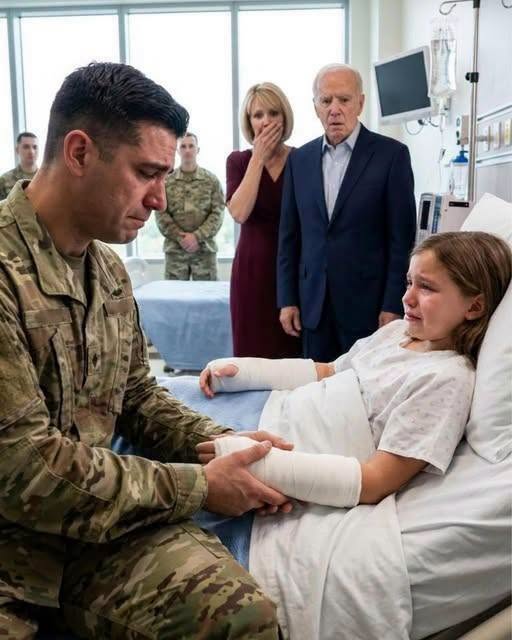
At 2:17 in the morning, my phone rang.
I was staying at a military training facility in New Mexico, less than two days away from completing an eight-month assignment.
When I saw my nine-year-old daughter Maya’s name on the screen, I immediately answered.
I expected to hear her sleepy voice.
Maybe she had woken from a nightmare.
Maybe she wanted to tell me something about school.
Instead, I heard quiet breathing.
Then a whisper.
“Daddy?”
“I’m here, sweetheart.”
“I’m in the hospital.”
I sat up so quickly that the chair beside my bed fell backward.
“What happened?”
There was silence.
I could hear her breathing unevenly.
“I’m scared.”
Those two words were enough to make every other thought disappear.
“Where are you?”
“El Paso.”
“Are you hurt?”
Another pause.
“Yes.”
I stood up and started putting on my boots.
“Listen to me, Maya. I’m going to get to you. I need you to stay calm and let the nurses help you. Can you do that?”
“I’ll try.”
Then she said something that I would replay in my mind many times afterward.
“Mommy was there.”
I stopped.
“What do you mean?”
“I called for her.”
Her voice became quieter.
“She didn’t come.”
I didn’t understand.
“What happened?”
Before Maya could answer, a nurse took the phone.
She explained that Maya was tired and frightened and that the medical team wanted to keep her calm.
I thanked her and asked for the hospital information.
Within minutes, I had arranged transportation.
But during that long journey from New Mexico to Texas, I couldn’t stop thinking about what my daughter had said.
The Family I Had Once Married Into
My former wife, Veronica, came from a wealthy and well-connected family.
The Vances owned several businesses in the region.
Her father, Arthur, had built a successful company over several decades.
They had money.
They had influence.
They knew a lot of people.
But I had never believed that money automatically meant someone was above the law.
During my marriage to Veronica, however, I gradually learned that her family was accustomed to getting its way.
They expected people to agree with them.
They were used to solving problems through lawyers, business relationships, and personal connections.
Veronica and I eventually divorced.
The process wasn’t easy, but we reached a custody arrangement that gave both of us time with Maya.
At first, I believed we could maintain a reasonable relationship as co-parents.
For Maya’s sake, I tried.
But over time, disagreements became more frequent.
Plans changed without consultation.
Family events were sometimes arranged during my scheduled time with Maya.
Messages would go unanswered.
Small disagreements became larger ones.
Still, I never imagined that something serious could happen to my daughter while she was staying with her mother’s family.
Arriving at the Hospital
By the time I reached the hospital, the sun was coming up.
I was exhausted.
But I barely noticed.
A nurse directed me to the pediatric unit.
When I finally saw Maya, my entire body went still.
She looked frightened and exhausted.
There were doctors and nurses around her.
She had several injuries that required treatment and observation.
I didn’t ask for every detail immediately.
I walked to her bed.
“Daddy.”
“I’m here.”
She reached for my hand.
I held it.
For several minutes, neither of us said anything.
I didn’t want to overwhelm her with questions.
Eventually, a doctor explained that Maya had been injured at her grandparents’ property.
She would require treatment and follow-up care.
The doctor also emphasized that the medical team had already contacted the appropriate authorities because of the circumstances surrounding her injuries.
That information mattered.
This wasn’t going to be something I could solve by confronting someone.
There needed to be a proper investigation.
What Maya Told Me
Later, when Maya was calmer, she explained what she remembered.
She had been at her grandparents’ home with her mother and two uncles.
An argument had started after she accidentally damaged something that belonged to one of them.
According to Maya, the situation escalated.
She became frightened.
She tried to get away.
At some point, she was injured.
She remembered calling for her mother.
She remembered seeing Veronica nearby.
And she remembered Veronica moving away instead of intervening.
Maya didn’t know what happened after that.
Some parts of her memory were confused.
That was understandable.
She was nine years old.
She had been frightened.
I didn’t pressure her for additional details.
I told her that she didn’t have to explain everything to me immediately.
“You’re safe now,” I said.
She squeezed my hand.
“Are you angry?”
I looked at her.
“I am angry that you were hurt.”
She stared at me.
“But I’m not going to do anything that makes this worse.”
That was a promise I needed to make to both of us.
The Investigation
The hospital had already contacted child protection authorities.
A law enforcement officer also came to speak with me.
I gave them everything I knew.
I didn’t exaggerate.
I didn’t speculate.
I didn’t tell them what I thought should have happened.
I simply explained what Maya had told me and provided the custody documents and other information I had available.
The officer asked whether I had previous concerns about Maya’s safety.
I told him about the disagreements I had experienced with Veronica’s family, but I made an important distinction.
Family conflict was not proof that someone had harmed my daughter.
The investigator appreciated that distinction.
“We need facts,” she said.
“I understand.”
She asked whether I had received messages from Veronica that night.
I checked my phone.
There were several missed calls from an unknown number.
There was also a message from Veronica sent earlier that evening.
It simply said:
“Something happened. Don’t panic.”
That message made my stomach turn.
But again, I didn’t assume what it meant.
I gave the phone to the investigator.
The First Major Problem
As the investigation continued, inconsistencies began appearing in the accounts given by the adults who had been present.
One person claimed they hadn’t been near the garage.
Another said they had left the property earlier.
Someone else said Maya had accidentally fallen.
The explanations didn’t fit together.
Investigators began checking timestamps.
They reviewed available security footage.
They spoke with neighbors.
They examined photographs.
They collected medical records.
They interviewed people separately.
This was slow.
Painfully slow.
I wanted answers immediately.
But investigations don’t always work that way.
Evidence has to be collected.
Statements have to be verified.
People have to be given opportunities to explain what they know.
And when children are involved, investigators have to be especially careful.
Veronica Finally Called
Three days after the incident, Veronica called me.
I almost didn’t answer.
But I did.
“How is she?”
I could hear the emotion in her voice.
“She’s recovering.”
She started crying.
“I didn’t know what to do.”
I said nothing.
“I was scared.”
“What happened that night?”
She didn’t answer.
“Veronica, I need you to tell the truth.”
“I was there.”
“I know.”
“I heard her.”
My grip tightened around the phone.
“Why didn’t you help her?”
“I froze.”
That was the first time she had given me an explanation.
I didn’t know whether it was complete.
I didn’t know whether it was true.
But I knew one thing.
The investigation would have to determine that.
Not me.
The Evidence Nobody Expected
A week later, investigators discovered something that changed the direction of the case.
There was a security camera mounted near a side entrance of the property.
The family had apparently forgotten about it.
It wasn’t pointed directly toward the garage.
But it captured part of the driveway and the entrance to the building.
More importantly, the system automatically stored recordings for several weeks.
Investigators obtained the footage.
It didn’t show everything.
But it showed enough to challenge some of the statements that had been given.
One of the adults who claimed to have left the property before the incident was visible arriving later.
Another person who said they had never entered the building appeared on the recording.
The footage didn’t answer every question.
But it established a timeline.
And timelines matter.
Maya’s Recovery
While the investigation continued, my priority was Maya.
She spent several days in the hospital.
I stayed beside her whenever I could.
She had difficult moments.
Sometimes she wanted to talk.
Sometimes she wanted to watch cartoons.
Sometimes she wanted nobody to speak to her at all.
I learned to follow her lead.
A child who has experienced something frightening doesn’t always recover simply because the physical injuries begin healing.
There can be fear afterward.
Fear of being alone.
Fear of unfamiliar places.
Fear of making mistakes.
Fear that something bad might happen again.
A counselor began working with Maya.
I was grateful for that.
I didn’t try to become her therapist.
I was her father.
My job was to listen, provide stability, and make sure she had professional support.
The Family Tried to Control the Story
During those weeks, members of the Vance family began telling people their own version of events.
Some claimed Maya had simply fallen.
Others said the situation had been misunderstood.
One person suggested that I was using the incident to gain an advantage in the custody dispute.
That accusation hurt.
But I didn’t respond publicly.
I knew that arguing with rumors wouldn’t help my daughter.
Instead, I focused on documentation.
Every medical appointment.
Every court filing.
Every message.
Every conversation with investigators.
Every custody-related communication.
I kept records.
Not because I wanted revenge.
Because facts are easier to defend when they are documented.
The Court Hearing
Several weeks later, there was a custody hearing.
I expected it to be hostile.
Instead, it was focused and procedural.
The judge reviewed the information available.
There were medical reports.
Investigator summaries.
Security footage.
Witness statements.
Custody records.
The court didn’t need dramatic speeches.
It needed evidence.
My attorney explained that I was asking for temporary changes to the custody arrangement while the investigation continued.
Veronica’s attorney presented a different interpretation.
The judge listened.
Then the court ordered that Maya remain in my care while the appropriate agencies completed their work.
There was no celebration.
No victory.
Just relief.
I knew the situation wasn’t over.
What Happened to Veronica’s Brothers
The investigation eventually led to criminal charges against one of Veronica’s brothers.
The other faced separate legal consequences related to his actions that night.
I won’t pretend that seeing them face legal proceedings made me feel satisfied.
Mostly, I felt tired.
I had spent weeks focused on one question.
How could this have happened to my daughter?
The legal process was separate from my personal emotions.
The court would decide what penalties were appropriate.
My responsibility was to protect Maya and support her recovery.
Veronica’s Decision
Veronica eventually admitted that she had been afraid of her brothers.
She said that when the situation became violent, she froze.
She claimed that she didn’t believe they would seriously hurt Maya.
That explanation did not erase what had happened.
But it helped me understand that complicated family dynamics can cause people to make terrible decisions.
Veronica lost unsupervised custody for a period of time.
She was required to participate in counseling and follow the court’s conditions before visitation could expand.
I didn’t ask the judge to permanently remove her from Maya’s life.
I wanted the court to make decisions based on Maya’s safety and well-being.
That distinction mattered.
The Evidence That Changed Everything
The security footage eventually became one of the most important pieces of evidence.
It didn’t contain some dramatic secret.
It did something much more useful.
It contradicted several false statements.
That was enough.
The investigators were able to reconstruct a more accurate timeline.
They learned who had been present.
They identified inconsistencies.
They connected physical evidence with witness accounts.
And they established that the incident had not happened in the way some members of the family initially claimed.
The evidence didn’t “bring down” the entire Vance family.
Their businesses continued.
Their property remained.
Their lives didn’t suddenly disappear.
Real life rarely works that way.
Instead, specific people faced specific consequences for specific actions.
That was enough.
Going Home
Several months later, Maya returned to school.
The first morning was difficult.
She stood beside me at the front door.
“I don’t want to go.”
“I know.”
“What if people ask questions?”
“You don’t have to tell them anything you don’t want to.”
She looked at me.
“Can I just say I was sick?”
“Yes.”
She took a breath.
Then she walked inside.
I watched her disappear through the doors.
That was the moment I realized something.
Healing doesn’t always look dramatic.
Sometimes it looks like a child returning to school.
Sometimes it looks like laughing again.
Sometimes it looks like sleeping through the night.
Sometimes it looks like asking for ice cream.
Sometimes it looks like complaining about homework.
Those ordinary moments were what I wanted for her.
A Conversation Months Later
One evening, Maya and I sat at the kitchen table.
She was doing homework.
After a while, she looked up.
“Daddy?”
“Yeah?”
“Are we going to be okay?”
I knew she wasn’t asking about the court.
She wasn’t asking about the investigation.
She was asking about life.
I reached across the table.
“We’re already getting there.”
She smiled.
Then she went back to her homework.
I looked at her and thought about the night she called me from the hospital.
At the time, I had wanted to fix everything immediately.
I wanted answers.
I wanted accountability.
I wanted to confront everyone who had hurt her.
But I eventually understood that protecting my daughter wasn’t about anger.
It was about making careful decisions.
It meant listening.
It meant allowing trained professionals to investigate.
It meant documenting facts.
It meant keeping my promises.
And most importantly, it meant making sure Maya knew she was believed, valued, and safe.
What I Learned
The experience changed the way I think about family.
People often assume that protecting a child means fighting the loudest.
It doesn’t.
Sometimes protection means staying calm when you are furious.
Sometimes it means refusing to spread rumors.
Sometimes it means allowing investigators to do their jobs.
Sometimes it means taking your child to a counselor instead of trying to handle everything yourself.
And sometimes it means accepting that people you once trusted may not behave the way you expected.
I also learned that money and influence don’t automatically determine the outcome of every situation.
Evidence matters.
Documentation matters.
Professional investigation matters.
And courts are supposed to make decisions based on the information presented to them, not simply on someone’s reputation or wealth.
The most important lesson, however, came from Maya.
She taught me that children don’t need perfect parents.
They need adults who listen.
They need consistency.
They need someone who will take their concerns seriously without making them carry the weight of adult conflict.
I couldn’t undo what had happened.
I couldn’t erase her memories.
I couldn’t guarantee that she would never be afraid again.
But I could be there.
Every day.
And I could remind her that what happened to her was not her fault.
A New Beginning
A year after the incident, Maya’s life looked very different.
She was healthier.
She was back in school.
She had returned to activities she enjoyed.
She still worked with a counselor.
There were difficult days, but there were many more ordinary ones.
Veronica’s relationship with Maya remained complicated.
The court continued to supervise the arrangements.
I didn’t know what the future would look like.
But I no longer needed to know every detail.
For the first time in a long time, I could simply focus on the present.
One evening, Maya asked me whether I was still planning to return to military service.
I told her that I was considering my options.
She thought about that.
“Whatever you do, can you stay close?”
I smiled.
“I’ll always be close.”
She nodded.
Then she returned to her drawing.
I watched her for a moment.
The little girl who had called me from a hospital bed was still there.
But she was also growing.
Stronger.
More confident.
More willing to laugh.
And I realized that our story wasn’t really about a powerful family, a courtroom, or a hidden piece of evidence.
It was about what happens when a frightening event forces people to choose what matters most.
For me, the answer was simple.
My daughter.
I couldn’t change the past.
But I could help her build a future that wasn’t defined by it.
And that was enough.