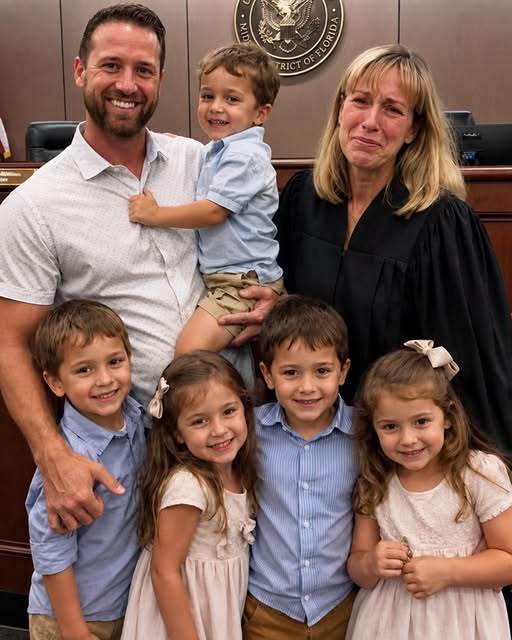
I was twenty-nine years old when I walked into family court and realized that my life might be about to change forever.
I wasn’t married.
I didn’t own a mansion.
I wasn’t wealthy.
I didn’t have years of parenting experience.
What I did have was a small home, a steady job, a workshop behind the house, and a strong belief that five young siblings shouldn’t have to lose each other simply because their circumstances had changed.
That belief would eventually lead me into one of the most difficult decisions I had ever made.
At the time, I didn’t know whether I was capable of raising five children.
Honestly, I wasn’t even sure whether anyone could prepare for something like that.
But I knew one thing.
Those children had already lost enough.
The Children on the Bench
I first learned about the siblings through a local emergency placement service.
Their situation had been complicated, and because they were all under the age of seven, social services had been trying to find safe arrangements for them.
There were five children.
Three boys and two girls.
The oldest was six.
The youngest had only recently turned two.
Their names were Daniel, Ethan, Noah, Lily, and Grace.
I won’t pretend I knew anything about them when I first saw their photographs.
I didn’t.
I didn’t know their favorite foods.
I didn’t know which one was afraid of thunderstorms.
I didn’t know who liked cartoons or who hated vegetables.
I didn’t know what their bedtime routines were.
I only knew that they were siblings.
And I knew that the proposed arrangement would place them in separate homes.
The social workers had understandable reasons for considering that option.
Finding one household capable of taking five young children at once is extremely difficult.
There are practical requirements.
There are background checks.
There are financial considerations.
There are housing requirements.
There are questions about work schedules, transportation, education, medical care, and emotional support.
Finding one person who can meet all of those requirements is difficult enough.
Finding one person who can do it for five children is much harder.
At first, I was simply concerned.
Then I learned that the children had been very close to one another before entering care.
That changed the way I looked at the situation.
I kept thinking about what it would feel like for a six-year-old to be told that his brothers and sisters were going to different houses.
I understood that sometimes separation is unavoidable.
But if there were a safe alternative, I wanted to explore it.
So I contacted the social worker.
“You Need to Think Carefully”
The first conversation did not go the way I expected.
The social worker was professional and polite.
But she was also cautious.
“You are twenty-nine,” she said.
“Yes.”
“You’re single.”
“Yes.”
“You’ve never raised children.”
“That’s correct.”
She paused.
“And you’re asking whether you can be considered as a placement option for five children.”
“Yes.”
There was another pause.
“I need you to understand that this isn’t something you decide because you feel sorry for them.”
“I understand.”
“It’s a full-time responsibility.”
“I understand.”
“You can’t simply rearrange your house and assume everything will work.”
“I know.”
She looked at me for several seconds.
“Then why are you asking?”
I didn’t have a perfect answer.
Because the truth was, I didn’t know whether I could do it.
But I knew I wanted to learn whether it was possible.
“I don’t want to promise that I’m capable before anyone has evaluated me,” I said. “I just want the opportunity to be evaluated.”
That seemed to change the tone of the conversation.
She explained the process.
There would be background checks.
Home inspections.
Financial reviews.
References.
Interviews.
Training.
A review of my employment.
A review of my support network.
There would also be conversations about whether I understood the needs of five young children.
I agreed to everything.
Preparing My Home
I didn’t suddenly become a parent overnight.
I didn’t empty my bank account and pretend that money wasn’t important.
Instead, I started preparing carefully.
My house had three bedrooms.
It wasn’t large, but there was an unfinished section above my workshop that I had originally planned to turn into storage.
I began working on it.
I installed proper insulation.
I repaired the electrical system.
I added safe windows.
I installed smoke detectors.
I built sturdy bunk beds after confirming that the design met appropriate safety standards.
I created a separate sleeping area for the youngest child.
I added storage for clothing and toys.
I also realized that a house full of children would require much more than furniture.
It needed structure.
It needed safety.
It needed routines.
Most importantly, it needed adults who could help me.
That was something I hadn’t considered enough at the beginning.
My sister lived about twenty minutes away.
She had two children of her own and immediately offered practical advice.
My neighbor, an older retired teacher, offered to help with homework.
A friend from work offered to recommend reliable childcare services.
Another friend helped me understand how difficult it could be to coordinate school schedules, appointments, meals, and transportation.
I began to understand something important.
Being responsible for five children didn’t mean doing everything alone.
It meant building a reliable support system.
Meeting the Siblings
Several weeks later, I was allowed to meet the children.
I was nervous.
More nervous than I had expected.
I sat in a room with toys scattered across the floor.
The oldest boy, Daniel, watched me carefully.
His younger brother stayed close to him.
Lily held a stuffed animal against her chest.
Grace sat quietly.
The youngest, Noah, was more interested in a toy truck than in anything I was saying.
I smiled.
“Hi.”
Nobody answered.
I didn’t blame them.
They didn’t know me.
I wasn’t there to ask them to trust me immediately.
I was there to let them get comfortable at their own pace.
So I sat on the floor.
Daniel eventually asked what I did for work.
“I build things.”
“What kind of things?”
“Houses sometimes. Repairs. Woodwork. Different projects.”
He looked interested.
“Can you build a castle?”
I laughed.
“I can try.”
That was the first real smile I saw from him.
It was small.
But I remembered it.
Over the next few meetings, the children became more comfortable.
We played games.
We drew pictures.
We read books.
I learned that Daniel liked building toys.
Ethan was fascinated by animals.
Noah wanted to touch everything.
Lily liked drawing.
Grace loved music.
Their personalities were completely different.
But they had one obvious connection.
They looked after one another.
The older children tried to comfort the younger ones.
They shared snacks.
They made sure everyone had a place to sit.
Whenever one child became nervous, another would move closer.
That made my determination stronger.
But it also made me more aware of the responsibility involved.
The First Honest Conversation
One afternoon, I spoke privately with the social worker.
“I need to ask you something.”
“Of course.”
“What happens if I can’t handle it?”
She didn’t immediately answer.
Then she said, “That’s why we’re doing this process.”
I appreciated her honesty.
“I don’t want to make a promise I can’t keep.”
“That’s a good thing to understand,” she said.
She explained that becoming a foster or adoptive parent isn’t simply about having good intentions.
Children need stability.
They need consistency.
They need adults who can manage difficult days as well as good ones.
They need medical care, education, emotional support, and patience.
“They’ve already experienced major disruption,” she said. “Any placement needs to be considered carefully.”
I agreed.
That night, I sat alone in my workshop for a long time.
I thought about my finances.
My work.
My house.
My personal life.
My future.
Then I thought about the five children.
I realized I wasn’t afraid of losing my freedom.
I was afraid of making a promise that I couldn’t keep.
That distinction mattered.
The Reason I Hadn’t Told Anyone
Eventually, the judge asked about my motivation.
That was the part I had been avoiding.
There was a personal reason I felt so strongly about keeping siblings together.
Years earlier, when I was a child, my own family had gone through a difficult period.
My parents had separated.
For a time, our family situation became unstable.
My younger brother and I were temporarily placed with different relatives because no single household was immediately available.
We were not separated permanently.
But the experience affected me deeply.
I remember standing in a hallway with a small bag of clothes, wondering when I would see my brother again.
I remember asking adults questions they couldn’t answer.
I remember feeling as though decisions about my life were happening around me rather than with me.
Eventually, my brother and I were reunited.
Our circumstances improved.
But I never forgot what that uncertainty felt like.
I had never told many people about it.
Not because it was a secret.
I simply didn’t talk about it.
When the judge asked why I was willing to consider such a significant responsibility, I finally told him.
“I know what it feels like to be a child who doesn’t understand why the people you love can’t stay together.”
The courtroom became quiet.
I continued.
“I’m not saying my experience is the same as theirs. It isn’t. Their situation is their own. But when I learned that five siblings might be separated, I couldn’t stop thinking about how frightening that must feel.”
I paused.
“I’m not asking the court to choose me because of my past. I’m asking the court to evaluate whether I can provide them with a safe and stable home.”
That was the truth.
I wasn’t trying to rescue anyone.
I wasn’t trying to become a hero.
I simply wanted to know whether I could help.
The Judge’s Questions
Judge Miller didn’t react dramatically.
He didn’t become emotional.
He didn’t immediately approve my request.
Instead, he asked difficult questions.
How would I manage five children while working?
Who would care for them if I became ill?
What would happen during emergencies?
Could I afford their expenses?
What would happen if one child needed specialized care?
How would I manage school transportation?
Did I understand that children who have experienced instability may have behavioral and emotional challenges?
What would I do when things became difficult?
I answered as honestly as I could.
“I don’t know everything yet.”
The judge looked at me.
I continued.
“But I know who I can ask.”
I explained my support network.
My sister.
My friends.
My neighbors.
My employer.
The childcare options I had researched.
The schools I had contacted.
The training programs I had completed.
The financial plan I had prepared.
The emergency arrangements I had made.
I wasn’t claiming that everything would be easy.
I was showing that I had thought about the difficult parts.
The Decision
The court did not make the decision based on emotion.
There were procedures to follow.
There were assessments.
There were reports.
There were interviews.
There were home visits.
There were professionals whose responsibility was to determine what arrangement would serve the children’s interests.
That process took time.
During that period, I continued visiting the children.
We developed routines.
On some days, everything went well.
On other days, nothing went according to plan.
One afternoon, all five children argued over a toy.
Another day, Noah refused to eat lunch.
Lily became upset because she couldn’t find her stuffed animal.
Daniel became frustrated during a game.
These moments were ordinary.
But they taught me something.
Parenting wasn’t going to be a series of emotional movie scenes.
It was going to be laundry.
Meals.
Homework.
Appointments.
Arguments.
Laughter.
Bedtime.
Early mornings.
And hundreds of small decisions.
The ordinary parts were just as important as the dramatic ones.
The First Night Together
Eventually, after the appropriate approvals and a carefully planned transition, the children were able to spend an extended period in my home.
I had prepared everything.
Five beds.
Fresh clothes.
Books.
Towels.
School supplies.
Nightlights.
Food.
A small basket of toys.
I had even labeled drawers because I knew five children would quickly create confusion.
The first evening was chaotic.
Someone spilled juice.
Someone couldn’t find a sock.
Someone wanted a different blanket.
Someone asked for another glass of water.
Then another.
By the time everyone was finally in bed, I was exhausted.
I stood in the hallway and listened.
For a few minutes, the house was quiet.
Then I heard a little voice.
“Are you there?”
It was Daniel.
“Yes.”
“Are we staying here tomorrow?”
I walked to the doorway.
“Yes.”
“And the day after?”
“Yes.”
He seemed satisfied.
“Okay.”
Then he went back to sleep.
I returned to the hallway.
That simple conversation stayed with me.
Children don’t always need complicated promises.
Sometimes they need to know what tomorrow looks like.
Learning How to Be a Parent
I made mistakes.
Many of them.
I underestimated how much food five children could consume.
I forgot school forms.
I bought the wrong size shoes.
I once packed lunches and forgot the drinks.
I tried to create a complicated morning schedule that lasted approximately two days.
Then we simplified it.
Clothes were prepared the night before.
Breakfast was kept simple.
School bags were packed in the evening.
Homework happened at the same time each day.
Bedtime followed a routine.
The house became more organized.
The children became more comfortable.
And I slowly became more confident.
But there were still difficult days.
Some children struggled with transitions.
Some had trouble sleeping.
Some became anxious when plans changed.
I learned not to take those moments personally.
They weren’t being difficult because they wanted to make my life harder.
They were children trying to understand a world that had changed around them.
That required patience.
What Happened to the Other Placement Plans?
The original plan had been to place the children in three different homes.
Those arrangements were not necessarily bad homes.
That is important to say.
The people who had offered to help were caring and capable.
The problem was simply that the siblings would have been divided.
After my home was approved and the professionals involved reviewed the situation, the plan changed.
The children were able to remain together.
That outcome wasn’t the result of one person winning an argument.
It was the result of many people doing their jobs carefully.
Social workers.
Court officials.
Caregivers.
Teachers.
Family members.
And professionals who spent time determining what would provide the children with stability.
Eventually, the court approved a long-term arrangement that allowed the siblings to stay together.
I was grateful.
But I also understood that the approval was not the end.
It was the beginning.
A Different Kind of Family
Our household became unusual.
People sometimes asked questions.
“Are all five yours?”
I usually smiled.
“They’re my family.”
That answer was enough.
Over time, the children stopped worrying about whether they belonged.
They knew where their shoes went.
They knew which cabinet contained snacks.
They knew whose turn it was to choose the movie.
They argued about chores.
They fought over the bathroom.
They laughed at dinner.
They celebrated birthdays.
They made drawings for the refrigerator.
The house became noisy.
Sometimes overwhelmingly noisy.
But it also became home.
Years Later
The children eventually grew older.
Daniel became interested in engineering.
Ethan loved animals and talked about becoming a veterinarian.
Lily remained artistic.
Grace became fascinated by music.
Noah, the youngest, developed an endless interest in sports.
Their lives weren’t perfect.
No family’s life is.
But they had stability.
They had one another.
And they knew that there would be someone waiting for them at home.
Looking back, I realize how easy it would have been to describe my decision as heroic.
But I don’t see it that way.
I was simply one person who decided to ask a question.
Could these children stay together?
Could I help?
Could I create a stable home?
The answers weren’t obvious.
They required work.
They required professionals.
They required preparation.
They required admitting when I didn’t know something.
Most importantly, they required putting the children’s needs ahead of the story I might have wanted to tell about myself.
The Lesson I Carry With Me
People sometimes ask me why I did it.
My answer has changed over the years.
At first, I would say, “Because I didn’t want the siblings separated.”
That’s still true.
But now I say something else.
“I wanted them to have the opportuni