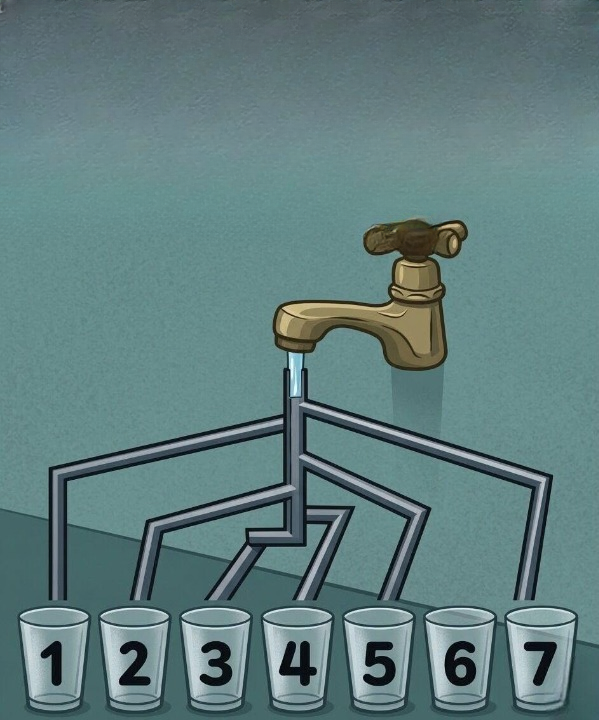
Logic puzzles are popular because they encourage people to slow down, examine details carefully, and think critically. Among the most widely shared puzzles are water pipe challenges, where a stream of water appears to flow through a network of connected pipes toward several numbered containers or glasses.
At first glance, these puzzles often seem straightforward. It appears that all you need to do is follow the direction of the water and identify which container fills first. However, many of these diagrams include blocked passages, disconnected sections, or hidden details that change the correct answer entirely.
The goal is not simply to guess quickly but to carefully observe every part of the illustration before drawing a conclusion.
Why These Puzzles Are So Popular
Visual reasoning puzzles appeal to people of all ages because they combine observation with logical thinking.
Unlike questions that rely on memorized knowledge, these challenges reward patience and attention to detail.
Many people enjoy sharing them with friends, family members, classmates, or coworkers because different people often notice different details.
They also encourage discussion about problem-solving strategies rather than simply arriving at an answer.
Looking Beyond First Impressions
When most people first see a pipe puzzle, they instinctively begin tracing the path of the water.
That approach is reasonable.
However, many puzzles are intentionally designed to encourage quick assumptions.
Some pathways appear connected even though they are blocked.
Others seem open until closer inspection reveals interruptions.
The most successful puzzle solvers spend time studying the entire diagram before following any individual route.
Careful observation often makes the solution much clearer.
How Water Pipe Puzzles Work
Although every puzzle is different, most follow a similar structure.
A source of water enters the system.
Several branches divide the flow.
Each branch appears to lead toward one or more containers.
The challenge is determining which pathways remain open and which are blocked.
Only continuous, unobstructed paths allow water to reach a container.
Any interruption prevents water from flowing beyond that point.
The Importance of Checking Every Connection
One of the most common mistakes involves assuming that touching lines are automatically connected.
In many diagrams:
- Pipes cross without joining.
- Openings are blocked.
- Valves remain closed.
- Pipe sections stop unexpectedly.
- Small gaps interrupt the flow.
Missing even one of these details can completely change the outcome.
Carefully examining every junction helps prevent incorrect answers.
Why Observation Matters More Than Speed
People naturally enjoy solving puzzles quickly.
However, speed is not always an advantage.
Many visual puzzles are specifically designed to reward careful thinking rather than fast responses.
Taking an extra minute to review the illustration often reveals details that were overlooked initially.
Developing the habit of slowing down can improve accuracy in many types of problem-solving situations.
Understanding Blocked Pathways
A blocked pipe prevents water from continuing beyond that point.
Blockages may appear in several forms.
Examples include:
- Closed ends
- Missing pipe sections
- Barriers across openings
- Misaligned connections
- Dead-end passages
Recognizing these interruptions is usually the key to finding the correct solution.
Why Some Containers Never Fill
In certain puzzles, one or more containers appear reachable.
Closer inspection, however, may reveal that every possible path is interrupted.
When all routes are blocked, none of the containers receive water.
Although this outcome may initially seem surprising, it reflects the importance of analyzing the complete system rather than relying on first impressions.
Sometimes the correct answer is that no container fills at all.
Common Mistakes When Solving Logic Puzzles
Several habits frequently lead to incorrect answers.
Following Only the Most Obvious Path
The first visible route may contain a hidden blockage.
Ignoring Small Details
Tiny interruptions often determine the correct solution.
Assuming Symmetry
Two sides of a puzzle may appear identical while containing subtle differences.
Guessing Too Quickly
Taking time to examine the illustration generally improves accuracy.
Developing Better Observation Skills
Visual puzzles provide excellent opportunities to strengthen attention to detail.
Helpful techniques include:
- Examining the entire diagram before tracing water flow.
- Looking closely at every junction.
- Checking each pathway individually.
- Reviewing the illustration after reaching an initial answer.
- Remaining open to revising conclusions.
These habits become useful beyond puzzles and can support careful decision-making in everyday life.
Educational Benefits of Logic Puzzles
Teachers and educators often use puzzles because they encourage important thinking skills.
Benefits include:
- Critical thinking
- Pattern recognition
- Logical reasoning
- Patience
- Visual analysis
- Problem-solving confidence
These abilities support learning across many subjects, including mathematics, science, engineering, and computer programming.
Why Puzzles Encourage Discussion
One interesting feature of visual puzzles is that different people often notice different details.
After solving a puzzle, discussing the reasoning process can be just as valuable as identifying the answer itself.
Questions worth exploring include:
- Which detail changed the outcome?
- What assumption proved incorrect?
- Which pathway initially seemed open?
- What was overlooked?
These conversations help strengthen analytical thinking.
Applying Logical Thinking Beyond Puzzles
The habits developed through puzzle solving extend into many everyday situations.
Examples include:
- Reading maps
- Understanding diagrams
- Planning projects
- Reviewing contracts
- Following instructions
- Troubleshooting technical problems
Careful observation supports better decision-making in many areas of life.
Practicing Patience
One important lesson from logic puzzles is that patience often produces better results than rushing.
Instead of immediately selecting an answer, experienced puzzle solvers pause to verify every assumption.
This approach reduces errors while improving confidence in the final conclusion.
Creating Your Own Logic Challenges
Designing puzzles can be just as educational as solving them.
Simple activities include:
- Drawing pipe networks.
- Creating maze puzzles.
- Designing branching paths.
- Inventing multiple possible solutions.
- Asking friends to explain their reasoning.
Building puzzles encourages creativity while reinforcing logical thinking.
Tips for Solving Future Water Pipe Puzzles
Whenever you encounter similar challenges, remember these steps:
- Start at the water source.
- Examine every connection carefully.
- Look for blocked or disconnected pipes.
- Ignore pathways that cannot carry water.
- Confirm each route before selecting an answer.
- Review the entire diagram one final time.
Following a consistent method improves both speed and accuracy over time.
Why Visual Puzzles Remain Popular
Logic puzzles continue to attract millions of people because they combine entertainment with learning.
Unlike many forms of passive entertainment, puzzles encourage active participation.
They challenge the brain to recognize patterns, evaluate evidence, and solve problems using careful observation.
Whether completed individually or shared with others, these activities remain enjoyable ways to strengthen reasoning skills.
Conclusion
Water pipe logic puzzles demonstrate how careful observation can completely change an answer that initially appears obvious. Rather than rewarding quick guesses, they encourage patience, attention to detail, and systematic thinking.
By examining every connection, identifying blocked pathways, and verifying assumptions before reaching a conclusion, puzzle enthusiasts improve valuable analytical skills that extend well beyond games. Whether solving puzzles for enjoyment, education, or mental exercise, the most successful approach remains the same: observe carefully, think logically, and remember that sometimes the simplest-looking problems contain the most interesting lessons.
In many cases, the correct answer is not determined by following the most obvious path—it comes from noticing the details that others may overlook.