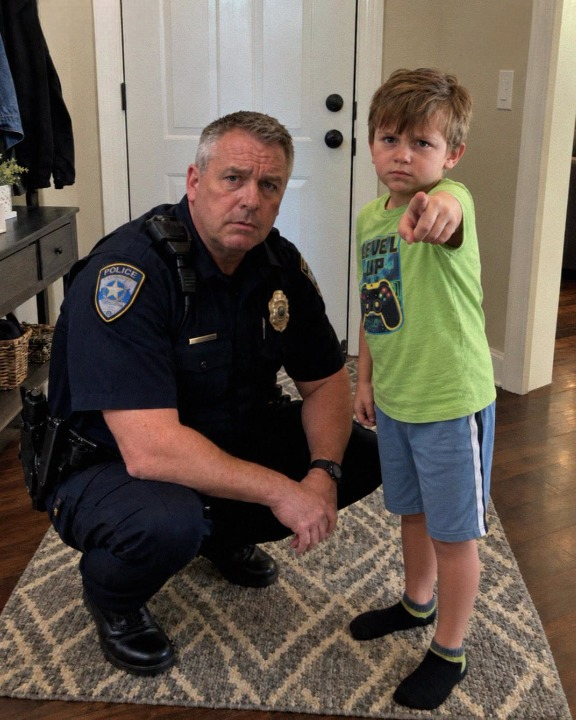
My seven-year-old son, Tyler, has always had a very strong personality.
He is sweet, funny, curious, and usually full of energy.
But when Tyler decides he wants something, convincing him to wait can sometimes feel like negotiating with a tiny lawyer who has prepared arguments in advance.
Most of the time, I can handle it.
I’ve learned that children have big emotions, and sometimes the best thing a parent can do is stay calm and give them time to settle down.
But last Tuesday evening, Tyler took one of his ordinary disagreements with me to a completely unexpected level.
It started with something incredibly simple.
Dinner.
I had spent most of the afternoon getting everything ready.
I was making chicken, roasted vegetables, and rice, and the kitchen smelled wonderful.
Tyler had been playing in the living room while I cooked.
At one point, he wandered into the kitchen and opened the freezer.
I looked over my shoulder.
“What are you looking for?”
“Ice cream.”
He said it as though the answer were obvious.
I smiled.
“You can have some after dinner.”
He stared at me.
“But I want it now.”
“I know.”
“Just a little.”
“No, sweetheart. Dinner is almost ready.”
He opened the freezer again.
I walked over and gently closed it.
“After dinner.”
That was when his expression changed.
He folded his arms.
“You never let me do anything.”
I couldn’t help smiling.
“That’s not true.”
“Yes, it is.”
“You played outside for an hour today.”
“That doesn’t count.”
“You watched your favorite show.”
“That doesn’t count either.”
“You had a snack.”
“I want ice cream.”
I took a breath.
“Tyler, we’re going to eat dinner in about twenty minutes. You can have ice cream afterward.”
He frowned.
Then he announced:
“You’re the meanest mom ever.”
I had heard that sentence before.
Many parents probably have.
I simply returned to the stove.
“Okay. You can be upset, but the answer is still no.”
Tyler stomped out of the kitchen.
I heard him disappear into the living room.
A few minutes later, everything became quiet.
I assumed he had gone back to his toys.
I continued cooking.
I didn’t think anything else about it.
Twenty minutes later, someone knocked on the front door.
I wiped my hands on a towel and walked over.
When I opened the door, I found a police officer standing on the porch.
For a moment, I couldn’t understand why.
“Good evening,” he said politely. “Ma’am, we received a call concerning a child at this address. I just need to make sure everything is okay.”
My heart immediately started racing.
“A call?”
The officer nodded.
“Yes.”
Then I heard a familiar voice behind me.
“I called.”
I slowly turned around.
Tyler was standing in the hallway.
He looked completely serious.
The officer looked at him.
Tyler pointed at me.
“My mom won’t give me ice cream.”
I wanted to disappear.
There are moments in parenting when you realize your child has managed to create a situation you never could have predicted.
This was one of those moments.
I looked at the officer.
“I’m so sorry. Everything is fine. He wanted ice cream before dinner, and I told him he had to wait.”
The officer remained professional.
He didn’t laugh.
He didn’t look annoyed.
He simply nodded.
Then he crouched slightly so he was closer to Tyler’s height.
“Is that why you called?”
Tyler nodded.
“Yes.”
“Did you think your mom was hurting you?”
“No.”
“Did you think you were in danger?”
Tyler shook his head.
“No.”
“Then why did you call?”
Tyler answered without hesitation.
“Because she wouldn’t give me ice cream.”
I closed my eyes for a second.
The officer stood again.
I expected him to smile and explain that emergency services should only be contacted when someone is actually in danger.
Instead, he did something I wasn’t expecting.
He asked me a question.
“May I come inside for a moment?”
“Of course.”
I stepped aside.
He entered and looked around.
Everything was perfectly normal.
Dinner was almost ready.
The kitchen was clean.
Tyler’s toys were scattered across the living room floor.
Nothing about the house suggested that anything was wrong.
The officer looked at Tyler again.
“Can I ask you something?”
Tyler nodded.
“Do you know what the police are for?”
Tyler thought for a moment.
“To help people.”
“That’s right.”
“And to catch bad guys.”
“Sometimes.”
The officer smiled.
“But we also help people when they’re in danger or when they need immediate assistance.”
Tyler nodded.
“So if someone is hurt, scared, or unsafe, calling for help is a good thing.”
Tyler nodded again.
“But if your mom tells you that you can’t have ice cream yet, is that an emergency?”
Tyler looked at the floor.
“No.”
“Right.”
Tyler seemed embarrassed.
I expected the officer to lecture him.
Instead, he said something that surprised me.
“You actually did one thing very important today.”
Tyler looked up.
“What?”
“You asked an adult for help when you thought you needed it.”
Tyler smiled slightly.
“However,” the officer continued, “you need to learn when something is a real emergency and when it isn’t.”
Tyler nodded.
The officer then looked at me.
“He’s seven. This is probably a good opportunity to teach him rather than simply punish him.”
I nodded.
“I agree.”
Then the officer did something even more unexpected.
He asked Tyler to imagine three different situations.
“What would you do if you fell off your bike and couldn’t get up?”
“Call for help.”
“Good. What if you couldn’t find your mom in a crowded store?”
“Find an employee.”
“Exactly. What if you wanted ice cream and your mom said no?”
Tyler thought about it.
“Wait.”
The officer smiled.
“Exactly.”
Tyler looked at me.
“I’m sorry.”
I crouched down beside him.
“Thank you.”
He hugged me.
I hugged him back.
The officer stood by the doorway.
Before leaving, he said something that stuck with me.
“He’s going to test boundaries. That’s part of growing up. Your job is to make the boundaries clear, and his job is to learn them.”
I thanked him.
After he left, Tyler and I stood quietly in the hallway.
Then Tyler looked at me.
“Can I have ice cream now?”
I couldn’t help laughing.
“After dinner.”
He sighed dramatically.
“Okay.”
We went back into the kitchen.
Dinner was served a few minutes later.
Tyler ate surprisingly well.
Then he got his ice cream.
He sat at the table, took one bite, and smiled.
“Mom?”
“What?”
“The police officer was nice.”
“Yes, he was.”
“Can he come back tomorrow?”
I laughed.
“Hopefully not.”
“Why?”
“Because I don’t want you calling him again just because you don’t like my answer.”
Tyler smiled.
“I won’t.”
And this time, I believed him.
The whole experience left me thinking about how quickly an ordinary parenting moment can turn into something much bigger.
At first, I was embarrassed.
Then I was frustrated.
Then I was worried that my son didn’t understand the seriousness of calling emergency services.
But the officer handled the situation differently than I expected.
He didn’t humiliate Tyler.
He didn’t frighten him.
He didn’t make him feel foolish for asking for help.
Instead, he used the moment to teach him something important.
There is a difference between asking for help and misusing an emergency service.
Children don’t automatically understand that difference.
They have to be taught.
That night, after Tyler went to bed, I sat on the couch thinking about the whole thing.
I realized that my son had learned something far more valuable than simply “don’t call the police over ice cream.”
He learned that emergency services exist for genuine emergencies.
He learned that adults can help when something is seriously wrong.
And perhaps most importantly, he learned that being told “no” isn’t the same thing as being unsafe.
I also learned something as a parent.
Sometimes the moments that embarrass us the most can become the moments our children remember for the right reasons.
Tyler probably won’t remember what we had for dinner that night.
He probably won’t remember which flavor of ice cream he chose.
But I think he’ll remember the officer explaining when it’s appropriate to ask for emergency help.
And hopefully, the next time I tell him he has to wait for something he wants, he’ll remember that waiting isn’t an emergency.
Although knowing Tyler, I have a feeling he’ll still negotiate.
He’s seven.
That’s what seven-year-olds do.
And honestly?
I’d rather have a curious, outspoken child who needs to learn boundaries than a child who is afraid to ask for help when something genuinely goes wrong.
So the next time Tyler asks for ice cream before dinner, I’ll give him the same answer.
“Not yet.”
And if he dramatically tells me I’m the worst mother in the world?
I’ll probably smile.
Because now I know that sometimes parenting isn’t about preventing every mistake.
It’s about being there when the mistake happens, explaining why it matters, and helping your child understand what to do differently next time.
And, of course, making sure the ice cream stays safely in the freezer until dinner is finished.