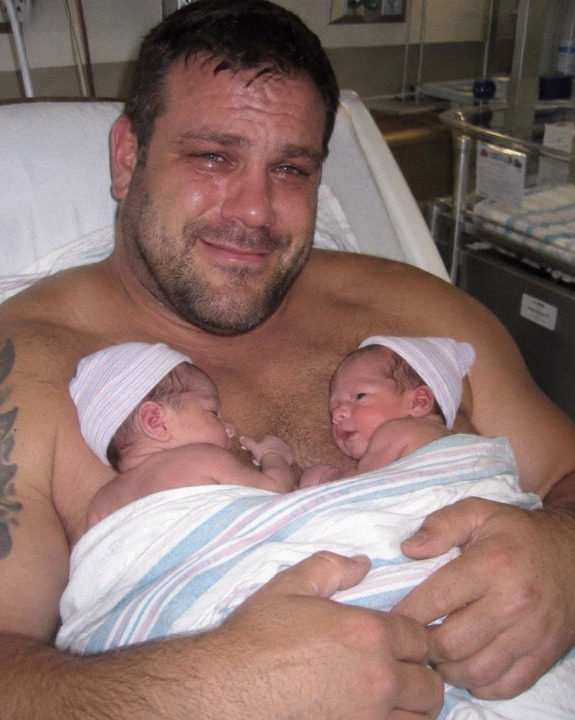
Our daughter, Hannah, grew up believing she had been born alone.
She wasn’t.
She had a twin sister named Rosie.
Rosie was eleven minutes older than Hannah.
The two girls had entered our lives together, and for nine days, our home was filled with the overwhelming joy and exhaustion that comes with caring for newborns.
Two cribs.
Two tiny blankets.
Two sets of clothes.
Two bottles warming on the kitchen counter.
Two little faces sleeping beside each other.
We were learning how to become parents to twins.
Then, nine days after we brought them home, Rosie passed away unexpectedly.
There was no warning that made sense to us.
The doctors explained what had happened, and the official conclusion was sudden infant death syndrome.
There was no simple explanation.
There was no mistake we could point to.
No decision we could undo.
No person we could blame.
In some ways, that made the loss even harder to process.
We were left with questions that had no answers.
And while we were grieving Rosie, we still had another newborn daughter who needed us.
Hannah needed to be fed.
She needed to be held.
She needed clean clothes.
She needed her parents.
So we kept moving.
We learned how to smile when people asked how our baby was doing.
We learned how to answer questions without saying too much.
We learned how to keep going.
But inside our house, there was a silence that never completely disappeared.
The second crib was the first thing I couldn’t bear to see.
While my husband was away handling arrangements, I took it apart myself.
Piece by piece.
I carried the parts into the garage and leaned them against the wall.
I didn’t want to see the empty crib.
I didn’t want to walk past it every morning.
I didn’t want to explain to visitors why there were two cribs but only one baby.
I told myself that I was doing what I needed to do to survive.
At first, we believed we would eventually explain everything to Hannah.
We told ourselves she was too young to understand.
Then she became five.
She was starting school.
She was learning how to read.
She was making friends.
We told ourselves that five was too young to carry such a complicated story.
Then she turned twelve.
That year was particularly difficult for her.
She was struggling with school and going through the normal challenges of growing up.
We told ourselves it wasn’t the right time.
Then she became a teenager.
Then she started thinking about college.
Every time we considered telling her, another reason appeared.
She was too young.
She was having a difficult year.
She was preparing for exams.
She was applying to college.
We kept postponing the conversation.
Eventually, postponing became a habit.
And the habit became eighteen years.
My mother had once kept a photograph of Rosie in the hallway.
After a while, she took it down.
My sister learned not to mention Rosie’s name at family gatherings.
Not because anyone had forgotten her.
Quite the opposite.
Everyone remembered.
We simply became very good at pretending the subject didn’t exist.
There was one person who occasionally tried to break through that silence.
My husband.
Once a year, usually when we were driving somewhere together, he would bring it up.
“She has a right to know.”
I knew what he meant.
I always knew.
But I was afraid.
“Know what?” I would ask.
“That she had a twin?”
“That she’s the one who lived?”
My husband would go quiet.
He never pushed me.
And because he never pushed, the conversation ended.
Until the next year.
I often wondered whether he regretted agreeing with me.
Perhaps he did.
But neither of us knew how to undo eighteen years of silence.
I had held two babies for nine days.
And for eighteen years, I had carried the memory of one of them quietly inside me.
Every September 9th was difficult.
That was Hannah’s birthday.
It was also Rosie’s birthday.
One birthday was celebrated.
The other was remembered privately.
Sometimes I would set four places at the dinner table without thinking.
Then I would realize what I had done.
I would quietly remove the extra plate.
Nobody ever commented.
My husband handled the day differently.
Every September 9th, after dinner, he would go into the garage.
He usually stayed there for about an hour.
I never asked what he was doing.
I assumed he needed somewhere quiet.
I had my own places where I went when the memories became too heavy.
The laundry room.
The kitchen.
The shower.
Sometimes grief doesn’t need words.
Sometimes people simply need a place to sit alone with their thoughts.
But that birthday was different.
Hannah had turned eighteen.
We decided to have a small celebration in the backyard.
There were about thirty people.
Family.
Friends.
Neighbors.
Folding tables had been set up across the yard.
There was a grocery-store sheet cake with Hannah’s name written in blue icing.
My brother stood near the grill.
Music played from a small speaker.
People laughed.
Hannah opened her presents one by one.
When she opened the box containing the car keys we had bought for her, she screamed with excitement.
Then she ran over and hugged her father.
I watched them together.
My little girl wasn’t little anymore.
She was eighteen.
An adult.
And for the first time, I wondered whether keeping the truth from her had protected her at all.
Maybe we had only protected ourselves.
After the gifts were opened, my husband stood up.
He looked around the yard.
“Can everyone give us a minute?”
People seemed confused, but they quietly moved toward the house.
My husband disappeared into the garage.
I watched him go.
Something inside me immediately felt different.
I knew.
I didn’t know exactly what he was going to say, but I knew the time had come.
A few minutes later, he returned carrying a wooden box.
I had never seen it before.
That surprised me.
We had lived in that house for eighteen years.
I had organized the garage countless times.
I had moved boxes, cleaned shelves, and searched for holiday decorations.
Yet I had never seen that box.
My husband carried it carefully and placed it in front of Hannah.
She looked at him.
“What is this?”
He sat beside her.
Then he took a deep breath.
“Hannah, there is something your mother and I should have told you a long time ago.”
I stood a few feet away.
My heart was pounding.
Hannah looked at me.
Then back at her father.
“What?”
My husband opened the box.
Inside were several carefully preserved memories.
A tiny hospital bracelet.
A photograph.
A pair of newborn socks.
And two small blankets.
Hannah looked at everything with confusion.
My husband reached for the photograph.
“You weren’t born alone.”
She stared at him.
“What do you mean?”
“You had a twin sister.”
Hannah didn’t move.
Her expression was completely blank.
Her father continued.
“Her name was Rosie.”
For several seconds, nobody spoke.
I watched my daughter’s face as she tried to process those words.
“A twin?”
My husband nodded.
“She was born eleven minutes before you.”
Hannah looked at me.
“Mom?”
I couldn’t speak immediately.
Then I nodded.
“Yes.”
Her eyes returned to the box.
“What happened to her?”
My husband explained gently that Rosie had passed away when they were still newborns.
He didn’t overwhelm her with details.
He simply told her the truth.
And then he said something that broke my heart.
“We should have told you years ago.”
Hannah looked at both of us.
“Why didn’t you?”
I finally found my voice.
“Because I was afraid.”
“Afraid of what?”
“Of hurting you.”
She looked at me for a long moment.
Then she asked, “Did you think I couldn’t handle it?”
I wiped away a tear.
“I didn’t know how to handle it myself.”
The words were difficult to say.
“But every year, I thought maybe the next year would be easier.”
Hannah looked down.
“Was it?”
“No.”
She was quiet.
Then she reached toward the wooden box.
She placed both hands on it.
My husband looked at her.
“I started making this the night Rosie died.”
Hannah looked at him.
“What is it?”
He explained that, after taking apart the second crib, he couldn’t bring himself to throw everything away.
So he had started collecting small memories.
A photograph.
A blanket.
A hospital bracelet.
The little things that remained from the nine days Rosie