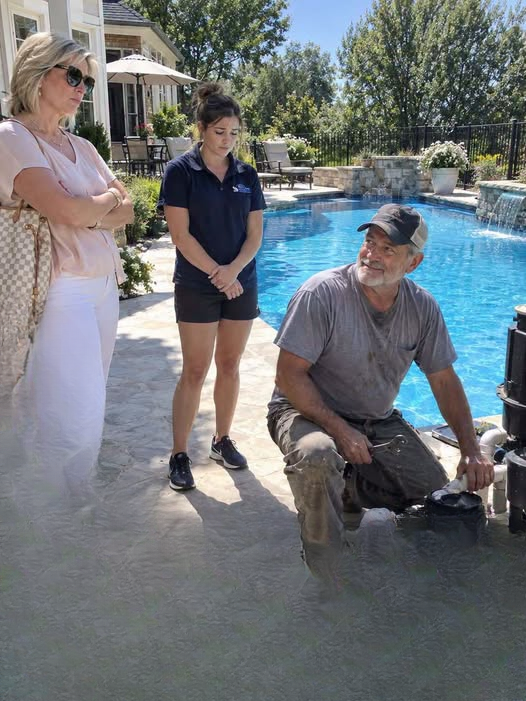
For nearly three decades, my father had made a living repairing swimming pools.
He was the kind of tradesman who rarely talked about how good he was at his job. He did not advertise himself as an expert, and he never tried to impress customers with complicated explanations. Instead, he relied on experience, careful observation, and a habit of documenting every job he completed.
At sixty-one years old, he had spent twenty-nine years working around pumps, filtration systems, pipes, heaters, drains, and pool equipment. He could often identify a problem simply by listening to a pump operate. He understood water chemistry well enough to recognize when something was wrong before the test results confirmed it.
His work truck was an aging Ford F-150, and his tools were always arranged in the same order. He also carried a spiral notebook that had followed him from one job to another for years.
He wrote down everything.
Measurements.
Replacement parts.
Repair dates.
Customer instructions.
Unexpected problems.
And, most importantly, what had been agreed upon before the work began.
That habit would eventually become very important.
A Difficult Pool Repair
My boss, Richard Emory, owned a large home with a neglected gunite swimming pool. The pool had not received proper maintenance for some time, and several parts of the system needed attention.
Richard asked my father to inspect it.
After examining the equipment and the pool itself, my father prepared an estimate for the necessary repairs. The project included replacing the aging pump, repairing damaged plumbing, installing new filtration equipment, and addressing several problems that had affected the pool’s water quality.
The agreed price was $7,800.
Richard signed the estimate and the work authorization, allowing my father to begin.
The job turned out to be more complicated than it initially appeared.
Instead of a quick repair, my father spent nine days working on the property. He replaced the pump, repaired sections of damaged pipe, installed the filtration equipment, and carefully balanced the water.
By the time he finished, the pool looked completely different.
The cloudy water had become clear again. The equipment was operating properly, and the system was ready for regular maintenance.
My father considered the job finished.
Unfortunately, the payment became a problem.
An Unexpected Disagreement
When my father returned to discuss the final invoice, Richard’s wife, Melissa, told him that they were not willing to pay the full amount.
She offered $3,000 instead of the agreed $7,800.
My father explained that the amount reflected the work that had actually been completed and that the original estimate had been signed before the project began.
Melissa disagreed.
Then she reminded him that her husband was my employer.
It was an uncomfortable situation.
My father knew that I worked for Richard, but he also knew that his business arrangement with Richard was separate from my employment.
He did not want the disagreement to become personal.
So he simply told me, “I’ll handle it.”
He did not threaten anyone.
He did not raise his voice.
He did not make a scene.
He gathered his paperwork and left.
At the time, I assumed the disagreement would eventually be resolved through a normal conversation or perhaps a formal invoice dispute.
I had no idea that something much more unusual had already happened during the repair.
The Detail My Father Had Noticed
While working around the pool, my father had noticed something unusual near one of the buried sections of plumbing.
There was an area with an unusual calcium deposit surrounding part of the buried pipe.
To someone unfamiliar with pool construction, it might have looked like nothing more than mineral buildup.
But my father had spent decades working with buried plumbing, concrete, and pool structures. The location and appearance of the deposit made him curious.
He carefully examined the area.
Rather than immediately disturbing it, he documented what he saw.
Eventually, he determined that something beneath the surrounding material did not appear to be part of the pool’s normal construction.
He proceeded carefully and discovered a sealed metal container beneath the pool area.
What was inside was not related to the plumbing system.
It was a collection of old watches and a small clock.
My father stopped working and made sure the discovery was properly documented.
He did not take the items home.
He did not attempt to determine how much they were worth on his own.
And he certainly did not assume that finding something meant he had the right to keep it.
Instead, he began looking for information about the property’s history.
A Connection to the Past
My father eventually learned that the property had once belonged to a Hungarian watchmaker named Tibor.
An elderly neighbor named Eleanor remembered him.
She had lived in the area for decades and had kept records connected to the former owner and his family.
According to the information available to her, Tibor had worked with watches for many years, and the collection discovered beneath the property appeared to have a connection to his family.
At that point, my father realized that the items could potentially have considerable sentimental or historical importance.
But he still did not treat them as his own.
He contacted the appropriate authorities and made sure the discovery was documented.
The police were eventually involved, and the circumstances surrounding the collection could be investigated properly.
That was when the situation at Richard’s house became much more complicated than a disagreement over a repair bill.
The Family Returns
Tibor’s son, Martin, who was seventy-three years old and living in New Mexico, eventually learned about the discovery.
He traveled to the area to see the collection and provide information about his father.
The watches and clock were reportedly valuable, although the exact value would depend on proper authentication and appraisal.
More importantly, the family was able to provide information connecting the items to Tibor.
For Martin, the discovery was about more than money.
It meant that objects connected to his father’s life had unexpectedly resurfaced after many years.
My father had not gone looking for valuable items.
He had simply noticed something unusual while doing the job he had been hired to do.
And because he had documented what he found and involved