When you are twenty-seven years old, death feels like a concept that only exists in history books or on late-night television. You live in a bubble of invincibility, believing that time is an endless resource. So, when I first met Margaret—or “Margarine,” as I affectionately called her because she always managed to find a way to melt my heart—I knew she was dealing with health issues, but I foolishly didn’t understand the gravity of it.
She suffered from a rare, aggressive autoimmune disease that slowly dismantled her body from the inside out. At first, it was just fatigue, joint stiffness, and missed dates. We were young, vibrant, and deeply in love. I figured it was just a temporary hurdle, a minor inconvenience that modern medicine would inevitably fix.
As the months bled together, however, the reality of her condition began to tear through our lives like a wildfire. Margarine grew progressively weaker. The vibrant spark in her eyes began to dim, replaced by the hollow fatigue of chronic pain. And through every single dark turn, I stayed. I didn’t even think twice about it. I drove her to endless specialist appointments across the state, sat beside her on hard plastic chairs while doctors threw around complex medical jargon, and held her trembling hand through the nights when the pain was too much for her to bear alone.
Whenever the heavy weight of her illness threatened to crush us, I tried to anchor us to the future. I proposed marriage—not just once, but multiple times. I wanted to build a life, a proper home, a sanctuary for us.
Yet, no matter how many times I asked, her answer was always an unwavering no.
Her reasoning broke my heart every time. She told me she refused to make me a widower before we had even truly begun our lives. More than that, she carried a crushing burden of guilt, terrified that tying her legal and financial life to mine would leave me drowning in insurmountable medical debt and hospital bills long after she was gone. She wanted to protect me from the fallout of her disease.
The Hospital Wedding
Then, everything changed in a single, terrifying afternoon.
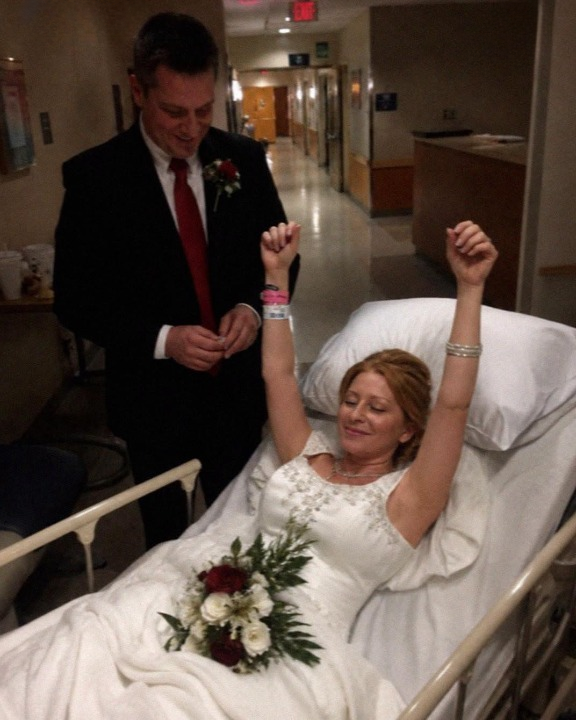
It was autumn, exactly one week before what the surgical team warned us would be a high-risk, life-or-death operation. Margaret was frail, her skin pale against the stark white hospital pillows, when she suddenly reached out and grabbed my hand with a surprising burst of strength.
She looked up at me and asked me to marry her.
Yes, I got proposed to by a dying woman. But the atmosphere in that sterile room was so heavy, exhausting, and charged with desperation that the unorthodox reversal of roles didn’t even register in my mind until months later.
“Look,” she told me, her voice raspy but fierce, her thumb gently stroking my knuckles. “I might not make it out of this operating room. And if I don’t, I want to die as your wife. Not your girlfriend.”
There was no hesitation in me. How could I possibly refuse the woman I loved more than life itself what was quite clearly her final, desperate wish?
We pulled off the lamest, yet most profoundly beautiful hospital wedding imaginable. It was thrown together in forty-eight hours. Our parents drove in through the night. A handful of our closest friends showed up with mismatched clothes and tear-streaked faces. Even a couple of compassionate doctors and nurses we had grown close to over the years slipped into the back of the room, standing quietly with us.
There were no elaborate floral arrangements, no rented ballroom, and certainly no first dance. Just Margaret propped up in her hospital bed wearing a simple white cardigan, me standing beside her in a wrinkled button-down shirt, and the people who loved us most watching as we exchanged vows that carried the absolute weight of eternity.
She wore her simple silver wedding ring proudly into her final surgery. And when that surgery ultimately failed—when the monitors flatlined and our prayers weren’t enough—she was buried wearing it.
The weeks that followed passed in a blur of hollow grief. I existed in a fog, moving through the motions of an empty apartment, barely eating, and replaying the final days in my head over and over again.
The Lawyer’s Phone Call
Then, one quiet Tuesday afternoon, my phone rang. It was Margaret’s family lawyer, an older gentleman with a gentle, weathered voice and a slight Southern drawl.
“I think you might want to sit down for this,” he told me over the line, the gravity in his tone cutting straight through my grief-induced numbness.
I obeyed instantly. When a solemn old lawyer tells you to sit down before reading your late wife’s final testament, you don’t argue. I perched precariously on the edge of my kitchen counter, holding an unopened packet of instant ramen in one hand and my phone gripped tightly in the other.
There was a long, agonizing pause on the line. I could hear the faint rustle of heavy cardstock paper in the background.
Then, the lawyer let out a soft, melancholic chuckle.
“Well,” he said quietly, “I suppose it makes complete sense now why she was so dead set on marrying you before she went.”
My stomach tightened into a knot of pure anxiety. The hair on the back of my arms stood up.
“What do you mean?” I asked, my voice cracking.
I heard more papers shuffling on his end of the call, followed by a heavy sigh. Then, quoting directly from the legal document resting on his desk, he read the words that changed everything:
“To my husband, my anchor, and the only man who ever truly saw me: If you are hearing this, it means I lost the fight. For months, I pushed you away and refused your proposals because I was terrified that my medical debt would consume your future. I couldn’t bear the thought of leaving you bankrupt, drowning in bills for a life I couldn’t stay to share.
But what I didn’t realize until my attorney laid out the law is that unmarried partners have no legal protections when it comes to medical debt inheritance and estate claims in our state. Had I died your girlfriend, the hospital and collection agencies could have legally pursued you for every single cent of my unpaid treatments, stripping you of everything you own.
By making you my husband in my final week, you legally became my next-of-kin, shielding your personal assets and locking my medical debts entirely within my estate, where they die with me. I spent my whole life trying to protect you from my illness, and this was my final way of making sure it couldn’t hurt you after I was gone. I love you, Margarine’s boy. Don’t spend the rest of your life alone.”
The phone slipped from my hand, clattering against the kitchen floor, but I couldn’t even bring myself to look down. The tears finally broke free, streaming down my face as the ultimate depth of her love—and the heartbreaking brilliance of her final, protective strategy—finally crashed over me.