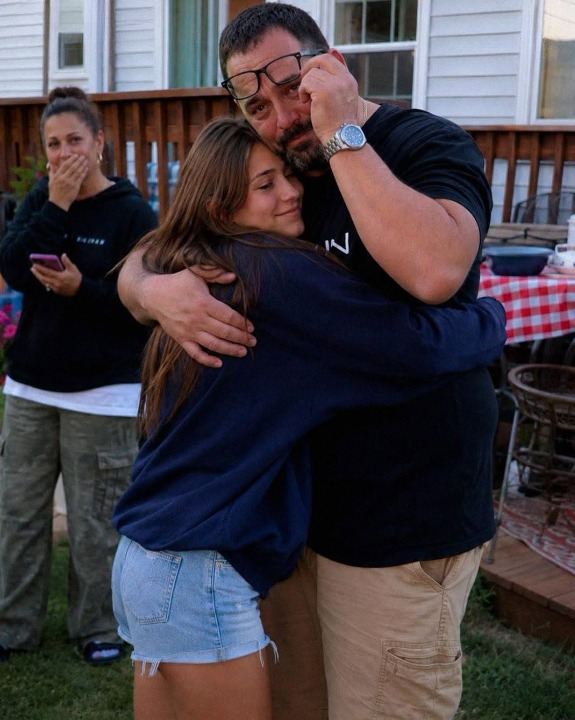
The morning sun had barely crested the horizon when the kitchen floorboards groaned beneath Dan’s heavy, worn work boots. It was 6:40 AM, and the air already smelled of cheap, dark-roast coffee and the faint, lingering scent of motor oil that seemed permanently woven into the fabric of his life.
I sat at the Formica kitchen table, stirring a cold cup of tea, watching him. He stood by the counter, wearing yesterday’s chambray work shirt with the sleeves rolled up to reveal forearms mapped with grease stains, tiny burn marks from soldering irons, and faint white scars from knuckle-skin lost to stubborn engine blocks.
He didn’t look at me right away. He stared down at his coffee mug, his broad shoulders slightly hunched as if bracing for a blow he had grown accustomed to taking.
“I’m sorry,” Dan said, his voice dropping into that quiet, gravelly register he used whenever he felt he had failed someone. “I’m not the dad who can buy you a car.”
He said it with a quiet, crushing humility that made my throat tighten instantly. It wasn’t an excuse; it was an admission of a limitation that he felt deeply, as though the empty driveway outside was a personal indictment of his worth as a provider. He apologized on my sixteenth birthday for something that wasn’t his fault in the slightest—for not being a wealthy man, for not having a corporate credit card, for not being able to hand over the keys to a gleaming, bow-wrapped luxury vehicle like the ones my peers took for granted.
My mind instantly flashed to the high school parking lot just a few miles away. By the time I would arrive there later that morning, the asphalt would be transformed into a glittering showcase of inherited wealth. There would be brand-new luxury SUVs gleaming under the autumn sun, imported sedans with temporary dealer plates, and teenagers tossing designer key fobs back and forth while laughing about weekend trips to the coast.
And there I was, turning sixteen with a canvas backpack whose frayed shoulder strap I had mended twice with safety pins, walking toward the bus stop where the exhaust from the 4:15 public transit bus would coat my jacket in a familiar, soot-gray film.
The Ghosts of the Past
My real father had vanished when I was two years old, dissolving into the ether of broken promises and unpaid child support. He left behind no photographs worth keeping, no college fund, and certainly no memories of bedtime stories.
He never called on birthdays or holidays. He never sent a card with a crumpled twenty-dollar bill tucked inside. Nobody had ever taught me how to balance on two wheels without training wheels, cheering as I wobbled down the sidewalk. No one had ever looked at me and called me a princess.
By the time I was twelve, I had built a fortress of bitterness around my heart. I viewed the world through a lens of inevitable abandonment.
When Mom first introduced Dan into our quiet, fractured lives, I was actively, creatively cruel to him. I tested him with the venomous precision that only a wounded child can muster. I told him straight to his face that he wasn’t my father, spatting the words out like an insult. I looked him dead in the eye and warned him that he would eventually leave just like the other one did—treating his eventual departure not as a possibility, but as a mathematical certainty.
One particularly rainy Tuesday, when the frustration of our cramped, drafty rental house boiled over, I screamed at him that our entire home smelled like an unventilated garage because of his endless tinkering with broken lawnmowers and scrap metal.
Dan hadn’t yelled back. He hadn’t slammed a door or raised a hand. He had simply looked at me with those steady, tired hazel eyes, nodded slowly, and said, “Okay.”
And then, remarkably, he kept showing up.
He showed up the next day, and the day after that. When I was cast as a nameless tree in the back row of the school dance recital—a performance that lasted all of ninety seconds—Dan sat through the entire two-hour production in a hard folding chair, squinting through the dim auditorium lights, and applauded louder than anyone else when my brief moment on stage arrived.
He moved into our lives without fanfare, quietly transforming himself into the structural pillar of a house that had been falling apart for a decade. He fixed the leaking kitchen sink that hissed every time the faucet was turned. He planed the warped front door so it finally locked smoothly against the winter wind. He bled the radiators, patched the roof leak that nobody else could find, and stretched an eleven-dollar-an-hour paycheck across grocery bills, utility notices, and my school supplies without ever once complaining out loud.
Mom told me years later, in a rare moment of quiet confidence, that she hadn’t married him for money—because, quite simply, there wasn’t any to be had.
“It’s hard enough to find a man who loves you in this life,” she had whispered, resting her hand over mine on the kitchen table. “It is an absolute miracle to find one who loves you and your child, and who chooses to stay when things get heavy.”
The Midnight Disappearances
Despite all of that history, October brought a strange and unsettling change to our household.
It started subtly at first. Dan began disappearing late at night. He would wait until Mom and I were fast asleep upstairs, slipping out the back door with the practiced stealth of a ghost. He wouldn’t return until the first gray streaks of dawn began to paint the eastern sky, bringing with them the chill of the approaching winter.
Morning after morning, he would sit at the breakfast table with eyes ringed in exhaustion, his skin pale, and his hands physically wrecked—calluses torn, knuckles scraped raw, and fingernails permanently stained with grease and dark engine grime. When I pressed him about where he went during those ungodly hours, his response was always the same deflection, delivered with a faint, tired smile.
“Where do you go, Dan?” I asked one morning, crossing my arms over my chest.
“Nowhere, kiddo. Eat your eggs before they get cold,” he replied, turning away to rinse his mug in the sink.
My teenage imagination, fueled by insecurity and old trauma, immediately went to the darkest possible places. I convinced myself that there was another woman. I tortured myself with the thought that he was building a life elsewhere, preparing to pack his bags and vanish into the night just like my biological father had done a decade before. The silence between us grew heavy, charged with unspoken fears.
One night, driven by a mixture of anxiety and defensive anger, I crept downstairs like a criminal. The house was dead silent, save for the hum of the refrigerator. Dan’s heavy canvas work jacket hung over the back of the kitchen chair. With a pounding heart and trembling fingers, I slid my hand into the deep pockets.
I expected to find a receipt from a restaurant across town, a business card, or a note confirming my worst suspicions. Instead, my fingers grazed something cold, metallic, and heavy. I pulled it out into the dim light of the hallway.
It was a brass key, its edges completely oxidized and turned a strange, powdery green with age. It looked like it belonged to an old padlock that had sat exposed to the elements for decades.
I stood there in the dark, staring at the green-tinted key, completely baffled. It didn’t make any sense. A key to what?
The Reveal Behind the Shed
The mystery remained unsolved until the crisp, golden morning of my sixteenth birthday.
The high school parking lot had lived up to every dreaded expectation. Through the bus window, I had watched classmates step out of spotless luxury SUVs, their arms loaded with shopping bags from the mall downtown. I had walked through the front gates with my pinned-up backpack, feeling invisible, bracing myself for a day of feeling entirely out of place.
When I finally returned home that afternoon, the atmosphere in the house was unusually solemn.
Earlier that morning, right after his quiet apology over coffee, Dan had been standing by the kitchen counter holding that very same brass key. Without saying a word, he motioned for me to follow him.
We walked together out the back door, stepping across the heavy, frost-kissed grass of the backyard. The morning air bit at my cheeks, but the sun was beginning to break through the mist, casting long, dramatic shadows across the yard. Dan walked with a slow, deliberate pace, his boots crunching on the frozen blades of grass, until we reached the old wooden toolshed tucked away in the far corner of the property.
The shed’s double doors were held shut by a massive, weathered steel padlock that had rusted shut years ago—a lock everyone in the family had long assumed was permanently jammed.
Dan stopped right in front of the padlock, turning to look down at me. His hazel eyes were intensely serious, devoid of any self-pity, shining with a quiet, fierce pride.
“Your mom hasn’t seen it either,” he said softly, his voice steady against the morning wind. “Nobody has. I didn’t want to show it to anyone until it was actually finished.”
He pulled the green-tinted brass key from his pocket, but before sliding it into the rusted mechanism, he reached out and placed a heavy, calloused hand gently on my shoulder. His hand was warm, grounding me completely.
“I want you to remember something before you look inside,” Dan said, his gaze holding mine with absolute conviction. “Your father should have been the one to give you this. He isn’t here, and he never will be. So it’s me.”
With a firm, practiced twist of his wrist, the old padlock clicked open with a sharp, echoing snap that broke the morning silence. Dan pulled the heavy iron shackle free, reached out, and pulled the wooden shed doors wide open, revealing the secret he had spent months of sleepless nights protecting.