The Quiet Corridor
Grief is a heavy, stagnant weight that settles into your bones, making everyday movements feel like wading through thick mud. At twenty-nine, following the agonizing, lingering loss of my mother, my world had shrunk to the four walls of my apartment and the suffocating ache in my chest. Nothing made sense anymore. The routines of daily life felt meaningless, a cruel reminder of how fragile existence truly is.
In an effort to escape the deafening silence of my empty home, I started volunteering at the regional hospital. Walking the quiet corridors, offering a glass of water, or simply sitting in silence with patients became the only anchor keeping me grounded. For nearly a year, I gravitated toward the hardest rooms—the ones where patients had no family, no visitors, and no one to hold their hands as the sun went down.
That was how I met Thomas.
He was seventy-two years old, frail, and battling an advanced stage of congestive heart failure that the doctors knew they couldn’t reverse. His silver hair was uncombed, and his skin had the pale, papery texture of someone who had spent a lifetime wrestling with unseen burdens. His eyes were deeply tired, etched with the unmistakable loneliness of a man whose world had quietly emptied out around him.
Yet, the moment I walked into his room to adjust his pillows, he offered me a slow, gentle smile that completely transformed his face.
We started talking. At first, it was just polite pleasantries about the weather or the hospital food. But within days, those brief conversations blossomed into deep, wandering dialogues that became the highlight of both our routines. He asked about my mother, listening with a patient, profound empathy that made me feel truly seen for the first time in months. I learned fragments of his past—he spoke vaguely of a career in logistics, a lifetime of moving from city to city, and an estranged family that had drifted away decades ago.
We became each other’s sanctuary against the sterile, fluorescent reality of the medical ward.
The Soda Tab Vows
Then, one rainy Tuesday afternoon, as the wind rattled the windowpanes of his room, Thomas reached out with a trembling, translucent hand and wrapped his fingers around mine.
“Marry me, Sarah,” he whispered, his voice rough and breathless.
My breath caught in my throat. My heart hammered against my ribs. “Thomas… you’re seriously ill. We barely know each other, and… how can you even think about that right now?”
“I’ve spent my entire life building walls to keep people out,” he said, squeezing my fingers with a surprising surge of strength. “And now, at the end, I realize how cold it is inside those walls. I don’t want the state handling my final hours. I don’t want to die as a nameless file on a desk in the county morgue. My last wish is to leave this world as a husband, not as a ghost.”
I knew how bizarre, how utterly irrational it sounded. Marrying a man I had known for barely a month, a man standing on the very threshold of death. But looking into his weary, hopeful eyes, I saw the reflection of my own deep, echoing isolation. We were two broken pieces finding a strange, quiet refuge in one another.
“Yes,” I whispered, tears blurring my vision. “I’ll marry you, Thomas.”
Things moved with astonishing speed. The hospital chaplain, touched by the raw vulnerability of our request, bypassed red tape and arranged a brief bedside ceremony forty-eight hours later.
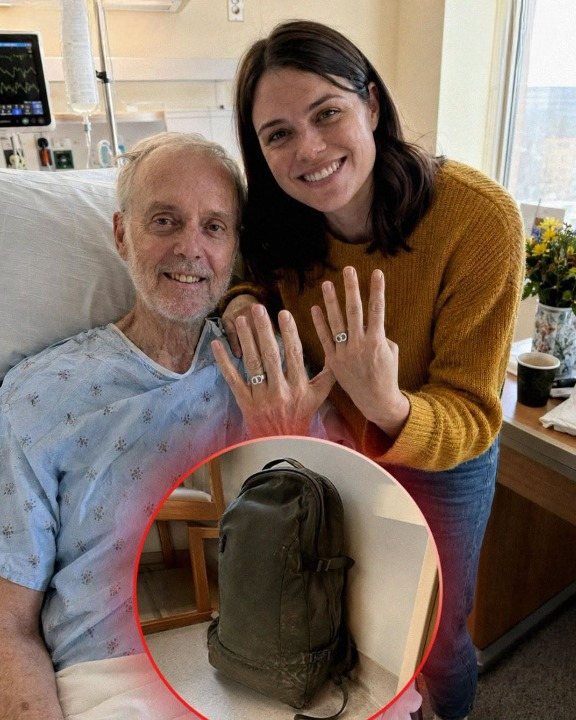
There were no white dresses, no soaring organ music, and no grand reception. I wore my favorite mustard-yellow sweater, brushing my hair back in the hospital bathroom mirror. Since we had no rings, Thomas carefully twisted an aluminum soda can pull tab into a makeshift band, sliding it onto my left ring finger with a shaky, tender smile.
“Forever,” he rasped quietly as the chaplain pronounced us husband and wife.
For the next seven days, I didn’t leave his side. I slept in the uncomfortable vinyl armchair beside his bed, holding his hand through every agonizing, difficult breath, feeding him ice chips, and whispering stories about my mother’s garden to soothe the rising panic in his chest. I became his wife in every sense that mattered.
On the eighth night, right as the dawn began to paint the sky in pale shades of lavender and gray, Thomas’s breathing hitched. His hand grew cold in mine, and with one final, peaceful sigh, his heart stopped.
The room plunged into an absolute, crushing silence.
The Green Backpack
Hours later, after the nurses had taken him away and the sterile sheets had been stripped from the bed, I sat alone in the empty room. I stared down at the aluminum soda tab still gleaming on my finger, trying to comprehend how a man who had entered my life so briefly could leave behind such a massive, agonizing void.
Footsteps echoed softly in the doorway.
I looked up, expecting a hospital administrator with discharge paperwork. Instead, an elderly man with kind, crinkling eyes and a worn leather briefcase stepped into the room. He carried a heavy, olive-green canvas backpack in his left hand.
“Sarah?” the man asked gently, his voice carrying the calm, measured cadence of a courtroom professional.
“Yes?” I croaked, wiping a stray tear from my cheek.
“My name is Arthur Pendelton. I am your husband’s legal counsel.” He stepped forward, placing the heavy green backpack carefully on the metal bedside table. “Thomas left specific instructions. He wanted you to have this the moment he passed away.”
I stared at the canvas bag. It looked rugged, worn at the seams, and far heavier than an ordinary backpack should be.
“What is this?” I asked, my voice trembling.
The lawyer looked down at the bag, then raised his gaze to meet mine. A strange, solemn expression crossed his face, and he lowered his voice to a conspiratorial whisper.
“Thomas wasn’t who you thought he was, Sarah,” the old man said quietly. “For twenty years, you thought he was just a lonely, dying old man with no one left in the world. But he wanted you to know the absolute truth.”
With shaking fingers, I reached out, unzipped the heavy brass zipper of the backpack, and parted the canvas flaps. Inside, resting beneath a stack of legal documents and old photographs, was a heavy canvas pouch. When I opened it, the afternoon sunlight caught the dull, heavy gleam of thousands of dollars in bearer bonds—alongside a handwritten envelope addressed to me in Thomas’s looping, familiar cursive, detailing a past, a family, and a secret fortune that would change my life forever.