For eleven years, the soundtrack of my summers was the aggressive, metallic rasp of a suitcase zipper.
The very first time Nathan left us behind, our daughter Sophie was only four years old. She had clutched a little yellow plastic beach shovel to her chest for three days straight, sleeping with it under her pillow because her father had promised, with a pat on her head, that she would get to use it “next time.”
Next time never came.
As the years rolled by, that suitcase zipper became a cruel metronome ticking away my dignity. I learned to hate the sound of it echoing down the hallway.
“Daddy, can we come this time?” Sophie asked, standing in the doorway of our bedroom, her wide, hopeful eyes fixed on the man tossing neatly folded polos into a sleek designer duffel bag.
Nathan didn’t even look up from his packing. He just kept folding, his movements practiced and efficient. “Sweetheart, this is just how my family does vacations. You know that.”
Standing right beside me in the hallway was our eleven-year-old son, Caleb. He had his hands shoved deep into his pockets, his jaw set in a hard, stubborn line. Caleb had stopped asking years ago. He had learned the bitter lesson of rejection long before a child ever should.
“We are your family,” I said, my voice trembling with a mixture of exhaustion and suppressed fury.
Nathan paused, letting out a heavy, patronizing sigh that made my blood run cold. He turned to me, his expression radiating the weary patience of a man dealing with an unreasonable child. “You know what I mean, Claire. My parents, my siblings, the people I grew up with. It’s tradition. It’s just… our circle.”
That sacred “tradition” permeated every aspect of our lives, casting a long, chilly shadow over our marriage. Family birthday group chats somehow managed to “forget” to add me. During holiday dinners, I was never seated at the table; I was always the designated photographer standing behind the lens, capturing memories of a family I was never truly allowed to belong to. Whenever I walked into the kitchen at a family gathering, the lively conversations would instantly evaporate into awkward, heavy silence.
For over a decade, I tolerated it. I swallowed the lump in my throat and smiled through the exclusion because fighting for basic acceptance felt infinitely more exhausting than staying quiet. I told myself it didn’t matter. I told myself I was doing it to keep the peace for the kids.
The Blue Shirts
That morning, Nathan kissed Sophie on the forehead, whispered a vague promise to bring back sea glass and postcards, and walked out the door before breakfast even hit the table.
Two hours later, while I was sitting at the kitchen island cleaning up cereal bowls, my phone buzzed with a notification. It was a public post uploaded by Nathan’s younger sister to social media, tagging the rest of the clan from a luxury beach resort three states away.
I froze as the image loaded on my screen.
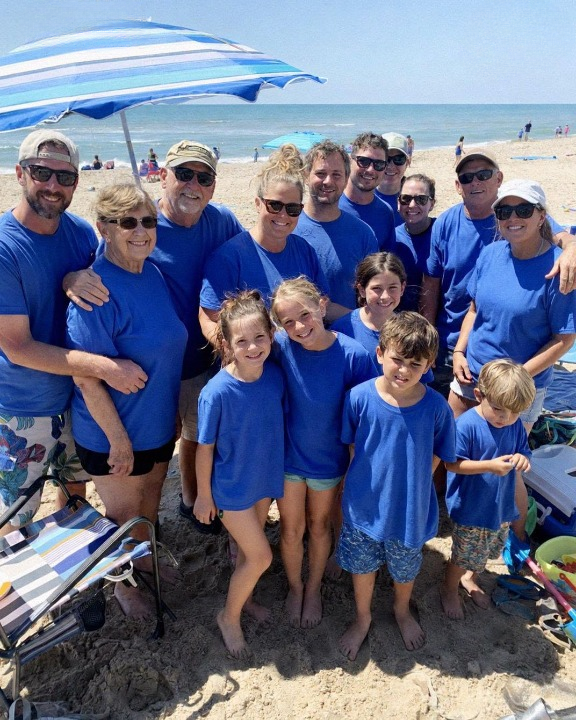
There they were. Every single one of them. Nathan’s parents, his siblings, their spouses, and all the cousins. They were all standing shoulder-to-shoulder on the pristine white sand beneath a massive rented blue-and-white striped umbrella. And to top it off, every single person in the photo was wearing matching royal blue linen shirts.
It was a uniform of exclusion. A visual declaration of who mattered and who didn’t.
Sophie, sensing the shift in the air, wandered over and peeked over my shoulder. Her small eyes scanned the bright, happy faces of her grandparents, her aunts, uncles, and cousins—people who shared her blood, yet felt entirely like strangers.
“Mom,” Sophie whispered, her voice cracking slightly, “why don’t Grandma and Grandpa want us?”
That single, innocent question shattered something deep inside my chest. All the years of swallowed pride, of forced smiles, of bending over backward to excuse Nathan’s selfish behavior—it all broke into a million sharp pieces. The dam burst.
Without a word to Sophie, I closed the app, locked my phone screen, and opened my contacts. My thumb hovered over a name I rarely dialed directly, a name I usually only spoke to when forced by social obligation.
I pressed call.
Linda—my mother-in-law—answered on the second ring. The sound of roaring ocean waves and distant, happy laughter blasted through the receiver, drowning out the quiet hum of my kitchen.
“Claire?” Linda’s voice sounded clipped, almost annoyed, as if I had interrupted something important.
I didn’t bother with pleasantries. The rage and grief bubbling up inside my throat gave me a sudden, terrifying clarity. “Tell me the truth,” I said, my voice shaking. “Why are my children never invited? Why are we left behind year after year?”
The line went dead silent. The ocean wind in the background seemed to muffle as Linda pulled the phone away from her ear, or perhaps walked away from the crowded group on the beach.
“Nathan told you it was our family tradition, didn’t he?” Linda finally asked, her voice dropping to a low, defensive whisper.
My grip tightened around the plastic casing of my phone until my knuckles turned stark white.
“Yes,” I spat out. “He told me it was just how your family does vacations. He told me you prefer small, close-knit trips without the extended household.”
There was a long, agonizing pause on the other end of the line. The heavy ocean noise suddenly faded completely, as if Linda had stepped inside a quiet room away from the festivities.
“Then I’m going to tell you the truth,” Linda said quietly, and the cold tremor in her tone made my breath catch in my throat.
Unraveling the Web
“For eleven years,” Linda began, her voice steadying into a bitter confession, “Nathan has told us something entirely different.”
I stood frozen in the center of the kitchen, the sunlight streaming through the window feeling suddenly freezing cold. “What are you talking about, Linda?”
“Every single year, when we start planning the family reunion, we ask Nathan about you and the kids,” Linda said, a note of genuine exhaustion creeping into her older voice. “And every single year, Nathan tells us that you refuse to come. He tells us that you hate traveling, that you despise the beach, that you prefer to stay home, and that you explicitly forbid him from bringing Sophie and Caleb because it interferes with their school schedules or your strict home routine.”
My knees felt weak. I had to grab the edge of the marble countertop to steady myself.
“He… what?” I breathed, the words barely escaping my lips.
“He told us you were fiercely independent to a fault, that you didn’t want to mix with our side of the family, and that whenever we invited you, you threw a fit behind closed doors,” Linda continued, the pieces of a massive, calculated deception falling into place with terrifying speed. “He told us he begged you to let the kids come just for a weekend, but that you threatened to lock him out of the house if he tried to take them away from you. He made you out to be a tyrant, Claire. He told us he suffered in silence just to keep the peace at home.”
The kitchen seemed to spin around me. Eleven years. Eleven years of carrying guilt, of wondering what was wrong with me, of feeling like an unwanted outsider at every family gathering, while Nathan played the martyr. He had built a double life, carving out a pristine, carefree bachelor persona with his family of origin, while portraying me to them as a cold, controlling warden—and portraying them to me as snobs who wanted nothing to do with us.
It was a masterpiece of manipulation. By driving a permanent wedge between us, he got to enjoy the prestige and freedom of being an unencumbered son and brother on every vacation, while keeping his wife and children safely locked away in the shadows of his suburban life.
“We believed him, Claire,” Linda whispered, a sudden break in her voice. “We thought you were shutting us out. When we saw photos online or asked about the kids, he always changed the subject. My God… my grandchildren have been sitting at home every summer because my son is a coward.”
Tears spilled over my eyelashes, hot and furious, tracking down my cheeks. But this time, the tears weren’t born of sadness or self-doubt. They were fueled by a cold, righteous anger that burned hotter than anything I had ever felt.
“He’s not a coward, Linda,” I said, my voice dropping into a tone so icy it startled even me. “He’s a fraud. And his little vacation is about to come to a very sudden end.”
“What are you going to do?” Linda asked, alarm flashing in her tone.
I looked across the room where Sophie was quietly folding her little beach shovel into her backpack, her small shoulders slumped with rejection. Then I looked at Caleb, who was watching me with an intense, questioning gaze, sensing that the dynamic of our entire world had just shifted forever.
“I’m going to pack a suitcase,” I told my mother-in-law, a sharp, fierce smile touching the corners of my lips. “And this time, we’re not staying behind.”
I hung up the phone without waiting for her reply. I walked straight to our bedroom, pulled Nathan’s half-empty laundry basket off the bed, and dumped every single one of his neatly folded clothes onto the floor. It was time to pay him a visit, and I was bringing the whole family.