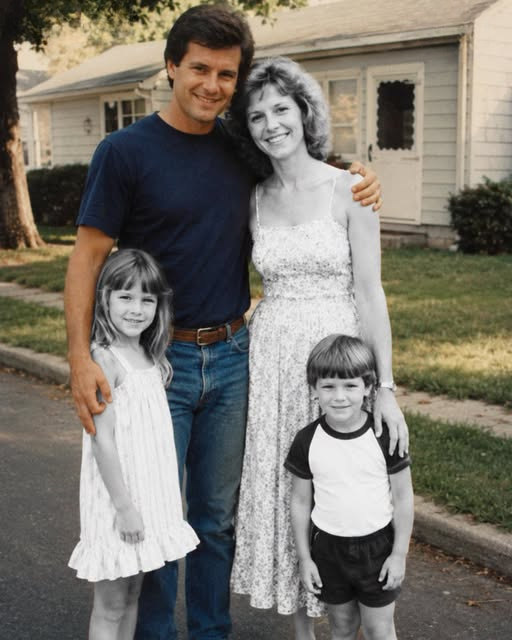
Four decades ago, my life was shattered into a million pieces in the span of a single afternoon.
It was a crisp autumn weekend when my wife, Clara, decided to take our eight-year-old daughter, Emily, and our five-year-old son, Leo, on a short road trip to visit her elder sister, Gwen. Gwen lived in a picturesque coastal town three hours away. I was completely overwhelmed with seasonal work at my accounting firm, so despite Clara’s gentle insistence that I join them, I stayed behind, promising we would take a proper family vacation together the following month.
I kissed my wife goodbye, hugged my children tightly on the porch, and watched their blue station wagon pull out of our driveway. I had no idea that would be the last time I would ever see their faces.
Late that evening, my phone rang. It was Gwen, her voice trembling with anxiety. She asked why Clara and the kids hadn’t arrived yet, as they were already four hours overdue.
Panic seized my chest. I immediately dialed the state police, launching an urgent search operation along the highway route Clara was supposed to take.
Two days into the search, authorities made a devastating discovery: Clara’s station wagon was found abandoned on a remote, narrow bridge spanning a deep, fast-flowing river. The driver’s door was left ajar, but there was no sign of Clara, Emily, or Leo.
The police launched a massive, years-long investigation. Dive teams dragged the turbulent river for miles downstream, search dogs scoured the dense surrounding woodlands, and investigators questioned dozens of potential witnesses.
The primary theory concluded that the vehicle had skidded on slick ice, hit the low bridge guardrail, and that in a moment of panic or displacement, my family had been swept into the icy, powerful current.
Two years after the disappearance, with no bodies ever recovered and no new leads, the state officially declared Clara, Emily, and Leo deceased.
From that moment on, I ceased to truly live; I was merely existing. I spent the next forty years wandering through the quiet, echoing rooms of our home like a ghost. I refused to touch a single item in my children’s bedrooms. Emily’s color pencils remained scattered across her small wooden desk, and Leo’s toy trains sat untouched on his bedroom floor. In some irrational, heartbreaking corner of my mind, keeping their rooms preserved felt like keeping a candle lit in the window, holding onto the impossible belief that they might somehow walk through the front door again.
Forty years passed in an agonizing blur of solitude. My hair turned snow-white, my body grew frail, and the grief in my heart remained as sharp as the day they vanished.
Then, shortly after my eighty-second birthday, my doctor delivered news I had been dreading: my declining physical health made it unsafe for me to live alone any longer.
My caring nephew, Thomas, insisted that I come live with his family. However, moving meant selling the family home I had lived in for over fifty years. I was forced to face the overwhelming task of finally packing up my wife’s, daughter’s, and son’s long-forgotten belongings.
On a warm Tuesday afternoon, I stepped into my daughter Emily’s room with cardboard boxes and packing tape. The heavy emotional toll of holding her tiny dresses and reading her old storybooks drained every ounce of my strength. Exhausted and lightheaded, I collapsed onto the edge of her small twin mattress.
As my weight settled on the old springs, I heard a sharp CRACKING sound underneath me.
I stood up, pushed my hand deep into the center of the mattress, and felt a dense, hard, rectangular object embedded within the cotton padding. Confused, I turned the heavy mattress completely over. There, stitched clumsily along the bottom seam, was a hidden, hand-sewn slit.
My heart began to hammer violently against my ribs. I grabbed a pair of sharp sewing scissors from my tackle box, snipped the thick black threads, reached deep into the mattress foam, and pulled out a tarnished metal lockbox.
My hands shook uncontrollably as I used a small screwdriver to pry open the rusted latch.
Inside rested a single folded document—a handwritten letter preserved in a clear plastic sleeve. The moment my eyes landed on the neat, elegant cursive script, my breath caught in my throat.
It was Clara’s handwriting.
I sank to the floor, my eyes brimming with fresh tears, and unfolded the yellowed paper. My blood ran completely cold as I read the opening lines:
My dearest Andrew,
If you are reading this letter, it means my worst fears have come true and I am no longer there to protect our children. Please, my love, read every word of this carefully, and do not trust anyone—especially not my sister, Gwen.
There is something terrifying you never knew about her.
The letter revealed a chilling truth that had been hidden from me for decades. Clara explained that months before her disappearance, she had discovered that Gwen was deeply involved in a dangerous, illegal financial extortion ring operated by her shady business partners. When Clara accidentally stumbled upon documents proving Gwen had used our family’s name and identity to secure fraudulent loans, Gwen’s tone completely changed.
Gwen began threatening Clara, warning her that if she ever revealed the truth to me or the authorities, there would be catastrophic consequences for our children.
Clara had planned the weekend trip to Gwen’s coastal house not as a friendly visit, but as a final attempt to confront her sister, demand that she clear our family’s name, and sever all ties forever. Knowing the danger involved, Clara had hidden the lockbox inside Emily’s mattress before leaving, complete with bank statements, forged signatures, and receipts proving Gwen’s criminal activities.
If we do not make it back, Andrew, Clara wrote in her final paragraph, know that I never stopped loving you. Fight for our children, and make sure the truth comes to light.
Tears streamed down my weathered cheeks as forty years of unanswered questions, false theories, and misplaced grief culminated in a single, earth-shattering moment of clarity. The abandoned car on the bridge hadn’t been an accidental crash—it had been a staged crime scene engineered to cover up a targeted foul play orchestrated by Gwen to permanently silence my wife.
I sat alone on the floor of my daughter’s room, holding Clara’s letter tightly against my chest.
Forty years of pain transformed instantly into a cold, unwavering resolve. I picked up my phone, dialed the chief of state police, and requested an immediate reopening of the case, presenting the definitive proof that Clara had left behind for me half a century ago.
Gwen had spent four decades believing she had successfully buried her dark secret beneath the river. But a mother’s foresight, preserved in the heart of a child’s mattress, ensured that justice would finally be served.