I began volunteering at a retirement community four months after my husband, Michael, passed away unexpectedly.
People assumed I was there because I wanted to help older residents feel less isolated. That was partly true. I read books aloud, organized board games, delivered tea, and sat with residents whose families lived too far away to visit regularly.
But if I am completely honest, I was not only there to help them.
I was trying to help myself.
After thirty-eight years of marriage, the silence inside my house had become unbearable. Every room reminded me of Michael. His coffee cup was still in the kitchen cabinet. His jacket remained on the hook near the front door, and his reading glasses sat on the bedside table exactly where he had left them.
Friends encouraged me to remove his belongings, but I was not ready. Putting them away felt like admitting that he would never return.
At the retirement community, silence was rare. Someone was always laughing, asking a question, telling a familiar story, or complaining about the afternoon television schedule.
That was where I met Albert.
He was eighty-nine years old and one of the sharpest people in the building. He walked slowly with a cane, but his mind seemed to move twice as fast as everyone else’s. He remembered birthdays, noticed when staff members changed their hairstyles, and could defeat almost anyone at chess.
Albert and I quickly developed a Wednesday routine.
I would bring tea to the sunroom, and he would already have the chessboard waiting. He liked his tea with a small amount of milk and no sugar. I preferred mine with lemon.
“You ruin perfectly good tea,” he told me during our first game.
“And you distract people because you’re afraid of losing,” I replied.
He laughed so loudly that three residents turned to look at us.
I lost that game in twelve moves.
Over the following months, Albert told me stories about his life. He had worked as a high-school history teacher before becoming a principal. He had two adult children, five grandchildren, and three great-grandchildren.
His wife, Margaret, had died seven years earlier after nearly sixty years of marriage.
Albert spoke about her often. He described the yellow dress she wore on their first date, the way she sang while cooking, and her habit of rearranging the furniture whenever she was worried about something.
Some people tried to change the subject when he mentioned Margaret, perhaps because they were uncomfortable with grief. I never did.
I understood that continuing to speak about someone was not a refusal to move forward. Sometimes it was simply how love survived an absence.
In return, Albert allowed me to talk about Michael.
I told him about our first apartment, the vacations that went wrong but became our favorite memories, and the terrible jokes Michael repeated at every family gathering.
Albert never offered empty advice. He did not tell me that everything happened for a reason or that time would erase the pain.
He simply listened.
One Wednesday afternoon, while we were setting up the chessboard, another resident announced that her granddaughter was getting married.
The news started a conversation about weddings. People compared ceremonies, recalled forgotten details, and laughed about nervous grooms and misplaced rings.
I jokingly asked Albert whether he would ever consider getting married again.
He straightened his shoulders and pretended to look offended.
“I’m only eighty-nine,” he said. “Give me a little more time. There is no need to rush.”
Everyone laughed, including me.
I forgot about the conversation almost immediately.
Albert did not.
The following Wednesday, we met in the sunroom as usual. Something about him seemed different. He wore a dark blue jacket, a neatly pressed shirt, and a tie decorated with tiny silver squares.
“You’re unusually formal today,” I said.
“A gentleman should make an effort occasionally.”
We played chess, although Albert appeared distracted. For the first time since I had known him, I won two games in a row.
“You’re letting me win,” I accused him.
“I would never insult you that way.”
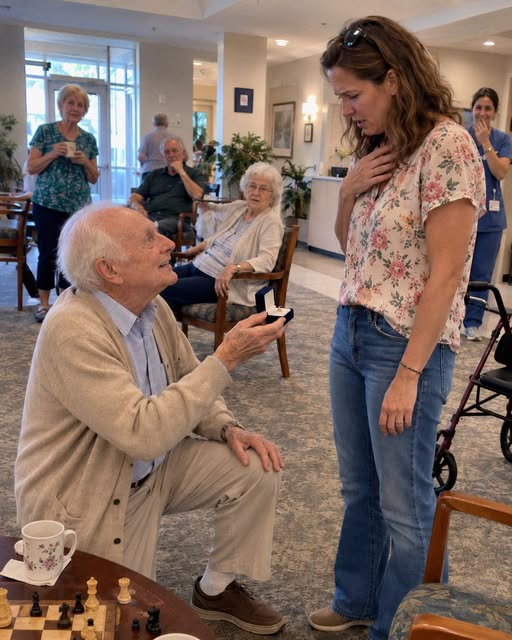
After the second game, Albert placed both hands on the arms of his chair and slowly stood. A nurse nearby immediately moved toward him, but he lifted one hand to indicate that he was fine.
He reached into his jacket pocket and removed a small velvet box.
Before I could ask what he was doing, Albert carefully lowered himself onto one knee.
Every conversation in the room stopped.
The residents, visitors, and staff members all turned toward us. Someone near the window gasped.
Albert looked directly into my eyes.
“Will you marry me?” he asked.
I could not move.
At first, I assumed it was a continuation of our joke from the previous week. I waited for him to smile or deliver a clever final line.
He did neither.
“Albert,” I whispered, “please let me help you stand.”
I reached for his arm, but he gently shook his head.
“There is a reason I chose you,” he said. “Once you understand it, you’ll know that this is not a joke.”
The nurse helped him back into his chair, and I sat across from him with my heart pounding. The room remained silent until Albert asked everyone to give us a few minutes of privacy.
We moved to a quiet corner of the sunroom.
Albert did not open the velvet box. Instead, he returned it to his pocket and removed a carefully folded letter.
“This was written by Margaret,” he said.
I looked at him in surprise.
“Your wife?”
“My wife and best friend.”
The letter was dated eight years earlier, several months before Margaret died. Albert handed it to me, but my hands remained in my lap.
“I don’t think I should read something private.”
“She wrote part of it for whoever might be sitting where you are now.”
Albert unfolded the letter and read a passage aloud.
“My dearest Albert,” Margaret had written, “if life offers you another person who makes you laugh, listens to your stories, and allows you to remember me without jealousy, do not reject that gift because you are afraid of what other people will think. Loving someone new would not erase the life we shared. It would prove that our life together taught you how valuable companionship can be.”
Albert stopped reading.
For several moments, neither of us spoke.
“Margaret knew me better than anyone,” he continued. “She knew that after she was gone, I would turn grief into a permanent address. She was right for a long time.”
“Why me?” I asked.
“Because you never treated me as an old man who needed to be entertained. You treated me as Albert.”
His answer was simple, but it affected me deeply.
“You challenge me,” he continued. “You laugh when my jokes are actually funny and tell me when they aren’t. You remember how I take my tea. Most importantly, you let me talk about Margaret without acting as though my love for her leaves no room for anyone else.”
He looked toward the windows.
“You speak about Michael the same way. You don’t want to replace him, and I would never ask you to. I don’t want to replace Margaret either.”
“Albert, my husband died only a few months ago.”
“I know.”
“I’m not ready to marry anyone.”
“I know that too.”
I stared at him.
“Then why did you ask?”
He smiled.
“Because at eighty-nine, I no longer believe in hiding an honest feeling until the timing becomes perfect. Perfect timing is often another name for never.”
Albert explained that he was not asking me to answer immediately. He did not expect me to move into his room, combine our finances, or make a decision while I was still grieving.
He simply wanted me to know that his proposal was sincere.
I looked around the sunroom. Although everyone was pretending not to watch us, they were doing a poor job of it.
“You proposed in front of the entire building,” I said.
“In my defense, I have always had a theatrical side.”
That finally made me laugh.
I reached across the table and took his hand.
“My answer today is no,” I said gently. “I’m not ready.”
Albert nodded.
“Then no is the answer, and I respect it.”
“But I would like to continue our Wednesday games.”
“I was hoping you would say that.”
“Without any more public proposals.”
“I can promise to consider that request.”
Life did not suddenly become a romantic story after that afternoon. I returned home alone, placed Michael’s photograph beside my bed, and cried.
Albert’s proposal had awakened emotions I was not prepared to confront. Part of me felt guilty for laughing with another man. Another part felt frightened by the possibility that I could care about someone again.
The following Wednesday, I almost stayed home.
Then I imagined Albert waiting beside the chessboard, uncertain whether his honesty had frightened me away.
I went.
He greeted me normally, poured my tea, and did not mention marriage. We played three games. He won two.
Our friendship continued, but something had changed. We began having lunch outside the retirement community. I met his daughter, Susan, who approached our relationship with kindness and appropriate caution.
“You make Dad happy,” she told me. “That matters to us. We also want both of you to take your time.”
My own children were more surprised.
Their first reaction was concern. They worried that I was acting out of grief or that Albert’s age would bring another painful loss into my life.
Those concerns were reasonable, so I listened. I explained that I had not agreed to marry him and that our relationship was developing slowly.
Over time, they saw what I saw.
Albert did not pressure me. He did not ask me to forget Michael, abandon my family, or make financial commitments. He encouraged me to attend grief counseling and reconnect with friends I had avoided after my husband’s death.
He was not trying to rescue me.
He was simply willing to walk beside me.
Six months after the proposal, Albert and I visited a botanical garden. We sat beneath a tree while he told me about the flowers Margaret used to grow.
Instead of feeling jealous or uncomfortable, I felt grateful that he trusted me with those memories.
I told him about the final morning I spent with Michael—the ordinary breakfast, the unfinished conversation, and the plans we assumed we had time to complete.
Albert took my hand.
“We were both lucky to have been loved so well,” he said.
That was when I understood what he had been trying to tell me.
Our previous marriages were not obstacles standing between us. They were part of what allowed us to understand each other.
Nearly a year after Albert first lowered himself onto one knee, I brought him tea in the sunroom. This time, I wore a blue dress and carried the same velvet box he had shown me.
I placed it beside the chessboard.
Albert stared at it.
“Should I be concerned?” he asked.
“I’ve reconsidered your proposal.”
He became completely still.
“I’m not looking for someone to replace Michael,” I said. “And I know you aren’t looking for someone to replace Margaret. But I don’t want fear to decide the rest of my life.”
Albert’s eyes filled with tears.
“Is that a yes?”
“It’s a yes, provided you agree never to lower yourself onto one knee again. I don’t think the nurses could survive another performance.”
He laughed and reached for my hand.
We married in the retirement community’s garden three months later. It was a small ceremony attended by our families, residents, staff members, and friends.
A photograph of Margaret rested beside Albert’s family, and a photograph of Michael stood beside mine. Their presence did not make the ceremony sad. It made it honest.
Albert and I kept our finances separate and worked with our families and legal advisers to make sure every decision was transparent. Neither of us needed ownership of the other’s past. We wanted companionship in the present.
Marriage at our ages did not look like the beginning of a conventional life together. We were not planning careers, buying our first home, or raising children.
We were choosing morning conversations, afternoon walks, chess games, shared meals, and someone to call when the night felt too quiet.
Albert had not chosen me because he was confused, lonely, or searching for someone to care for him.
He chose me because I saw the person beyond his age.
And eventually, I chose him because he saw the person beneath my grief.
His proposal did not erase the love we had each experienced before. It reminded us that the heart does not honor one relationship by remaining permanently closed after loss.
Sometimes it honors the past by carrying what it learned into a new beginning.