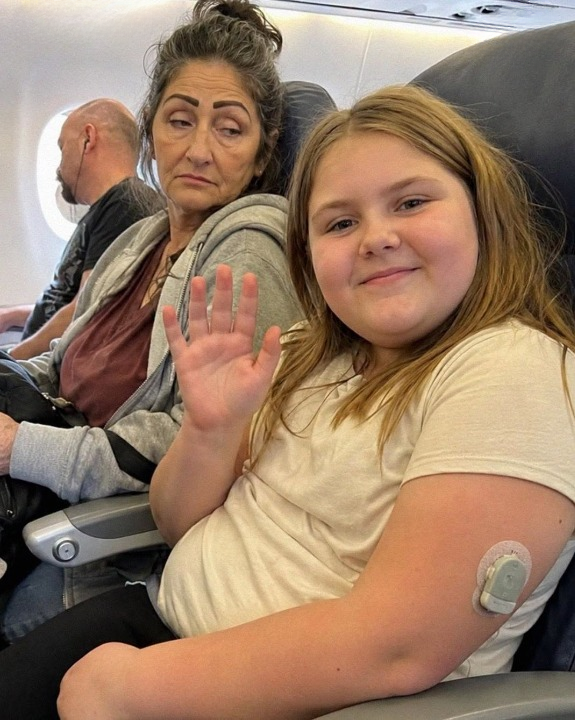
The woman sitting beside my nine-year-old daughter looked her up and down before saying something no child should ever have to hear.
“Your mother should have bought you two tickets.”
My daughter, Allison, had barely settled into her seat. She wasn’t blocking the aisle or interfering with anyone else’s space. She was simply fastening her seat belt when a complete stranger decided that her body was an acceptable subject for public criticism.
Allison was diagnosed with type 1 diabetes when she was very young. By the age of nine, she was already wearing a continuous glucose monitor and understood more about blood sugar management than many adults.
She knew how to recognize the warning signs of low blood sugar. She understood why she needed to carry fast-acting carbohydrates, and she had learned to remain calm when her monitor sounded an alert.
She was brave, responsible, and thoughtful.
She was also heavier than some other children her age. Until recently, she hadn’t paid much attention to the difference. Then a few careless comments at school made her increasingly self-conscious.
She started avoiding photographs. She wore oversized sweaters even in warm weather and sometimes asked whether a particular outfit made her look “too big.”
Each question broke my heart.
I tried to remind her that her value was not determined by a number on a scale or by someone else’s opinion. I also worked closely with her healthcare team to make sure her medical care was appropriate for her individual needs.
But one cruel remark can sometimes be louder than a hundred loving reassurances.
We were flying home after spending a week with my parents. By the time I booked our return tickets, the flight was nearly full, and I couldn’t find two seats together.
Allison was assigned an aisle seat, while I was seated directly across from her in the opposite aisle seat. We weren’t technically in the same row, but I could see her, speak to her, and reach her easily.
The arrangement wasn’t ideal, but I believed we could manage it for the relatively short flight.
A quiet man sat by the window in Allison’s row. The middle seat was occupied by a thin, well-dressed woman who appeared irritated before my daughter had even finished sitting down.
She sighed when Allison placed her small backpack beneath the seat. She complained when Allison briefly stood to adjust her jacket. Then she stared at the armrest as though my child’s presence had created an unbearable problem.
While the final passengers were still boarding, the woman leaned toward Allison.
“Your mother should have bought you two tickets,” she said. “You’re taking up more than one seat.”
Allison froze.
She didn’t argue or ask the woman to stop. She simply nodded, lowered her head, and picked up her phone.
I watched her switch repeatedly between the same two menu screens without opening anything.
That was something Allison did when she was trying not to cry.
I leaned across the aisle.
“Excuse me,” I said firmly. “Please do not speak to my daughter that way.”
The woman looked at me but offered no apology.
“I’m only being honest,” she replied.
“Honesty is not an excuse to insult a child.”
She turned away with an exaggerated sigh, as though I were the one creating a disturbance.
I wanted to ask a flight attendant for help immediately, but the aisle was still crowded with passengers storing luggage. Crew members were helping several people find seats, and the doors were about to close.
Before takeoff, I handed Allison a small carton of apple juice. I reminded her to drink it if her glucose monitor showed that her blood sugar was falling. We had followed the same routine many times.
A continuous glucose monitor is helpful, but it is not something a child should be expected to manage without adult support in an unfamiliar setting. I wanted Allison to have what she needed within easy reach.
The woman watched our exchange.
Then she looked at the juice and shook her head.
“Perhaps you should stop giving her sugary drinks,” she said loudly. “That might solve the problem.”
For a moment, I honestly thought I had misunderstood her.
“She has type 1 diabetes,” I explained. “The juice is there in case her blood sugar drops.”
The woman rolled her eyes.
“There is always an excuse,” she said. “Children spend all day staring at screens and consuming sugar, and then parents act surprised when they gain weight.”
Several nearby passengers turned toward us.
I could feel my face becoming warm, but I forced myself to stay calm. Allison was watching me, and I didn’t want the confrontation to frighten her.
“Type 1 diabetes is an autoimmune condition,” I said. “It is not caused by a child eating sugar. Juice can be used as a fast source of carbohydrates when someone is experiencing low blood sugar.”
The woman ignored the explanation.
“When I was younger, people had discipline,” she continued. “They exercised, ate vegetables, and didn’t expect everyone else to pretend unhealthy choices were acceptable.”
Allison’s face turned red. Tears gathered in her eyes.
The woman wasn’t offering health advice. She knew nothing about my daughter’s medical history, nutrition, activity level, or treatment plan. She was using health as an excuse to humiliate a child in front of strangers.
I reached for my seat-belt buckle, intending to call a flight attendant.
Before I could stand, a crew member approached.
She carried a folded napkin in one hand.
“Ma’am,” she said to the woman beside Allison, “another passenger asked me to give this to you.”
The woman opened it.
I couldn’t see the message from where I was sitting, but I saw her expression change. The confidence disappeared from her face as she read.
A moment later, she folded the napkin and placed it on her tray table.
“What does it say?” I asked the flight attendant.
The attendant glanced at the passenger seated behind Allison before answering.
“It says, ‘I am a pediatric nurse. Apple juice is commonly used to help treat low blood sugar. Please stop giving dangerous medical opinions and allow this child to travel in peace.’”
The woman’s face became bright red.
She turned around and stared at the passenger behind her. A woman wearing blue-framed glasses met her gaze without flinching.
“I heard everything,” the nurse said calmly. “That child has handled this situation with more maturity than you have.”
A few passengers nodded in agreement.
The woman beside Allison looked forward again.
“I was only expressing concern,” she muttered.
“No,” the flight attendant replied. “You were making repeated personal comments about another passenger’s body and medical condition after being asked to stop.”
Her voice was professional rather than angry, but it carried enough authority to silence the row.
The attendant then knelt beside Allison.
“Are you comfortable remaining in this seat?” she asked gently.
Allison shook her head.
The aircraft was full, so I assumed moving her would be impossible. However, the man in the window seat across from me had heard the entire exchange.
“I’ll switch,” he offered. “The girl can sit with her mother.”
The passenger beside me also volunteered to move. With help from the flight attendant, we rearranged three seats so Allison could sit beside me.
The process took only a couple of minutes.
No one shouted. No one made a dramatic announcement. The crew simply solved the problem with calm professionalism and the cooperation of kind passengers.
Once Allison was seated next to me, she leaned against my shoulder.
“Did I do something wrong?” she whispered.
Those words hurt more than anything the stranger had said.
“No,” I answered. “You did absolutely nothing wrong.”
“But she said I shouldn’t have had the juice.”
“The juice is part of your emergency plan. We listen to your medical team, not to strangers who do not understand your condition.”
I explained that people sometimes make judgments based on appearance because they do not know the full story. Their confidence does not make their assumptions accurate.
The flight attendant returned before takeoff. She quietly informed the woman that further harassment of any passenger would be documented and addressed according to the airline’s procedures.
The woman looked down at her hands.
For the first time, she seemed to understand that her words had consequences.
A few minutes into the flight, she attempted to pass another folded napkin across the aisle. I was reluctant to accept it, but Allison looked curious, so I opened it.
The message read:
“I am sorry. I should not have commented on your daughter’s body or medical condition. I was wrong.”
It was not a perfect apology. It did not erase what Allison had heard, and it could not restore the confidence damaged by those remarks.
Still, I showed it to my daughter.
“She says she was wrong,” I told her.
Allison read the note twice.
Then she folded it and placed it in the seat pocket.
“I know she was wrong,” she said quietly.
There was something powerful in hearing her say those words.
During the flight, the pediatric nurse introduced herself as Naomi. She didn’t offer medical treatment or interfere with Allison’s care. She simply spoke to her like a normal child.
They talked about books, school, and the small stuffed penguin attached to Allison’s backpack. That ordinary conversation helped restore the sense of safety the earlier remarks had taken away.
Later, Allison’s glucose monitor sounded an alert. Her blood sugar was beginning to fall.
She drank the apple juice exactly as instructed by her healthcare team. I monitored her closely, and the reading gradually returned to an appropriate range.
The woman across the aisle noticed what was happening. She didn’t say anything. She simply lowered her eyes.
Perhaps that was the moment she finally understood that the juice had never been a careless treat. It was something my daughter carried for a legitimate medical reason.
But even if there had been no medical explanation, she still would not have had the right to shame a child.
A person’s body does not become public property simply because it is visible. No stranger is entitled to make insulting comments, offer an unsolicited diagnosis, or assume they understand someone’s health by looking at them.
When we landed, Allison thanked the passengers who had switched seats and gave Naomi a quick hug.
As we walked through the airport, she reached for my hand.
“Mom,” she said, “next time someone says something like that, can I tell them to stop?”
“Absolutely.”
“What should I say?”
I thought for a moment.
“You can say, ‘Please don’t comment on my body.’ Then you can ask a trusted adult for help.”
She practiced the sentence under her breath.
By the time we reached baggage claim, she was standing a little straighter.
That flight reminded me how easily adults can affect a child’s self-image. Comments made in seconds may remain in a young person’s memory for years. Children deserve guidance from parents and qualified healthcare professionals—not public judgment from strangers.
It also reminded me that kindness does not always require a grand gesture.
One passenger offered a seat. Another wrote a short note. A flight attendant calmly enforced a boundary. Together, they transformed an upsetting situation into a lesson my daughter would remember for a different reason.
She learned that cruel words can hurt, but they do not define her.
She also learned that she has the right to speak up, ask for help, and expect to be treated with dignity—on an airplane and everywhere else.