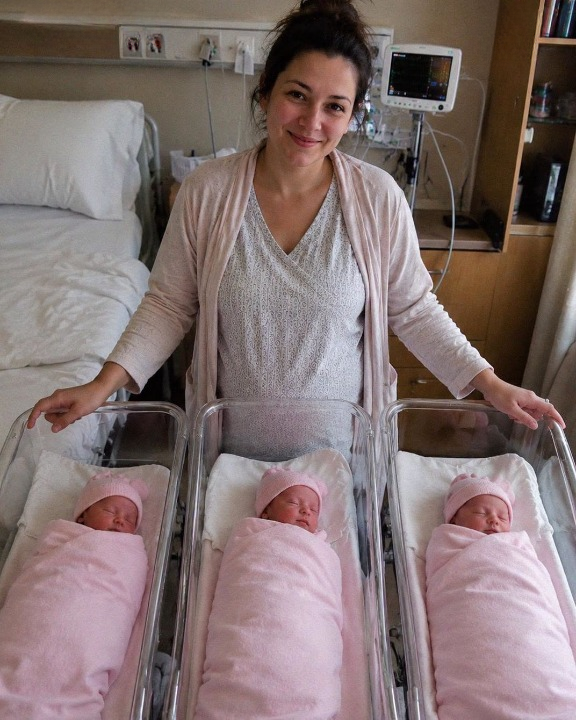
For as long as I could remember, I dreamed of becoming a mother.
My husband, Walter, shared that dream. From the earliest days of our marriage, we imagined family dinners, bedtime stories, birthday celebrations, and a home filled with the laughter of children. We talked about those moments so often that they felt almost real long before they happened.
Our journey to parenthood, however, wasn’t as simple as we had hoped.
Years passed with more questions than answers. Every month brought fresh optimism followed by quiet disappointment. Even so, we never stopped believing that one day our family would grow.
Then, during a routine appointment, our doctor smiled before speaking.
“There’s something special I need to show you.”
Moments later, the ultrasound screen revealed not one heartbeat.
Not two.
Three.
We looked at each other in complete disbelief before tears filled our eyes.
Triplets.
Neither of us could speak.
Walter squeezed my hand tightly and whispered, “Our family just became much bigger than we imagined.”
It felt like every hopeful conversation we’d shared over the years had suddenly become reality.
The months that followed were exciting but demanding.
Carrying three babies required constant medical monitoring.
Every appointment seemed to introduce another precaution.
My doctor encouraged plenty of rest, careful nutrition, and frequent checkups to support both my health and the babies’ development.
As my pregnancy progressed, everyday tasks became increasingly difficult.
Simple activities like walking across the house or climbing stairs left me exhausted.
By the beginning of my third trimester, my medical team recommended strict bed rest.
Eventually, I spent several weeks in the hospital so specialists could closely monitor the pregnancy.
Although it wasn’t easy being away from home, I understood the importance of every extra day the babies remained safely where they were.
Walter rarely missed a visit.
He brought fresh flowers almost every afternoon.
Sometimes he arrived carrying my favorite books.
Other days he simply sat beside me, held my hand, and talked about the future.
“We’re going to need a bigger dining table,” he’d joke.
“We’re definitely buying a bigger stroller.”
He even filled a notebook with possible baby names.
Watching his excitement made every difficult day feel worthwhile.
Whenever I became anxious, he reminded me that we were building the family we’d always wanted.
Finally, the long-awaited day arrived.
After many careful preparations, our three beautiful babies entered the world.
Hearing their tiny cries for the first time remains one of the happiest memories of my life.
The hospital room suddenly filled with doctors, nurses, smiling faces, and endless congratulations.
Although the babies arrived a little earlier than expected, everyone assured us they were doing remarkably well.
The first week became a blur.
Feedings.
Diaper changes.
Medical checkups.
Learning how to care for three newborns at once.
Sleep became almost impossible.
Yet every time I looked into those tiny faces, every challenge felt worthwhile.
Life had changed forever—in the best possible way.
One detail, however, slowly began to concern me.
Walter’s visits became shorter.
Then less frequent.
Eventually, nearly two days passed without seeing him.
I tried not to worry.
Preparing a house for three newborns was no small task.
Perhaps he was assembling cribs.
Installing car seats.
Buying supplies.
Organizing everything before we returned home.
Those explanations made sense.
So I pushed my concerns aside.
A week after giving birth, the doctors finally approved my discharge.
I felt excited.
I imagined Walter waiting at the hospital entrance with flowers.
Maybe balloons.
Perhaps even a camera ready to capture our first family photo outside the hospital.
When he didn’t answer my morning phone call, I assumed he was driving.
Rather than waiting longer, I decided to surprise him instead.
I arranged a taxi.
The nurses carefully helped secure the babies into their car seats.
Several staff members came outside to wish us well.
As the taxi drove toward home, I smiled almost the entire way.
I couldn’t wait to begin this new chapter.
The taxi stopped in front of our house.
Something immediately felt wrong.
Boxes covered the front porch.
Suitcases.
Storage bins.
Several baby items.
Even my favorite rocking chair.
The driver helped me unload the babies while I stared in confusion.
For a moment, I wondered whether renovations had begun unexpectedly.
Then my eyes moved toward the front door.
The lock looked different.
Brand new.
I carefully tried my key.
It didn’t fit.
My heartbeat quickened.
Before I could knock, the door slowly opened.
Walter stepped outside.
His expression remained completely unreadable.
No smile.
No excitement.
Nothing.
“I finally did what I’ve wanted to do for a long time,” he said quietly.
My mind struggled to understand the words.
“What are you talking about?”
“You and the babies aren’t coming back into this house.”
The sentence echoed inside my head.
I looked down at the sleeping infants.
Then back at him.
Surely there had been some misunderstanding.
“Walter…”
He interrupted.
“I’ve made my decision.”
I searched his face for some sign that this was a terrible joke.
There wasn’t one.
I didn’t argue.
I didn’t raise my voice.
Instead, I picked up my phone with trembling hands.
There was only one number I needed.
Twenty minutes later, my parents arrived.
The moment my mother stepped out of the car, she rushed toward me.
She didn’t ask questions immediately.
She simply wrapped one arm around me while helping with the babies.
My father quietly loaded every box into their vehicle.
Walter remained standing near the front door without saying another word.
The drive to my parents’ house felt incredibly long.
That evening, after the babies finally fell asleep, I allowed myself to cry.
Everything I’d imagined about bringing my children home had disappeared in a single afternoon.
Instead of celebrating together, I was trying to understand what had happened.
My parents never pressured me to explain immediately.
They simply reminded me that I wasn’t facing the future alone.
The next morning, after a few hours of restless sleep, I woke feeling different.
Still heartbroken.
Still confused.
But no longer frozen.
There were practical decisions to make.
Three babies depended on me.
I couldn’t spend every moment asking why.
I needed to focus on what came next.
I organized important documents.
Collected medical paperwork.
Updated temporary contact information with the pediatrician.
Spoke with several trusted family members.
Then I reached out to a professional who could explain my options regarding housing, finances, and family responsibilities.
The conversation wasn’t about revenge.
It was about understanding my rights and protecting my children’s future.
Knowledge replaced uncertainty.
Preparation replaced panic.
For the first time since leaving the hospital, I felt a small sense of control returning.
About two hours later, my parents’ doorbell rang.
My father looked through the window.
“It’s Walter.”
When the door opened, I barely recognized him.
The confidence I’d seen the previous day had completely disappeared.
He looked exhausted.
His face was pale.
His voice shook.
“Can we please talk?”
I stepped onto the porch while my mother stayed inside with the babies.
Walter looked at me for several long seconds before speaking.
“I made a terrible mistake.”
I remained silent.
“I thought I could handle everything.”
He admitted that in the weeks leading up to the births, he had become overwhelmed by financial worries, sleepless nights, and the sudden reality of raising three children at once.
Instead of asking for help, he allowed fear to grow.
The pressure affected his judgment until he made a decision he immediately regretted.
“I convinced myself everyone would be better off without me,” he confessed.
“But the moment I saw the house empty yesterday, I realized I’d destroyed the very thing I’d spent years hoping for.”
He explained that after we left, several close relatives learned what had happened.
Rather than criticizing him, they encouraged him to seek professional counseling and face the situation honestly.
Their conversations forced him to recognize how deeply his actions had affected our family.
“I’m asking for a chance to make things right.”
I listened carefully.
His apology sounded sincere.
But apologies alone couldn’t erase what had happened.
Trust, once broken, requires time to rebuild.
“I can’t pretend yesterday never happened,” I told him.
“I understand.”
“Our children deserve stability.”
“I know.”
“If we ever move forward, it will be slowly.”
He nodded.
“I’ll do whatever it takes.”
The months that followed weren’t easy.
Instead of rushing back into old routines, we chose a different path.
Family counseling.
Honest conversations.
Shared responsibilities.
Learning healthier ways to handle stress and fear.
Walter worked hard to rebuild the trust he had damaged.
He became actively involved in caring for the babies, attended every counseling session, and accepted responsibility for his choices without making excuses.
Most importantly, he learned that asking for help is a sign of strength—not weakness.
As for me, I discovered something equally important.
Even during the hardest moments, I was stronger than I had ever realized.
The experience reminded me that resilience often appears when we least expect it.
Looking back now, I still remember the shock of seeing those boxes on the porch.
But I also remember the people who stood beside me—my parents, friends, and professionals who reminded me that no one should face life’s biggest challenges alone.
Our story didn’t unfold the way we imagined when we first dreamed about becoming parents.
Life rarely follows a perfect script.
But sometimes the greatest lesson isn’t about avoiding hardship.
It’s about discovering the strength, wisdom, and support that help us move forward when everything seems uncertain.
And that, more than anything else, became the foundation on which our growing family learned to build a better future together.