My name is Robert. I am 73 years old, and yesterday, I said goodbye to the person who had been my closest friend for more than six decades.
His name was Daniel.
We had known each other since we were seven years old. Back then, life was simple. Our greatest worries were unfinished homework, scraped knees, and whether we would have enough time to play outside before our parents called us home.
There were three of us growing up: Daniel, Michael, and me.
We were practically inseparable.
We learned to ride bicycles together, explored the neighborhood, shared our first embarrassing experiences, and celebrated every little victory as though it were something extraordinary. As we grew older, our friendship grew stronger.
We stood beside one another at our weddings. We celebrated the births of our children and later welcomed our grandchildren into the world. We supported each other through difficult marriages, financial struggles, family disagreements, and the painful moments that life inevitably brings.
When our parents passed away, we were there for one another.
When one of us experienced heartbreak, the other two showed up.
We didn’t always agree, and there were times when life kept us busy for weeks. But somehow, we always found our way back to each other.
We never needed special occasions to stay connected.
Sometimes, a simple phone call was enough.
Other times, we would spend an entire afternoon sitting together, talking about absolutely nothing important.
Those ordinary moments eventually became some of the most valuable memories of our lives.
But there was one moment that changed everything.
Thirty-two years ago, when I was just 41, I experienced a terrible accident that permanently took away my eyesight.
I still remember waking up in the hospital and slowly realizing that the darkness around me wasn’t temporary.
The doctors explained my condition, but their words seemed distant. I couldn’t imagine living the rest of my life without seeing my children’s faces, watching the sunrise, or recognizing the people I loved.
For months, I struggled to accept what had happened.
I stopped answering phone calls. I avoided visitors and gradually withdrew from the people around me.
I felt as though the world had continued moving forward while my own life had suddenly stopped.
I didn’t know how to move on.
But Daniel and Michael refused to let me face that difficult chapter alone.
They never treated me as though I had become helpless. Instead, they reminded me that I was still the same Robert they had known since childhood.
They visited regularly, helped me adjust to everyday activities, and encouraged me to regain my independence.
They took me fishing, even though I could no longer watch the water. They drove me to family gatherings and made sure I remained part of every celebration.
Whenever we went somewhere beautiful, they described everything around me.
Daniel had a special way of explaining things.
He would describe the sky, the trees, and the changing colors of the evening as though he were painting a picture with words.
“Robert, the sunset tonight is incredible,” he would say. “Imagine the most beautiful painting you’ve ever seen. Now imagine something even better.”
I couldn’t see what he was describing, but somehow, I could feel his excitement.
And that was enough.
One tradition remained unchanged throughout those 32 years.
Every Sunday afternoon, the three of us gathered on Daniel’s porch.
Sometimes we discussed politics. Sometimes we talked about our families. Occasionally, we simply sat quietly, enjoying each other’s company.
It didn’t matter what we talked about.
What mattered was that we were together.
Those Sunday afternoons became the anchor of my life.
As the years passed, our hair turned gray, our steps became slower, and our conversations increasingly included stories about the past.
We often laughed about the foolish things we had done as children.
Daniel especially loved reminding us about the time Michael accidentally rode his bicycle into a neighbor’s flower garden.
Michael always insisted it wasn’t his fault.
We could argue about that story for hours.
We thought we had many more Sundays ahead of us.
Unfortunately, life doesn’t always follow the plans we make.
A few months ago, Daniel’s health began to deteriorate.
At first, he dismissed his symptoms as ordinary signs of aging. He told us he was simply getting tired more easily.
But eventually, his condition became more serious.
Our Sunday gatherings became shorter. Sometimes, Daniel was too exhausted to sit outside, so we visited him indoors instead.
Even then, he tried to maintain his usual sense of humor.
He would joke that we were becoming an old-fashioned club with increasingly complicated health problems.
We laughed, although none of us wanted to acknowledge how much things were changing.
During one of my final visits, Daniel held my hand and said something I didn’t fully understand at the time.
“Robert, promise me you’ll keep coming around, even when I’m not here.”
I smiled and told him he was talking nonsense.
He laughed softly.
I didn’t realize that he was trying to prepare me for goodbye.
Yesterday, Michael and I stood together at Daniel’s funeral.
We were both 73 years old now.
The cemetery was quiet, and a gentle breeze moved through the trees. Family members, neighbors, and longtime friends had gathered to pay their respects.
I could hear people speaking softly around me, but my thoughts were somewhere else.
I kept remembering the little boy I had met in second grade.
I remembered the teenager who shared his first adventures with us.
I remembered the young man who stood beside me on my wedding day.
And I remembered the friend who had helped me rebuild my life when I thought everything was lost.
It was difficult to accept that I would never hear his familiar voice again.
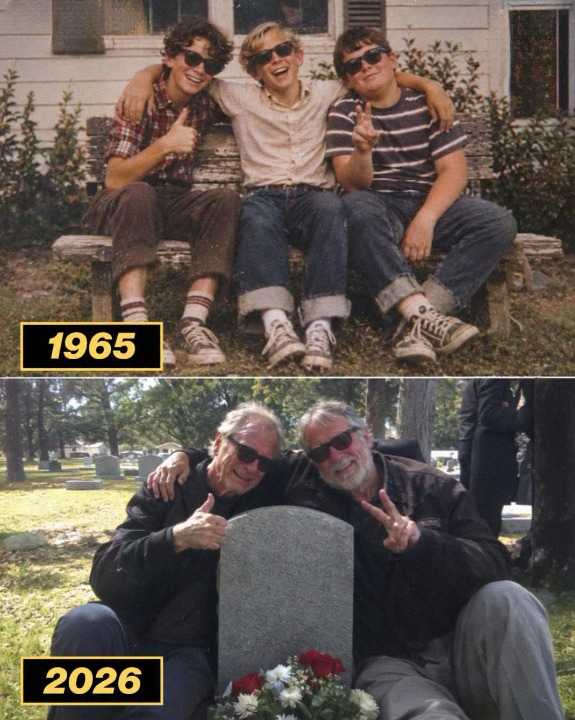
When it was time for Michael and me to speak, he reached into his jacket and removed an old photograph.
He explained that it showed the three of us sitting together on a wooden bench when we were twelve years old.
Daniel was sitting in the middle.
Michael stood on one side, and I stood on the other.
It was one of our favorite childhood photographs.
Michael paused for a moment before speaking.
“Daniel had one final wish,” he told everyone, his voice trembling. “He wanted the three of us to recreate this photograph someday. We kept putting it off because we thought there would always be another opportunity.”
He stopped speaking.
I could hear him trying to hold back his tears.
“So today, I think we should finally do it.”
We decided to take the photograph beside Daniel’s grave.
Michael stood on one side of the headstone, and I stood on the other.
We placed our arms around the cold stone, leaving an empty space between us where Daniel would have stood.
Someone took the photograph.
I couldn’t see the image, but I could feel Michael trembling beside me.
For a few seconds, neither of us spoke.
We simply stood there, holding on to the memory of the friend who had always been between us.
Then something unexpected happened.
Daniel’s wife, Margaret, approached me.
I recognized her footsteps and greeted her quietly.
She gently placed something into my hands.
It was a small wooden box.
I ran my fingers over its smooth surface. It felt carefully made, with a little metal clasp on the front.
Margaret leaned closer and whispered:
“Daniel wanted you to have this today. He spent 32 years working on it. He never told you because he wanted it to be a surprise.”
I froze.
Thirty-two years?
I couldn’t understand what she meant.
Why would Daniel spend more than three decades preparing something for me?
I carefully opened the clasp.
Inside, my fingers touched several small objects and what felt like a thick collection of papers.
Margaret explained that Daniel had written instructions for me.
“He told me that you should take your time,” she said. “He wanted you to understand everything before you reached the end.”
My hands began to shake.
Michael moved closer and offered to help me examine the contents.
The first thing we discovered was a small envelope with my name written across it.
The handwriting was unmistakably Daniel’s.
I asked Michael to read the letter aloud.
It began with a sentence that immediately brought tears to my eyes.
“Dear Robert, if you’re holding this box, it means I’ve finally run out of Sundays with you.”
Michael stopped reading.
I lowered my head.
For a moment, the entire cemetery seemed to disappear from my thoughts.
The letter continued.
“Thirty-two years ago, when you lost your eyesight, I watched you struggle with something I couldn’t begin to understand. I wanted to help you, but I knew there were things I couldn’t fix. I couldn’t give you back what you had lost, and I couldn’t make the difficult days disappear.”
“However, I made myself a promise. If I couldn’t change what happened, I would find a way to give you something meaningful that would remind you how much your friendship meant to me.”
Michael paused again.
I held the letter tightly.
Daniel explained that the wooden box was something he had been working on since the year of my accident.
Inside were carefully organized memories from our lives.
There were handwritten accounts of our childhood adventures, descriptions of important family celebrations, copies of old letters, and notes about the people and places that had shaped our friendship.
He had even included messages from people who had known us throughout the years.
Some were from former classmates.
Others were from neighbors, relatives, and friends who had witnessed our journey together.
Each memory had been written down with care.
Daniel knew that I couldn’t look through photographs in the same way he could, so he had decided to preserve our history through words.
He wanted me to experience our memories through stories.
But there was more.
At the bottom of the box, Michael discovered another envelope.
This one contained a message addressed to both of us.
Daniel had written:
“To Michael and Robert, I hope you never forget that the greatest part of my life wasn’t measured by the places I visited, the money I earned, or the things I owned. It was measured by the people who stayed beside me.”
“People often spend their lives searching for extraordinary happiness. But when I look back, I realize that my happiest moments were ordinary Sundays, shared jokes, long conversations, and knowing that I could always count on my two best friends.”
“Thank you for growing old with me. Thank you for allowing me to be part of your lives. And most importantly, thank you for never making me feel alone.”
Michael couldn’t continue reading.
I reached over and placed my hand on his shoulder.
We stood there for a long time.
There was no need for either of us to say anything.
We understood.
Daniel had spent 32 years creating something that money could never replace.
He had given us a way to remember the life we had shared.
And perhaps that was his greatest gift.
Before leaving the cemetery, Margaret handed me one final envelope.
She explained that Daniel had specifically asked her to give it to me after I had opened the box.
Inside was a short handwritten message.
It said:
“Robert, I know you sometimes wonder what the world looks like now. I wish you could see the things I saw during all those years. But I hope you understand something. Your blindness never made our friendship smaller. You were always the same friend, the same person, and the same boy I met in second grade.”
Then came the final sentence:
“Don’t spend the rest of your life mourning the Sundays we’ve lost. Spend them remembering how lucky we were to have so many.”
I couldn’t hold back my tears.
Michael wrapped his arms around me, and for the first time that afternoon, I allowed myself to cry without trying to hide it.
We had lost someone irreplaceable.
But Daniel had left us something beautiful.
That evening, I placed the wooden box beside my favorite chair.
I asked Michael to visit the following Sunday.
He immediately understood why.
We would sit together, just as we had done for decades.
We would open the letters, read the memories, laugh about our childhood mistakes, and talk about the friend who had brought us together.
Perhaps we would even recreate that old photograph one more time.
I am 73 years old.
I have experienced more happiness, sadness, and change than I ever imagined possible when I was a little boy.
I have learned that life doesn’t always give us the time we expect.
Sometimes, the people who mean the most to us leave before we are ready.
But I have also learned something else.
True friendship isn’t measured by how often you see someone or how many years you spend together. It’s measured by the love, loyalty, and memories that remain long after someone is gone.
Daniel spent 32 years preparing a gift for me.
But the truth is, he had been giving me that gift every Sunday for most of our lives.
He gave me his time.
He gave me his friendship.
And he reminded me that even when life becomes difficult, we don’t have to face it alone.
I can no longer see the world with my eyes, but I can still remember the faces of the people who made my life beautiful.
And I will carry Daniel’s friendship with me for as long as I live.
Because some friendships don’t end at a funeral.
They simply become memories that we carry forward.
And sometimes, the greatest gift a person can leave behind isn’t something wrapped in a box. It’s the reminder that we were loved, remembered, and never truly alone.