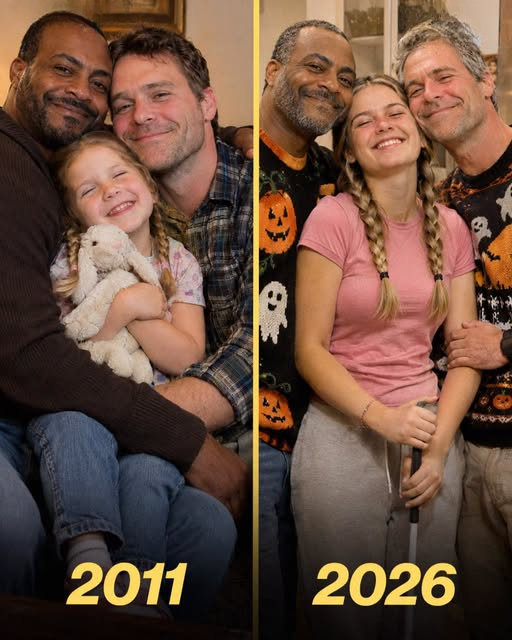
For years, my husband and I had dreamed of having a family of our own.
We knew our journey would not look like everyone else’s. We had already experienced rejection from people who should have supported us, and we had learned that sometimes love meant standing together even when the rest of the world disagreed.
But nothing prepared us for what happened when we decided to adopt a little girl named Willa.
She was four years old, blind since birth, and had already experienced more uncertainty than any child should have to endure.
We didn’t see her disability as a reason to turn away.
We saw a little girl who needed a safe home, patient parents, and people who would love her without conditions.
Twelve years later, when a famous man appeared at our front door claiming to be her biological father, we discovered that the biggest challenge facing our family had not been behind us after all.
He wanted Willa to leave with him.
And he was prepared to offer almost anything to make it happen.
But there was something he hadn’t considered.
Willa was no longer the frightened four-year-old who had once held tightly to my sleeve.
She was a sixteen-year-old girl with her own thoughts, feelings, and understanding of what family meant.
And this time, the decision would not be made without her.
The Little Girl Everyone Seemed to Reject
My husband, Reid, and I had been together for many years before we decided to adopt.
Our relationship had not always been accepted by our families.
My father gradually stopped inviting me to family celebrations. Reid’s mother continued introducing me as his friend, even after we had married.
Those experiences hurt, but they also taught us something important.
A family wasn’t defined only by tradition or other people’s approval.
It was built through commitment, kindness, and the decision to stand beside one another.
We wanted to share that kind of love with a child.
When our adoption caseworker first told us about Willa, she explained that the little girl had been blind since birth and had experienced several foster placements.
Many prospective families had decided not to proceed after learning about her additional needs.
We didn’t want to make a decision based on fear.
So we arranged to meet her.
During our first visit, Willa sat quietly on a sofa with a stuffed rabbit resting in her lap.
She repeatedly rubbed one of its worn ears between her fingers.
I sat beside her and introduced myself.
She didn’t say much at first.
After a while, I stood up to get a glass of water.
Suddenly, I felt her small hand reaching for my sleeve.
“Are you leaving?”
I turned around.
“No, sweetheart. I’m just getting some water.”
She didn’t release my sleeve until I sat down again.
That tiny moment stayed with me.
She wasn’t asking for a toy or a special treat.
She simply wanted to know whether someone was going to disappear again.
When Reid and I left that afternoon, we already knew what we wanted.
We wanted Willa to come home with us.
The Criticism We Never Expected
Not everyone supported our decision.
When I told my sister about the adoption, she immediately expressed concern.
“Are you sure you understand what you’re taking on?” she asked.
I explained that we had spent considerable time learning about Willa’s needs and preparing our home.
But she continued.
“That child already has so many difficulties. Are you sure you can give her everything she needs?”
Another person questioned whether we were prepared for the responsibilities of raising a blind child.
Some comments were even more hurtful.
One person suggested that Willa would struggle to understand our family because we had two fathers in her life.
Reid was furious.
“Why does everyone think she needs to fit somebody else’s idea of a perfect family?” he asked me one evening.
I didn’t have an easy answer.
The caseworker later told us that ten prospective families had already decided against adopting Willa after learning that she was blind.
Reid sat quietly at our kitchen table after hearing that.
He stared at the little yellow cup we had purchased for her.
“Do they really think we haven’t considered what she needs?”
I reached across the table and took his hand.
“We know what we’re doing. And we’re going to learn whatever we don’t know.”
That was the promise we made to each other.
Bringing Willa Home
When Willa finally moved in, we expected her to be excited about the bedroom we had prepared.
We had arranged everything carefully.
Her clothes were placed in familiar locations, her toys were organized, and we had learned about practical ways to make the home easier for her to navigate.
But she wasn’t particularly interested in the decorations.
Instead, she asked a question that broke my heart.
“Where do you sleep?”
I showed her our bedroom.
Then she asked:
“Can I wake you up if I need something?”
“Of course,” Reid replied immediately.
“Even at night?”
“Especially at night.”
For the first few weeks, Willa apologized constantly.
If she needed help finding something, she said sorry.
If she accidentally knocked over a cup, she said sorry.
If she wanted attention, she often waited until we noticed her.
We gradually helped her understand that she didn’t have to apologize for being a child.
She was allowed to ask questions.
She was allowed to make mistakes.
She was allowed to need us.
Most importantly, she was allowed to feel at home.
Learning to Become the Parents She Needed
Raising Willa required us to learn new things every day.
Reid became surprisingly skilled at braiding her hair.
At first, he struggled with the technique, but he kept practicing until he could create neat braids without needing to look at every strand.
Willa would sit patiently while he worked.
Sometimes she teased him when he made a mistake.
“Dad, that’s not how you do it.”
“I’m learning,” he would reply.
“You’re supposed to be the experienced one.”
We would all laugh.
I worked on making our kitchen easier for her to use independently.
I labeled jars and containers in Braille, organized cooking utensils, and made sure everything had a consistent place.
When Willa became interested in baking, I learned to step back rather than automatically doing everything for her.
She wanted to measure ingredients herself.
She wanted to understand the recipes.
She wanted to make mistakes and learn from them.
One afternoon, while preparing cookies, she announced:
“I can measure flour without supervision.”
I smiled.
“All right, chef. The kitchen is yours.”
Those moments meant more to us than we could explain.
We weren’t trying to make Willa dependent on us.
We wanted her to grow into someone who trusted her own abilities.
Twelve Years Later, She Had Become a Confident Young Woman
Time passed quickly.
The little girl who once held tightly to my sleeve became a confident teenager.
By sixteen, Willa had developed strong opinions about almost everything.
She borrowed Reid’s hoodies without asking, negotiated her curfew, and regularly reminded me that I was being unnecessarily dramatic.
She loved music, enjoyed spending time with friends, and had developed a particular talent for baking.
Our home was often filled with laughter.
There were ordinary teenage disagreements, too.
Sometimes she wanted more independence than we were comfortable giving her.
Sometimes we worried too much.
But that was part of being parents.
We had never considered Willa anything less than our daughter.
We didn’t think about her as someone we had rescued.
We thought about her as someone who had become part of our lives and changed them for the better.
Then, on her sixteenth birthday, someone knocked on our front door.
The Famous Stranger Who Knew Her Name
I opened the door and immediately recognized the man standing outside.
He was a well-known actor whose latest movie Reid and I had watched the previous weekend.
For a moment, I couldn’t understand why someone like him would be standing on our doorstep.
He introduced himself politely.
Then he said something that made my heart stop.
“I’m Willa’s biological father.”
I stared at him.
I had never seen his face in any of the adoption photographs or documents we had reviewed.
Reid came to the doorway.
The man asked whether he could come inside.
We invited him into the kitchen.
Willa was upstairs talking with a friend, so she hadn’t noticed his arrival.
Reid offered him coffee.
He accepted but barely touched the cup.
“I know I’ve missed a lot,” he began. “I understand that I can’t get those years back.”
I waited.
He continued.
“I would like to do something for her now. I can pay for her education. I can provide a comfortable home and make sure she has every opportunity.”
Reid nodded.
“Those things could certainly be helpful if they’re what Willa wants.”
The man leaned forward.
“But I need her to come and live with me.”
I looked at him.
“Excuse me?”
He repeated himself.
“I want her to stay with me permanently. I’d like her to move next month.”
Reid slowly placed his coffee cup on the table.
“You mean you’d like to meet her and see whether you can build a relationship?”
The man shook his head.
“No. I need her to live with me.”
I couldn’t believe what I was hearing.
“She doesn’t even know you,” I said.
He opened the bag beside his chair and removed a thick folder.
“My team has prepared a proposal. Nothing needs to happen without your cooperation.”
The Folder That Revealed His Real Motive
I opened the folder.
At first, I expected to find information about financial support, education, or perhaps a plan for gradually introducing himself into Willa’s life.
Instead, I found something very different.
There was a proposed television interview.
There were suggested questions.
And underneath each question were answers supposedly written in Willa’s voice.
I read the first page twice.
One answer described how her biological father had taught her to navigate the kitchen independently.
I looked toward the Braille labels on our kitchen jars.
That was something Reid and I had spent years helping her learn.
I turned another page.
There was a suggested introduction describing him as the person who had guided her through childhood.
I felt my hands tighten around the paper.
“She doesn’t remember you,” I said.
He adjusted his watch.
“That’s why we would need some time together before the interview.”
Reid took the folder from me and turned another page.
According to the proposed story, we were simply family friends who had occasionally helped Willa.
Reid looked up.
“You told people you raised her?”
The man seemed uncomfortable.
“In an interview, I mentioned having a daughter. The conversation developed from there.”
“Then correct it,” Reid replied.
The man sighed.
“It’s become a significant story. People are interested in meeting her.”
I couldn’t believe that our daughter’s childhood had somehow become part of a publicity plan.
Upstairs, Willa laughed at something her friend said.
The sound reminded me that she was completely unaware of the conversation happening downstairs.
The man leaned forward again.
“I can pay for her education. I can establish a trust fund. I can give her a future that most people could only dream of.”
Reid stood.
“I think you should leave.”
But I was still looking at the final page.
It contained a proposed interview question:
“What does family mean to you, and who do you consider the people who truly raised you?”
There was no answer written beneath it.
I read the question again.
Then I slowly closed the folder.
The One Condition He Never Expected
I looked directly at our visitor.
“An interview might be possible.”
Reid turned toward me.
“What?”
I held up one hand, asking him to let me finish.
The man immediately reached for his pen.
“Name your condition.”
I looked at the folder.
Then I looked toward the stairs.
“My condition is that Willa gets to decide what happens next.”
He frowned.
“Of course, we’ll discuss that.”
“No,” I replied. “I don’t mean a decision made after your team prepares her answers. I mean she gets to hear the truth, ask her own questions, and decide whether she wants to meet you.”
He shifted in his chair.
I continued.
“You don’t get to tell her what to say. You don’t get to describe our family as something it wasn’t. And you don’t get to offer money in exchange for her moving into your home.”
Reid stood beside me.
“She’s our daughter. Her feelings are not part of a business arrangement.”
The man looked down at the folder.
For the first time since arriving, he seemed uncertain.
Then I added one final condition.
“If you genuinely want a relationship with Willa, you must be prepared to build it slowly, without cameras, publicity, or promises you cannot keep.”
He remained silent.
At that moment, footsteps sounded on the stairs.
Willa appeared in the kitchen doorway.
“Mom? Dad? Who’s here?”
We all turned toward her.
The man stood up.
For a few seconds, nobody spoke.
Then he quietly said:
“Willa, my name is…”
She listened as we explained who he was.
Her expression changed several times.
She had questions, and some of them were difficult.
But we didn’t answer for her.
We allowed her to speak.
Finally, she asked him something simple.
“Why did you wait sixteen years to come and find me?”
The man looked down.
“I made mistakes,” he answered. “And I can’t change the past. But I’d like the chance to know you now.”
Willa thought for a moment.
Then she said:
“I don’t know you yet. Maybe we can talk. But I already have a family.”
Reid reached for her hand.
I felt tears filling my eyes.
The man nodded slowly.
For the first time, he seemed to understand that there was no amount of money that could instantly create the relationship he wanted.
What Family Really Means
That evening, after the visitor left, Willa sat with us in the kitchen.
She asked more questions about her adoption and her early childhood.
We answered as honestly as we could, always making sure she understood that none of what had happened was her fault.
She eventually reached across the table and held both our hands.
“You’re still my dads, right?”
Reid smiled.
“Nothing changes that.”
I kissed the top of her head.
“You’re our daughter. Always.”
She smiled.
Then she asked whether she could borrow Reid’s hoodie.
He laughed.
“You’re already wearing one.”
“Then I’ll take another.”
For the first time that day, everything felt normal again.
We didn’t know what would happen with her biological father.
Perhaps they would develop a relationship.
Perhaps it would take time.
Perhaps Willa would decide she wasn’t ready.
Whatever happened, we knew one thing.
The decision belonged to her.
We had spent twelve years teaching Willa that her voice mattered, that she could make her own choices, and that she never needed to earn our love.
We weren’t about to forget those lessons when someone wealthy and famous appeared at our door.
Because family isn’t measured by publicity, money, appearances, or the promises people make when they want something.
It’s measured by the people who stay.
The people who listen.
The people who help you grow without making you feel that you owe them your happiness.
And as Willa sat between us that evening, laughing about something she had read on her phone, I realized that we had already received the greatest gift we could ever have hoped for.
We had become a family.
And no television interview, expensive house, or financial offer could change that.
Willa’s biological father could offer her almost anything money could buy. But the one thing he couldn’t purchase was the twelve years of love, trust, and memories that had made our house her home.