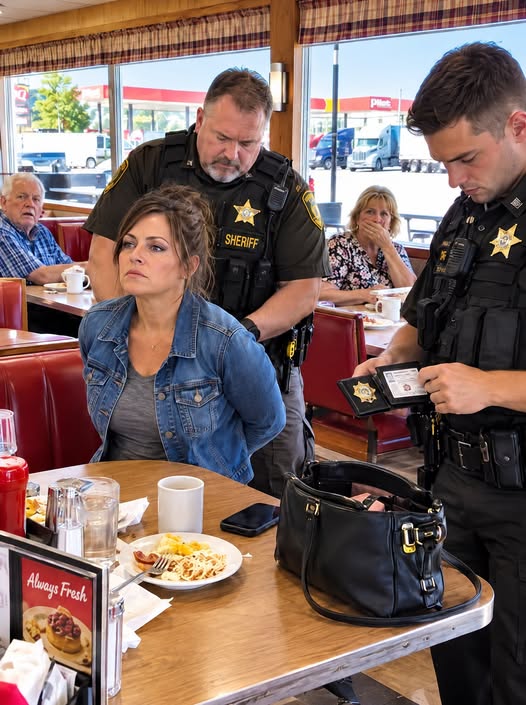
A Small-Town Sheriff Arrested a Woman Without Knowing Her True Identity — What Happened Next Changed Everything
The moment Sheriff Dalton Voss ordered his officers to place handcuffs on me, I realized that the troubling reports I’d received about his department might have been more serious than anyone had imagined.
I could have argued with him. I could have demanded that he explain the reason for his actions. I could even have revealed my professional identity immediately.
But I chose to remain calm.
I wanted to understand what was happening, why an ordinary visit to a small-town diner had suddenly turned into a confrontation with local law enforcement, and whether the complaints about the sheriff’s conduct had any truth behind them.
What I didn’t expect was how quickly the situation would escalate.
My name is Amara Whitlock. I’m forty-four years old, originally from Georgia, and I’ve spent much of my professional life working within the American legal system. For the past six years, I’ve served as a federal judge.
My career has taught me that justice depends on more than written laws and courtroom procedures. It also depends on how people are treated when they have little influence, limited resources, or no one available to speak on their behalf.
That belief was one of the reasons I had traveled to the county where Sheriff Voss served.
For several months, concerns about the local police department had been brought to the attention of the appropriate authorities. Some residents described encounters that left them feeling intimidated. Others alleged that complaints had been ignored or handled improperly.
The reports were serious enough to deserve careful attention.
However, allegations are not proof, and I had no intention of reaching conclusions before examining the available evidence.
I wanted to understand the situation from several perspectives, including those of residents who believed they had been treated unfairly.
That afternoon, I stopped at a neighborhood diner.
It was an ordinary establishment with wooden booths, a small counter, and photographs of local events hanging along the walls. A few customers were enjoying their meals, while others were having quiet conversations over coffee.
I had ordered lunch and was reading some notes when the atmosphere suddenly changed.
The entrance opened, and a uniformed man walked inside.
He was tall, broad-shouldered, and appeared accustomed to commanding attention. His badge identified him as Sheriff Dalton Voss.
He scanned the room before directing his attention toward my table.
“Ma’am, I need you to come with me,” he announced.
I looked up, slightly confused.
“Is there a problem, Sheriff?”
Instead of explaining, he stepped closer.
“Stand up and put your hands where I can see them.”
The conversation in the diner gradually faded.
A man sitting near the window lowered his newspaper. A waitress stopped beside the counter, holding a coffee pot. Several customers exchanged uncertain glances.
I placed my fork on the table.
“Could you tell me what’s happening?” I asked.
Voss appeared irritated by the question.
“We’re investigating a report involving someone who matches your description.”
I looked directly at him.
“What report? What description?”
He didn’t provide any additional information.
Instead, he instructed me to stand and place my hands behind my back.
I remained calm.
I understood that an encounter with law enforcement could become more difficult if emotions took control. I also knew that asking reasonable questions was not the same as resisting an officer.
“Officer, I would appreciate a clear explanation of the reason for this detention,” I said.
Voss gave a dismissive smile.
“You’ll get your explanation at the station.”
The situation was becoming uncomfortable, and the customers around us were watching closely.
I noticed something else, too.
Nobody seemed particularly surprised to see the sheriff behaving this way.
Their expressions suggested that they had witnessed similar confrontations before.
That observation stayed with me.
I was eventually placed in handcuffs and escorted toward the entrance. My lunch remained unfinished, and a glass of water had been knocked over during the commotion.
A young deputy followed us, carrying my handbag.
Before leaving the diner, I glanced back at the customers.
Some looked concerned. Others quickly returned their attention to their meals.
One elderly woman gave me a sympathetic look.
It was a small gesture, but it reminded me why the