Six Months of Frustration With a Neighbor Who Refused to Listen
My name is Robert. I’m 48 years old, and until recently, I thought I had a reasonably peaceful life.
I have always believed that being a good neighbor means respecting other people’s property, maintaining a friendly attitude, and trying to resolve disagreements without unnecessary arguments.
Unfortunately, not everyone shares that philosophy.
For the past six months, I had been dealing with a neighbor named Richard who seemed to believe that the normal rules of residential living did not apply to him.
Richard was a successful businessman who owned several expensive vehicles, including a Mercedes-Benz that he clearly treasured.
There would have been nothing wrong with that if he had simply parked his cars on his own property.
The problem was that he repeatedly parked his Mercedes on my front lawn.
At first, I assumed it was an occasional mistake.
Perhaps he had visitors, needed additional parking space, or had temporarily run out of room in his driveway.
I decided not to make an issue of it immediately.
However, what initially seemed like an occasional inconvenience gradually became a regular problem.
Richard continued leaving his vehicle on my grass, even though there was plenty of space for him to consider other parking arrangements.
My lawn began showing signs of damage.
The grass became flattened, and the ground developed noticeable marks from the weight of the vehicle.
I had spent time and money maintaining my yard, so watching someone repeatedly use it as an unofficial parking space was becoming increasingly frustrating.
I Tried Asking Politely Before Things Got Worse
One afternoon, I decided to speak with Richard directly.
I approached him while his Mercedes was once again sitting on my lawn.
“Richard, could you please move your car? You’re damaging my grass.”
I expected a simple conversation.
I thought he might apologize, move the vehicle, and perhaps avoid doing it again.
Instead, he laughed.
“Relax, old man. It’s just grass. You should be grateful there’s an expensive car decorating your yard.”
I was surprised by his response.
I tried explaining that the issue was not whether his car was expensive.
It was the fact that he was parking it on property that did not belong to him.
But Richard seemed completely uninterested.
He dismissed my concerns and acted as though I was making an unreasonable complaint.
I walked away rather than turning the conversation into an argument.
At that point, I still believed that a little patience might solve the problem.
Unfortunately, I was wrong.
The Parking Problem Became a Neighborhood Dispute
Over the following weeks, the situation continued.
I spoke to Richard several more times.
Each conversation followed roughly the same pattern.
I asked him to stop parking on my lawn.
He dismissed my request.
Sometimes he made jokes about my concerns. Other times, he simply ignored me.
I began wondering whether he genuinely did not understand how inappropriate his behavior was or whether he simply believed that I would eventually give up.
The situation was especially frustrating because I had tried to handle everything politely.
I did not want a feud with someone who lived only a short distance away.
Neighbors have to share streets, sidewalks, and common spaces. Even when disagreements occur, people still have to live alongside one another.
But mutual respect is important.
A person’s financial position or the price of their vehicle does not give them permission to disregard someone else’s property rights.
By this point, I had reached the end of my patience.
Every time I looked outside and saw that Mercedes sitting on my lawn, I felt the same frustration all over again.
The Night I Finally Decided to Take Action
One evening, I looked outside and saw the familiar Mercedes parked in exactly the same place.
I stood by the window for a moment, trying to decide what to do.
I had already spoken to Richard repeatedly.
Nothing had changed.
I was tired of seeing my lawn treated like an extension of his driveway.
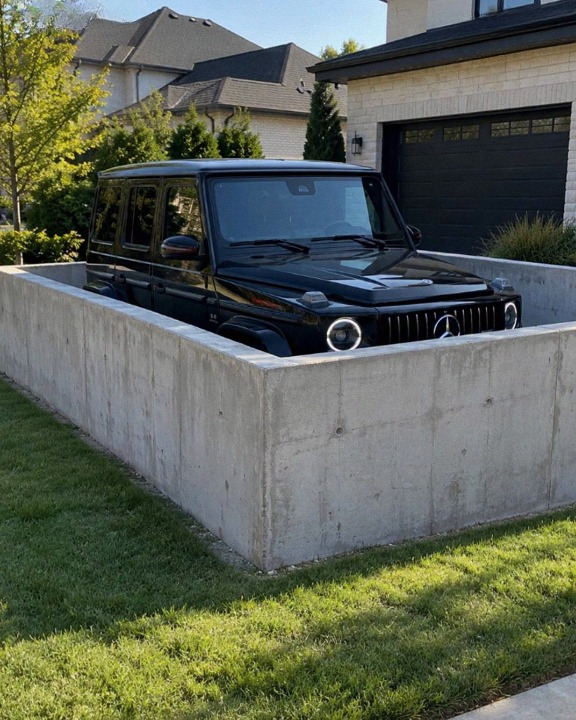
In the original version of this story, Robert responds by constructing a concrete barrier around the parked vehicle.
However, building a permanent structure around someone else’s car could create serious legal and safety problems.
A vehicle might become inaccessible, property could be damaged, and emergency access could be affected.
A safer approach would be to document the repeated parking incidents, establish clear property boundaries, and seek assistance from the appropriate local authorities.
Still, the central point of the story remains the same: Robert wanted Richard to understand that his repeated behavior could not continue without consequences.
Richard Finally Realized That Something Had Changed
The following morning, Richard discovered that his Mercedes was no longer easily accessible.
He immediately became furious.
He stormed toward Robert’s house, visibly upset.
“What have you done to my car?” he demanded.
Robert stepped outside.
For months, he had listened to Richard dismiss his concerns.
Now Richard was experiencing the frustration of an unexpected parking problem himself.
But Robert understood that the situation needed to be handled carefully.
He explained that the dispute had started because Richard repeatedly ignored requests to respect the property boundary.
Richard was not interested in discussing the history of the disagreement.
He wanted his vehicle back.
He threatened to take legal action and demanded that the situation be resolved immediately.
Robert knew that the disagreement could no longer be treated as a simple neighborhood inconvenience.
It had become a matter that might require formal intervention.
A Specialized Recovery Vehicle Arrived
After the initial confrontation, Richard began looking for a way to retrieve his Mercedes.
He was accustomed to having solutions available whenever he encountered a problem.
This time, however, the situation was more complicated.
The vehicle could not simply be driven away under the existing circumstances.
Richard eventually arranged for a specialized vehicle recovery company to inspect the situation.
When the large truck arrived, several neighbors came outside to see what was happening.
The unusual scene had quickly become the subject of conversation throughout the street.
The recovery operator carefully examined the vehicle’s position and the surrounding area.
After looking at the available space, he appeared concerned.
“Sir, this is extremely risky. The lifting angle is not suitable, and I strongly recommend against attempting this without a proper assessment.”
Richard was impatient.
“Just find a way to get it out. I’ll pay whatever it costs!”
The operator remained cautious.
He understood that recovering a valuable vehicle required more than simply having powerful equipment.
The wrong lifting method could damage the car, create an unstable load, or put nearby people at risk.
A responsible recovery company would need to establish whether the proposed operation could be performed safely and lawfully.
The Entire Neighborhood Watched the Situation Unfold
By this stage, several residents had gathered nearby.
Some had witnessed the original parking disagreements.
Others had only recently heard about the situation.
People were curious about how the dispute would end.
Richard’s expensive Mercedes had become the center of attention.
Robert stood at a distance, watching the recovery team evaluate the circumstances.
He was no longer interested in trading insults.
He simply wanted the property dispute resolved.
The recovery operator continued discussing the practical difficulties with Richard.
It was clear that removing the vehicle would require careful planning.
The truck was large, the available space was limited, and the surrounding property needed to be protected.
Richard continued insisting that the job be completed.
But the operator was understandably reluctant to take unnecessary risks.
For once, Richard could not simply demand that everyone do exactly what he wanted.
Why Respecting Property Boundaries Matters
Although this story focuses on an unusual disagreement involving an expensive vehicle, the underlying issue is something many homeowners understand.
Property boundaries exist for important reasons.
Homeowners invest time and money maintaining their gardens, driveways, fences, and outdoor spaces.
When another person repeatedly uses those areas without permission, frustration is understandable.
However, responding to unwanted parking with actions that could trap a vehicle or damage property may create additional legal problems.
There are more constructive ways to resolve these situations.
For example:
- Keep photographs of repeated unauthorized parking.
- Record dates and times when the incidents occur.
- Communicate your concerns clearly and calmly.
- Check local parking and property regulations.
- Install lawful boundary markers or appropriate fencing.
- Contact the relevant authorities when informal discussions fail.
- Seek legal advice if the dispute continues.
These steps help protect property rights without creating unnecessary danger.
The same principle applies to neighbors who share driveways, parking areas, access roads, or other residential spaces.
A little consideration can prevent months of frustration.
The Real Lesson Behind This Unusual Neighbor Dispute
The disagreement between Robert and Richard was never really about the Mercedes itself.
It was about respect.
Richard had treated Robert’s repeated requests as though they were unimportant.
He seemed to believe that owning an expensive vehicle somehow made his behavior acceptable.
But the value of a car does not determine someone’s right to use another person’s land.
Respect should work both ways.
A peaceful neighborhood depends on people understanding that everyone has responsibilities toward those living around them.
It also requires people to recognize when they have crossed a boundary and take steps to correct their behavior.
In this case, a relatively simple parking issue developed into a major confrontation because the original problem was never properly addressed.
Had Richard listened to Robert’s first request, the entire situation might have been avoided.
Final Thoughts: A Simple Parking Disagreement Became a Lesson About Boundaries and Respect
For six months, Robert had tried to deal with a neighbor who repeatedly parked his Mercedes on private property.
He had asked politely, explained the damage to his lawn, and hoped the problem would eventually stop.
Instead, the disagreement continued until it became a much larger neighborhood dispute.
When Richard finally arranged for a specialized recovery vehicle, the situation attracted the attention of nearly everyone nearby.
The operator’s concerns demonstrated that expensive equipment does not automatically make a difficult recovery safe or straightforward.
Ultimately, the story highlights an important lesson.
Being wealthy does not give anyone permission to ignore other people’s property rights.
Likewise, frustration does not justify taking actions that could endanger people or damage property.
The best outcome is one in which boundaries are respected, disagreements are handled fairly, and everyone can return to enjoying a peaceful neighborhood.