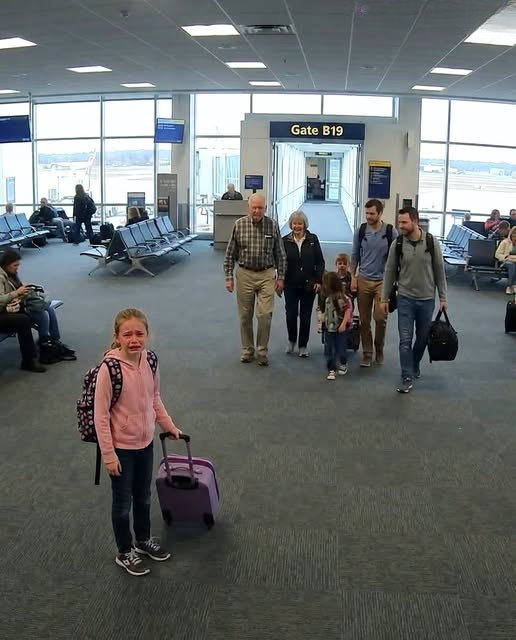
At exactly 5:42 on a Thursday evening, my nine-year-old daughter called me from a metal bench near Gate B19 at Denver International Airport.
Her voice was so small that, for a moment, I could barely hear her over the announcements echoing through the terminal.
“Mom,” she whispered, “Grandma and everyone else got on the plane without me.”
I stopped what I was doing.
I was attending a cybersecurity convention in Minneapolis, several states away from my daughter. Emma was supposed to be traveling from Denver to San Diego with my parents, my younger brother, his wife, and their two daughters.
I had arranged and paid for nearly every part of the family vacation, including Emma’s airfare, accommodation, meals, aquarium tickets, and other planned activities. Before the trip, my parents had assured me that they would look after her and make sure she felt included.
I had believed them.
Now my nine-year-old daughter was sitting alone in an airport, trying to understand why the people who had promised to care for her had left without her.
“Emma, sweetheart, are you still at Gate B19?” I asked, forcing my voice to remain calm.
“Yes, Mommy.”
“Are you hurt? Is anyone bothering you?”
“No. Aunt Lauren told me to stay here because someone would come back for me.”
My heart sank.
“Did she tell you who was coming back?”
Emma was silent for a moment.
“No.”
I opened my laptop, reached for my phone, and began looking for the family itinerary. Before I could ask another question, a message appeared on my screen.
It was from my sister-in-law, Lauren.
What she wrote next would change the way I saw my family forever.
The Message That Explained Everything
According to Lauren, the airline had offered five discounted first-class upgrades after several passengers missed their connecting flight. My family had apparently decided to accept every available upgrade.
There was one problem.
Six family members were traveling with Emma, and the five upgrades had gone to the adults and my two nieces.
Emma had been left behind.
I read Lauren’s message twice, hoping I had misunderstood.
Her explanation was brief and disturbingly casual.
“There were only five seats. Emma was the easiest person to leave because you can arrange another flight for her. Dad said this might teach her not to expect special treatment.”
I stared at the screen.
My daughter was nine years old. She was not an inconvenience to be managed or a lesson to be taught. She was a child entrusted to the care of adults who had agreed to accompany her on a family trip.
I immediately messaged my father.
His response arrived a few minutes later.
“She is safe inside the terminal. Airport employees deal with children every day.”
That was all he had to say.
No apology. No explanation of why they had not contacted me before boarding. No indication that anyone had considered the practical or emotional consequences of leaving a young child behind.
Instead, my father seemed to believe that being inside an airport automatically meant Emma was being properly supervised.
I returned to the video call.
Emma’s eyes were wet, and she was hugging her purple backpack against her chest.
“Mom, did I do something wrong?” she asked.
That question hurt more than anything my family had written.
“No, sweetheart,” I told her. “You did absolutely nothing wrong. The adults were responsible for making sure you were safe, and they should never have left you like this.”
She began to cry.
I wanted nothing more than to be beside her, but I knew that panic would not help either of us. I needed to make careful decisions quickly.
So I did exactly what my professional training had taught me to do when a situation became unpredictable.
I documented everything, contacted the appropriate people, and focused on protecting the person who needed me.
My First Priority Was Getting Emma Somewhere Safe
I contacted Denver International Airport’s police service and the airline’s customer-support team. I explained that my nine-year-old daughter had been left at the departure gate after the adults accompanying her boarded their flight.
I provided her name, age, flight details, booking information, and exact location.
I also requested that an airline representative and airport officer locate her and confirm that she was safe.
My work in cybersecurity had taught me that records matter, especially when people later disagree about what happened. I saved the messages from Lauren and my father, took screenshots of the family itinerary, and preserved the booking confirmations showing how the trip had been arranged.
I did not alter the messages or add my own interpretation to them. I simply kept the original records.
My company’s travel-security team also helped me identify the appropriate emergency-support channels available through my executive travel arrangements.
Throughout the process, I stayed on video with Emma whenever possible.
I asked her to remain in the public waiting area, avoid leaving with anyone she did not recognize, and follow instructions from identified airport personnel. I reassured her that she could ask a uniformed officer or an airline employee for help.
“Keep your backpack with you, sweetheart,” I said. “You don’t have to solve anything. Let the adults there help you while I arrange to come to you.”
She nodded, wiping her cheeks with the sleeve of her jacket.
A few minutes later, an airport officer located her and sat nearby while the necessary checks were completed.
When Emma saw the officer, her shoulders relaxed slightly.
“Mom, someone is here now,” she said.
I finally allowed myself to take a full breath.
My daughter was no longer waiting entirely alone.
But while I was working to make sure she was safe, my family’s behavior continued to unfold on social media.
The Vacation Photos That Made Everything Clear
My family group chat began filling with pictures from inside the aircraft.
My mother posed comfortably in her upgraded seat. My nieces smiled beside their desserts, and Lauren uploaded a photograph showing her feet stretched out beneath the spacious seat in front of her.
Her caption read:
“The family vacation has officially begun!”
I looked at the picture for a long moment.
They were celebrating the beginning of their holiday while Emma remained at the airport, frightened and confused.
I saved the photograph.
Then my mother added a message to the group chat.
“Rachel always fixes whatever Emma turns into a crisis. The child needs to learn that plans sometimes change.”
I read those words carefully.
Emma had not created the crisis. She had not missed her flight because she had wandered away, ignored instructions, or refused to cooperate.
The adults responsible for accompanying her had made a decision that excluded her from the journey without first ensuring that another appropriate arrangement was in place.
Yet my mother was already describing the situation as though my daughter were responsible.
That was when I began to recognize a pattern I had spent years trying not to acknowledge.
Whenever my family made an unreasonable decision, I was expected to handle the consequences. When someone needed money, I helped. When travel arrangements became complicated, I fixed them. When an expense exceeded the original budget, I often covered the difference.
I had convinced myself that helping was simply what family members did for one another.
But my family’s messages suggested that they no longer saw my help as a kindness.
They had come to expect it.
Worse, they appeared to believe that my willingness to help meant they would never have to take responsibility for their own choices.
This time, however, the consequences involved my child.
And that changed everything.
The Journey Back to Denver
I reserved the earliest practical flight from Minneapolis to Denver and informed my colleagues that I needed to leave the convention because of an urgent family matter.
Before departing, I completed the initial complaint process with the airline and recorded the details of the incident while they were still fresh.
I kept copies of the correspondence and requested written confirmation of the steps being taken.
I also asked for clarification about the boarding arrangements and whether the airline had been informed that Emma was traveling under the supervision of the family group.
I wanted facts, not assumptions.
By the time I reached Denver, several exhausting hours had passed.
Emma was waiting with airport personnel, holding a paper cup of hot chocolate. Someone had provided her with a sweatshirt because she was cold, and she still had her purple backpack clutched tightly against her side.
The moment she saw me, she hurried toward me.
“Mom!”
She wrapped her arms around my waist, and I dropped my handbag to hug her properly.
“I thought nobody was coming back,” she whispered.
I held her close.
“I came back for you,” I told her. “You can always tell me when something feels wrong, and you never have to believe that someone else’s poor decision is your fault.”
She began crying again, this time with the relief of finally being with someone she trusted.
I did not ask her to explain everything immediately. She had been through a frightening experience, and she needed reassurance more than questions.
The details could wait until she felt ready to talk.
For the moment, I was simply grateful that I could hold my daughter and take her home.
What the Airline Representative Told Me
An airline operations representative spoke with me after Emma had calmed down.
“Ms. Dawson,” the representative explained, “this appears to involve more than a disagreement about seating. We need to establish exactly what happened, who was responsible for supervising your daughter, and what arrangements were made before the aircraft departed.”
The representative also explained that the airline would review the available records and the circumstances surrounding the boarding process.
I requested that the incident be formally documented and that I receive information about the complaint procedure.
I understood that I could not determine every aspect of responsibility from the messages alone. The airline needed to review its own records, and any legal questions would require appropriate professional advice.
But I did know one thing with certainty.
My daughter had been left without the family supervision I had arranged for her.
The adults who had agreed to accompany her had not contacted me beforehand to discuss an alternative plan.
And when I asked them to explain themselves, their messages showed little concern for how Emma had experienced the situation.
I had spent years finding explanations for their behavior.
That evening, I stopped making excuses.
The Three Decisions I Made That Night
After Emma was safely home, I reviewed the financial arrangements connected to the trip.
I did not make decisions out of a desire to embarrass anyone or to create a public confrontation. I wanted to establish clear boundaries and ensure that I was no longer financially responsible for arrangements I could not trust my family to manage appropriately.
First, I reviewed the travel card I had made available for the vacation. I contacted the provider and asked about suspending further use and removing any additional access that was no longer necessary.
Second, I contacted the hotel to review the reservation and payment arrangements. I withdrew my authorization for future discretionary charges and requested a written breakdown of any existing obligations before making changes.
Third, I contacted the attorney handling my parents’ upcoming townhouse purchase. I explained that I wanted to review my role as their loan guarantor and understand the proper process for withdrawing that support before the transaction closed.
I followed the applicable procedures rather than assuming I could cancel every arrangement immediately. Some financial commitments require formal notice or the consent of other parties.
But the message was clear: my financial assistance would no longer be automatic.
I would not continue paying for arrangements that depended on trust while being treated as though my concerns did not matter.
For years, I had believed that saying no would damage my relationships with my family.
Now I understood that refusing an unreasonable expectation could be necessary to protect my own household.
My responsibility was to Emma first.
The Phone Call I Never Expected to Receive
The following morning, my phone began ringing repeatedly.
My mother called first.
“Rachel, what have you done?” she demanded.
I asked her what she meant.
“The travel card isn’t working the way it did before, and the hotel says they need to speak with us about the payment arrangements.”
I remained quiet for a moment.
“Did you ask Emma how she felt when you left her at the airport?” I asked.
My mother sighed.
“Rachel, we have already discussed this. There were only five seats, and someone had to make a decision.”
“You made a decision about a nine-year-old child without calling her mother,” I replied. “Then you told me she needed to learn a lesson.”
My mother insisted that the situation had been exaggerated. She argued that Emma had been inside the airport and that I should have trusted the family to manage the inconvenience.
I reminded her that trust had been the very reason I had allowed Emma to travel with them.
Trust did not mean ignoring the consequences of their actions.
Trust did not mean pretending that a frightened child had caused the problem.
And trust certainly did not mean continuing to provide unlimited financial support after my concerns had been dismissed.
My mother became silent.
For once, I did not rush to fill that silence with an apology.
I told her that I was willing to discuss the incident when everyone could speak calmly and acknowledge what had happened. Until then, I would be keeping some distance.
Then I ended the call.
The Lesson I Wanted My Daughter to Remember
That evening, Emma sat beside me on the sofa with her favorite blanket wrapped around her shoulders.
She asked whether Grandma was angry with her.
I put my phone aside and turned toward her.
“No, sweetheart. And even if someone is upset, that doesn’t mean you did something wrong.”
“Will they still want me to visit them?”
I took a moment before answering.
“I don’t know what they will decide, but you never have to earn your place in a family by accepting unfair treatment. The adults in your life are responsible for making sure you are safe.”
She rested her head against my shoulder.
I realized that what happened at Gate B19 would probably remain in her memory for a long time. I could not erase the experience, but I could help her understand that she had done nothing to deserve it.
I could also show her that boundaries were not punishments.
They were a way of protecting the people and responsibilities that mattered most.
My family had boarded that aircraft believing they had secured a remarkable upgrade. They had enjoyed comfortable seats, expensive desserts, and the beginning of a holiday they expected me to help finance.
What they had failed to consider was that their decision would change the way I approached our relationship.
The photographs, messages, booking records, and complaint documents were not collected to manufacture a dramatic story. They were saved because the details mattered, and because I wanted an accurate record of what had occurred.
I did not need to exaggerate the incident or make threats to prove that my daughter deserved better.
The facts were serious enough on their own.
A Different Kind of Family Boundary
In the weeks that followed, I focused on Emma’s well-being and allowed the appropriate review process to proceed. I kept communication about the incident clear and documented, and I sought professional guidance where financial or legal questions required it.
I also reconsidered the role I had played in my family’s expectations.
Helping people I loved had never been wrong. The mistake was believing that love required me to keep rescuing them, regardless of how they treated me or my daughter.
Financial support is a choice, not an unlimited obligation. Family relationships deserve compassion, but compassion should not require someone to overlook repeated disregard for their responsibilities.
I could love my parents and still disagree with their behavior.
I could care about my brother and still refuse to pay for his family’s decisions.
And I could hope for reconciliation without pretending that nothing had happened.
The most important lesson, however, was the one I wanted Emma to carry into adulthood.
She should never believe that she is less important because someone else has been given a more expensive seat, a better gift, or a greater share of attention.
Her worth has nothing to do with the convenience she offers other people.
At Gate B19, my family had made a decision that revealed far more than they intended. They had shown me what they expected me to tolerate and what they believed I would quietly repair.
I could not change their decision.
But I could decide what happened next.
And this time, I chose to protect my daughter, preserve the truth, and establish boundaries that would not disappear simply because someone called us family.
They had expected me to buy another ticket, apologize for the inconvenience, and quietly fix everything. Instead, I finally understood that protecting my daughter meant refusing to make their choices my responsibility.