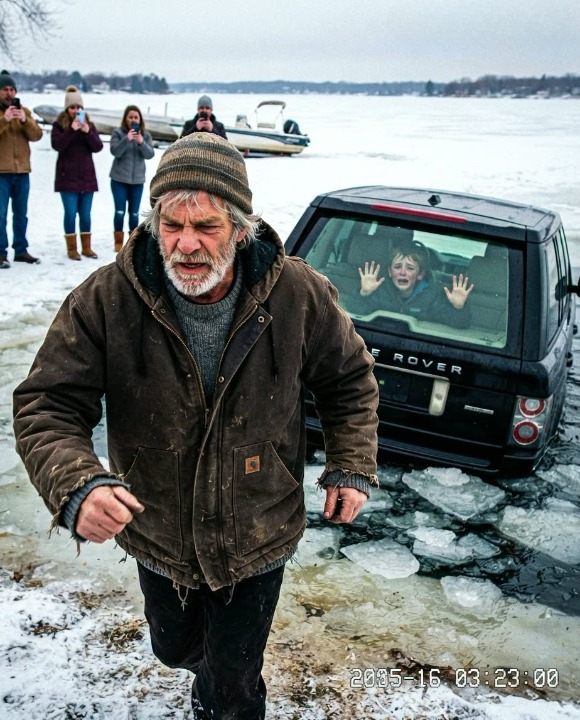
My name is Walt Hendricks. I’m sixty-one years old, a former Army soldier, and for the past few years, my truck has been the closest thing I’ve had to a permanent home.
I never imagined that one winter afternoon would turn my life upside down. I certainly never expected that rescuing a child from a frozen lake would lead me into a courtroom, where the boy’s father would accuse me of causing the very harm I had risked my life to prevent.
But sometimes, doing what you believe is right comes with consequences you could never have predicted.
I served in the Army for twenty-two years, including two overseas deployments. The military taught me discipline, patience, and the importance of staying calm when everything around me seemed to be falling apart.
When I finally returned to civilian life, I thought the hardest part was behind me.
I was wrong.
My marriage ended, and the job I had relied on disappeared a few years later. Medical bills and other expenses slowly drained my savings. Eventually, I could no longer afford the apartment I had called home.
One loss followed another until I found myself living out of my aging pickup truck.
I wasn’t proud of my circumstances, but I wasn’t ashamed of my service, either. I had worked hard, paid my bills when I could, and tried to treat people with respect. Life had simply taken a direction I hadn’t planned for.
Most nights, I parked behind a Lutheran church in Minnetonka, Minnesota. The pastor knew my situation and allowed me to use the church bathroom. He never made me feel as though I had to explain myself.
That small kindness meant more than he probably realized.
My days were quiet. I looked for temporary work, stretched my limited money as far as possible, and tried to keep my truck running through the harsh Minnesota winter.
Then came January 9.
It was a bitterly cold afternoon, and I had parked near a frozen lake to eat a sandwich before heading back into town. The sky was gray, and a sharp wind swept across the shoreline.
I was halfway through my lunch when I heard a sudden crack.
At first, I thought it was a branch breaking somewhere nearby.
Then I saw a black Range Rover moving across the ice near the boat launch.
The vehicle was traveling much too quickly for the conditions. Before the driver could correct its direction, the ice beneath the front wheels began to fracture.
The SUV tilted forward.
Within seconds, the front end dropped into the freezing water.
People along the shore began shouting. Some rushed toward the edge of the ice, while others stood back, uncertain about what to do.
I saw movement behind one of the windows.
A child was inside.
He was striking the glass with his hands, desperately trying to attract attention.
I didn’t stop to calculate what the rescue might cost me. I didn’t wonder whether anyone would thank me. I saw a frightened child in danger, and every instinct I had told me to move.
I ran toward the vehicle.
The ice shifted beneath my boots, and the cold water hit me with a force that stole my breath. For a moment, my body seemed unable to respond. The temperature was so severe that even simple movements became difficult.
But I kept moving.
The SUV was sinking, and the boy was trapped inside. I reached the rear window and tried to get his attention. The glass was already partly submerged, and there was very little time.
I managed to break an opening large enough to reach inside. Through the water and confusion, I found the boy’s seat belt and worked to free him.
His name was Austin. He was ten years old.
I pulled him out of the vehicle and struggled back toward the shoreline, fighting the cold and the unstable ice. When we finally reached solid ground, I laid him on the snow.
He wasn’t responding.
Someone shouted that an ambulance was coming.
I checked his condition and began CPR, following the training I remembered. I focused on what I needed to do, one step at a time, while people gathered nearby.
I didn’t know how long it took before Austin began responding. Time seemed to lose its meaning.
Then he coughed and began to cry.
The sound was the most welcome thing I had heard all day.
A few people cheered with relief. Someone wrapped a blanket around the boy, while another person helped me move away from the water.
My own clothes were soaked, and I was shaking uncontrollably.
The paramedics arrived and took over Austin’s care. They assessed him and prepared him for transport.
Only then did I look toward the shoreline and notice the driver.
He had managed to get out through the front window and reach land on his own. He was wearing an expensive coat, now wet from the water, and appeared to be focused on his phone.
His name was Graham Crane.
Austin was his son.
I expected Graham to rush toward the boy, ask about his condition, or at least thank the people who had helped him.
Instead, he remained occupied with his phone while the paramedics worked.
I told myself that shock could make people behave in unexpected ways. Perhaps he was frightened and didn’t know how to react.
I didn’t want to judge him in the middle of an emergency.
The following day, a local news report described the rescue. A few people called me a hero, and strangers sent messages thanking me for acting when a child needed help.
For a brief moment, I felt that something good had come from a difficult life.
Then, three weeks later, everything changed.
A man in a suit approached my truck and knocked on the window.
I lowered it slightly.
“Are you Walter Hendricks?” he asked.
“Yes.”
He handed me a thick envelope.
“You’ve been served.”
I opened the envelope and read the first page.
Graham Crane was suing me for four hundred thousand dollars.
I read it again, hoping I had misunderstood.
The lawsuit accused me of using unnecessary force during the rescue, causing injuries to Austin, and interfering with the family’s property rights near the lake.
The documents also claimed that my actions had caused emotional distress.
I sat in my truck for a long time after the man left.
I had risked my life to help a child, and now I was being accused of wrongdoing.
I didn’t have savings to cover a legal battle. I barely had enough money for food, fuel, and basic repairs. The thought of facing a wealthy man with a team of lawyers was overwhelming.
Still, I kept the papers.
A few days later, Graham appeared in a televised interview.
Standing outside his lakeside property, he described me as a drifter who had intervened without permission.
He questioned my judgment and suggested that the rescue had caused his son unnecessary harm.
The story spread quickly.
Online comments appeared from people who knew nothing about me or what had happened on the ice.
Some called me reckless. Others suggested that I had acted for attention or money.
I tried not to read the comments, but their words followed me into the quiet hours of the night.
The pastor offered to let me stay in the church basement while the case was pending.
I thanked him but declined. I didn’t want my legal problems to bring unwanted attention to the church or the people who had helped me.
Then I met Priya Shah, a young attorney who worked with a legal aid organization.
She listened carefully as I explained what had happened. She reviewed the lawsuit and asked for every detail I could remember.
When I finished, she folded her hands on the desk.
“This is going to take work,” she said. “But you don’t have to face it alone.”
She agreed to represent me without charging legal fees.
For the first time since receiving the lawsuit, I felt a small measure of hope.
We gathered the available evidence, including witness accounts, news footage, and records related to the rescue. Priya explained that the court would need to examine the circumstances carefully rather than simply accept either side’s version of events.
I didn’t know whether I would win.
I only knew that I had done what I believed was necessary to save a child.
The first day of trial arrived several months later.
I entered the Hennepin County courthouse wearing the cleanest shirt I owned. My boots were old, and my jacket had seen better days, but I had done my best to look presentable.
Graham Crane arrived with several attorneys and a reporter.
When he passed me, he gave a small, dismissive smile.
“Should have stayed out of it,” he muttered.
I said nothing.
His lead attorney later described me as an unstable man whose circumstances might have influenced his judgment. The implication was clear: because I had lost my home, I could not be trusted to act responsibly.
I had spent years trying to rebuild my life, and now my lack of money was being used to question my character.
I looked toward Priya.
She gave me a reassuring nod.
The judge, Ramona Ellis, listened carefully as the attorneys presented their opening statements. She reminded everyone that the case would be decided on evidence, not assumptions about a person’s wealth, employment, or living situation.
Then, just as the proceedings were getting underway, a woman stood from the second row.
“Your Honor?”
Everyone turned.
It was Celeste Crane, Graham’s wife.
Austin sat beside her, holding her hand. His arm was supported in a sling, and he looked nervous about being in the courtroom.
Celeste held a thick manila envelope.
Graham’s expression changed immediately.
“Celeste, sit down,” he said sharply.
She remained standing.
“I have something the court needs to see,” she said. “It’s information my husband told me never to share.”
Graham’s attorney rose from his chair.
“Your Honor, we object. This material has not been introduced through the proper procedure.”
Judge Ellis looked at him.
“Counsel, sit down for a moment. I will determine how this should be handled.”
She turned to Celeste.
“Please bring the envelope to the clerk.”
Celeste walked forward and handed it to the court staff. The judge reviewed the contents while the room fell silent.
Inside were photographs, printed messages, and documents that appeared to relate to the incident at the lake.
The judge studied the first few pages, then paused at one photograph.
She looked at it again.
Then she turned toward Graham.
“Mr. Crane,” she said, “I have some questions about this material.”
For the first time that morning, Graham seemed unable to maintain his composure.
His attorney leaned toward him and whispered something, but Graham barely responded.
Celeste returned to her seat and placed a protective hand on Austin’s shoulder.
I couldn’t see everything in the envelope from where I sat, and I didn’t know what the photographs would ultimately prove. But I could tell that the judge had found something important enough to examine before proceeding.
Priya leaned toward me.
“Stay calm,” she whispered. “Let the evidence speak for itself.”
The judge ordered the court to pause while the attorneys reviewed the newly presented material and determined the appropriate next steps.
Graham looked across the room at his wife.
She did not look away.
Then, for the first time since the day of the rescue, he turned his attention toward his son.
Austin was watching him with an expression I couldn’t quite understand.
I felt no satisfaction in seeing a family in conflict. I knew that legal proceedings could be painful, especially when a child was involved.
All I wanted was a fair hearing and the chance to explain why I had entered that freezing water.
As the courtroom settled, I remembered the moment I had first seen Austin behind the SUV’s window.
I hadn’t known his name, his father’s reputation, or the kind of life he came from.
I had only known that a child needed help.
That was enough.
Whatever the envelope contained, I hoped it would help the court understand what had happened that day and allow everyone involved to move closer to the truth.
I sat back in my chair and waited for the proceedings to continue.
For months, I had been judged by strangers who knew nothing about my life. Now the court had an opportunity to examine evidence rather than appearances.
And for the first time since the lawsuit began, I believed that the truth might finally have a chance to be heard.