Working offshore in the Gulf of Mexico meant making sacrifices that most people never had to consider. My schedule was simple on paper: twenty-eight days working on the rig, followed by twenty-eight days at home.
In reality, it meant missing birthdays, school events, family dinners, and countless ordinary moments that other fathers took for granted.
The job paid well, and I was grateful for that. My salary helped pay for our home outside Lafayette, Louisiana, my wife’s SUV, our son’s speech therapy, and the wooden swing set I had built in the backyard with my own hands.
I kept telling myself that the long absences were worth it because I was providing a stable future for my family.
My son, Eli, was eight years old. He was a little smaller than most children his age and often shy around strangers, but when we were together, he could talk for hours.
He loved small animals, especially the lizard he kept in a terrarium in his bedroom. He was also proud of a little fort he had been building beneath the back porch, using old blankets, cardboard boxes, and pieces of wood I had helped him arrange.
Whenever I was offshore, I tried to remain part of his daily life.
Every evening at seven, we had a video call. Eli would tell me about school, show me his latest drawings, or explain what he planned to build next.
Those conversations were the best part of my day.
But during my most recent rotation, something changed.
The calls became shorter. Eli rarely showed me his drawings anymore, and he stopped talking about the fort beneath the porch.
Whenever I asked why he seemed so quiet, my wife, Shannon, answered for him.
“He’s tired, Cole,” she would say while holding the phone. “He’s already getting ready for bed.”
Sometimes it was barely seven in the evening.
“He’s growing up,” she added when I questioned it. “You can’t expect him to spend every night talking to you.”
I tried to accept her explanation. I knew children changed as they grew older, and I didn’t want my concerns to turn into unnecessary arguments.
Still, something about Eli’s silence bothered me.
He had always been excited to see me on the screen, even when he had nothing important to report. Now, he often looked as though he wanted to say something but wasn’t sure whether he should.
A few times, I thought I heard a voice in the background, followed by Shannon quickly ending the call.
Whenever I asked about it later, she told me I was imagining things.
I had no proof that anything was wrong, so I continued working and hoped I would understand the situation when I returned home.
Then, two weeks before my scheduled departure, a hurricane warning changed everything.
Conditions in the Gulf were becoming increasingly dangerous, and the company began arranging an early evacuation. Within hours, our crew was preparing to leave the platform.
I was relieved to be heading home early. More than anything, I wanted to see Eli.
I decided not to call ahead.
I imagined his face lighting up when I walked through the door. I pictured him running into my arms and immediately telling me everything I had missed.
After a long journey back to Louisiana, I finally reached our neighborhood.
It was 9:58 p.m.
As I pulled into the driveway, I noticed an unfamiliar pickup truck parked where I normally left my vehicle. It was lifted high off the ground, with mud covering its tires.
I assumed someone must be visiting Shannon.
The front door was unlocked.
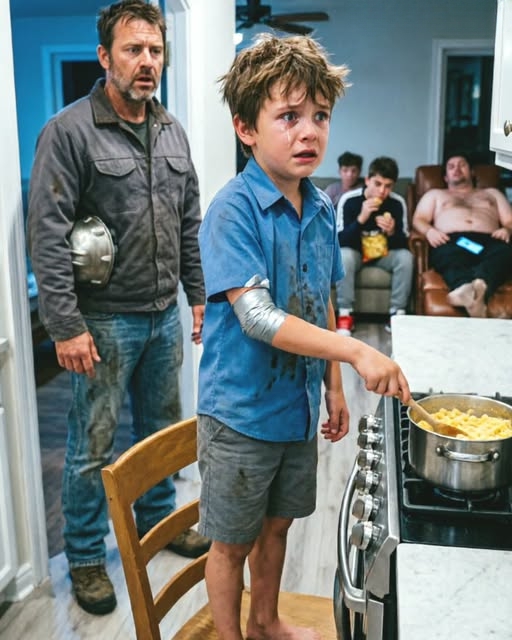
When I stepped inside, the television was playing loudly. Two boys I had never met were sitting on the living room couch, eating snacks and watching a football game.
A grown man was asleep in my recliner. His boots were resting near the edge of the coffee table, and an empty drink can sat beside him.
I stood there for a moment, trying to understand why strangers were occupying my home so late at night.
Then I heard something coming from the kitchen.
I followed the sound and stopped in the doorway.
My eight-year-old son was standing on a chair in front of the stove, carefully stirring a pot of macaroni.
His school uniform was stained, and his hair looked as though it had gone weeks without a proper haircut.
But what caught my attention most was his arm.
A strip of silver duct tape covered his forearm from near his wrist toward his elbow.
“Eli?”
He turned so quickly that the chair wobbled beneath him.
For one brief moment, his face filled with happiness.
Then the expression disappeared.
His eyes widened, and he looked frightened.
“Dad? You’re not supposed to be home.”
I immediately moved toward him, lifted him down from the chair, and held him close.
He felt smaller than I remembered.
I tried to keep my voice calm, even though my thoughts were racing.
“Buddy, what happened to your arm?”
He looked past my shoulder toward the living room.
“I burned it,” he whispered. “But it’s okay. I put tape on it.”
My stomach tightened.
“Who helped you with it?”
He lowered his eyes.
Before I could ask anything else, he spoke in a hurried whisper.
“Please don’t be mad, Dad. Troy says if dinner isn’t ready on time, I have to sleep in the shed.”
For a moment, I couldn’t respond.
The shed stood behind our house. I had built it to protect the lawnmower and garden equipment from the rain. It had no proper bedroom, no comfortable bed, and no reason for a child to spend the night inside.
I looked at my son and realized that he was not simply worried about getting into trouble.
He was afraid of what might happen if he failed to do what he had been told.
The man in the recliner had awakened and was now standing in the doorway.
He was a large man with a tattoo on his neck and an irritated expression.
“You must be Cole,” he said. “I’m Troy. Shannon’s friend.”
I kept my attention on Eli.
“Where’s my wife?”
“Out with friends,” Troy replied casually. “She’ll be back later.”
Then he glanced at my son.
“Your boy needs to toughen up. He gets upset over everything.”
One of the boys on the couch laughed.
I looked at Troy, then at the children, and finally at the kitchen.
I was furious, but I knew that losing control would not help Eli. He was already frightened, and the last thing he needed was another adult raising his voice.
I took a breath and asked Troy to explain exactly what had happened to my son’s arm.
He gave a vague answer about Eli accidentally touching a hot pan.
That explanation did not tell me whether the injury had been treated, how long ago it had happened, or why my son had been left to cover it with tape.
I decided that Eli needed my attention immediately.
I moved him away from the stove, turned off the burner, and checked his arm carefully without pulling at the tape. I also made sure he had something safe to eat.
Then I arranged to have his injury assessed by a medical professional.
I wanted answers, but my son’s well-being came first.
Shannon finally returned home shortly after one in the morning.
She entered the kitchen, saw me sitting at the table with Eli beside me, and stopped in surprise.
“Cole? You’re home early.”
I looked at her.
“Who is Troy, and why was our son cooking dinner for everyone at ten o’clock at night?”
Her expression hardened.
“He’s a friend. You know how difficult things have been with you gone.”
“I understand that my job keeps me away. But I don’t understand why our eight-year-old is responsible for cooking late at night or why he’s afraid of being sent to the shed.”
She glanced at Eli’s arm.
“He touched a pan. These things happen. You’re making it sound worse than it is.”
I asked why no one had sought proper care for the injury.
She didn’t give me a clear answer.
Instead, she accused me of arriving unexpectedly and judging a situation I didn’t understand.
I wanted to argue, but I stopped myself when I noticed Eli sitting silently in his chair, watching both of us.
I knew that whatever the truth was, he needed to feel safe enough to speak.
The next morning, while Shannon was asleep, I went into my old office closet to look for a first-aid kit and some documents.
Behind a stack of folders, I found an old mobile phone I had stopped using when I upgraded my work device.
It had no SIM card and could not make calls or send messages, but it still had enough battery power to turn on.
I almost put it back.
Then I noticed the Notes application was open.
There was a single document on the screen.
Its title was simple:
FOR DAD
I tapped it.
The note contained twenty-six separate entries, each marked with a date or a day number.
They had all been written by Eli.
My son had been recording his thoughts as though he were keeping a diary for me.
The first entry was short.
“Day 1. Hi, Dad. I’m writing you every night like you said. I’m okay. I miss you.”
I remembered the old phone. Before I left for my previous rotation, I had shown Eli how to use the Notes application. I had told him that if he ever wanted to write me a story or leave me a message, he could use it.
I had never imagined he would use it to record things he was afraid to say aloud.
My hands began to tremble as I scrolled through the entries.
Some were ordinary notes about school and his lizard. Others described how lonely he felt in the evenings.
Gradually, the entries became more concerning.
He wrote about being told to prepare meals, being afraid to ask questions, and worrying that adults would become angry if he made mistakes.
He described spending time alone when he wanted to be with someone who would listen to him.
I stopped reading for a moment and took a breath.
Then I scrolled to the final entry, written only two nights before I returned home.
I read it once.
Then I read it again.
It was not an angry message or an accusation. It was a frightened child’s attempt to explain why he had stopped telling me about his days.
He wrote that he missed me and wanted me to come home. He said he had tried to be good because he didn’t want anyone to be upset with him.
At the end, he had written a sentence that I will never forget:
“Dad, when you come home, can you please stay with me for a little while? I don’t want to be scared anymore.”
I sat on the floor of that closet, holding the phone, and felt the weight of every missed conversation.
I had spent weeks believing that Eli was simply growing quieter.
I had trusted that the adults around him were looking after him.
I had told myself that providing for my family meant doing my job well, earning enough money, and making sure our bills were paid.
But I had overlooked something essential.
My son needed to know that he could tell me when something was wrong, even if the truth was difficult to hear.
I put the phone in my pocket and went to find him.
Eli was sitting on the edge of his bed, holding the small toy lizard he often kept beside his pillow.
I sat beside him and spoke gently.
“You don’t have to be afraid to tell me anything, buddy. You’re not in trouble.”
He looked at me for a long moment.
Then he leaned against me.
I didn’t demand every detail at once. I told him that we would take things one step at a time and that my job was to make sure he was safe.
I also understood that this was not something I could resolve through a single conversation.
His injury needed proper attention. The circumstances described in his notes needed to be taken seriously. And the adults responsible for his care needed to be held accountable for their actions.
I arranged for Eli to remain in a safe environment while I sought appropriate professional guidance and made sure his account was documented carefully.
I would not allow fear, embarrassment, or family arguments to take priority over his well-being.
Later, I would need to make difficult decisions about my marriage and the arrangements at home. Those conversations would not be easy, and I knew there would be consequences for everyone involved.
But one decision was already clear.
I would no longer dismiss the signs that my son was struggling simply because I was far away.
My work offshore had always been about giving my family a better life. From that morning forward, I understood that being a good father meant more than providing a house, paying the bills, or bringing home a paycheck.
It meant listening when my child became unusually quiet.
It meant asking questions when something didn’t seem right.
And above all, it meant making sure he knew that he could always come to me for help.
I had returned home two weeks early because of a hurricane.
I never expected to discover that my son had been carrying such a heavy burden in silence.
But I was home now, and I intended to make those days count.
For the first time in weeks, Eli no longer had to wonder whether anyone would listen.
His father was there.
And this time, I was paying attention.