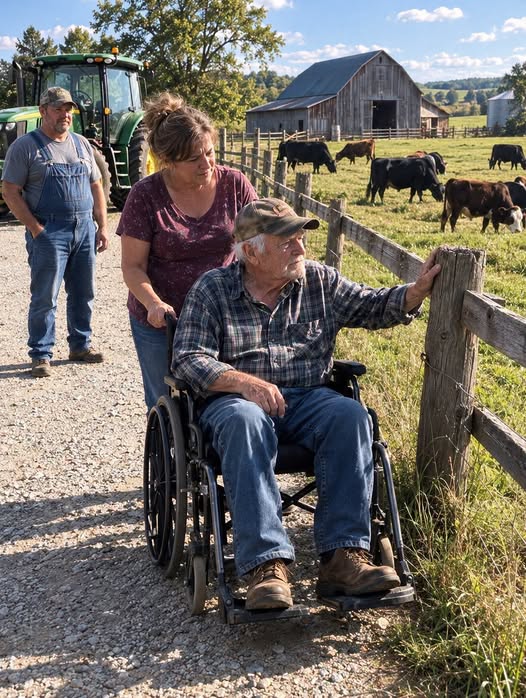
My Sister Collected Rent From Our Father’s 200 Acres While I Paid His Nursing Home Bills—Until Dad Asked One Question
An emotional fictional family drama about an aging father’s property, a daughter’s sacrifice, and the truth that finally came to light.
Chapter 1: Three Years of Sacrifice
For three years, I paid the difference between my father’s income and his nursing home expenses out of my own retirement savings.
Every month, $2,100 disappeared from the money I had carefully set aside for the years when my husband and I were supposed to slow down, travel a little, and enjoy the life we had worked so hard to build.
I never complained to my father.
I never asked him to feel guilty.
And I never imagined that my older sister might be receiving thousands of dollars in rent from the very land Dad had worked his entire life to preserve.
My name is Linda Whitaker. I am sixty-seven years old, retired from the United States Postal Service, and married to a patient man named Doug.
My father, Clayton Whitaker, is eighty-four.
He is a quiet man who spent most of his life working outdoors. His hands are broad, his skin is weathered, and his memory remains remarkably sharp. He can remember the year a particular fence was built, the price of corn during a difficult season, and the exact location of a tree his father planted decades ago.
His legs, unfortunately, no longer carry him the way they once did.
Three years ago, a serious medical setback left him unable to live safely by himself. After several weeks of rehabilitation, the family agreed that a nursing home would provide the care he needed.
It was not an easy decision.
Dad had lived in the same farmhouse for nearly sixty years. He knew every creaking floorboard, every uneven step on the porch, and every corner of the property surrounding his home.
Moving him into a nursing facility meant leaving behind more than a building.
He was leaving the life he had known.
We tried to make the transition as comfortable as possible. We brought his favorite chair, family photographs, and the old brown felt hat he had worn to the fields for most of his adult life.
My older sister, Sherry, handled much of the paperwork.
She was the one who held Dad’s power of attorney, which allowed her to manage the financial and administrative matters covered by that authority. At the time, I thought it made sense. Sherry lived closer to the bank, had always been comfortable with paperwork, and insisted that she could keep everything organized.
I trusted her.
She was my sister, after all.
When the nursing home bills began arriving, Sherry explained the financial situation.
Dad’s Social Security benefits and an existing long-term care policy covered approximately $5,300 of his $7,400 monthly bill.
That left a shortfall of $2,100.
According to Sherry, the remainder of Dad’s money had been used up by medical expenses, home repairs, and the costs associated with moving him into care.
She said there was nothing left to cover the difference.
I looked at the numbers and felt my stomach tighten.
Dad had spent his life working. He had owned his home, saved what he could, and held on to the farmland he inherited and expanded over the years.
I could not understand how everything had disappeared so quickly.
But Sherry sounded certain.
She told me that the bills needed to be paid and that we could not risk interrupting Dad’s care.
I agreed.
My postal retirement check was modest, but Doug and I had paid off most of our mortgage. We had savings, and our everyday expenses were manageable.
So I volunteered to cover the difference.
At first, I thought it would be temporary.
Perhaps a few months, I told myself. Perhaps we would discover another source of support or find a way to reorganize Dad’s finances.
But the months became years.
Every month, I transferred $2,100 to help cover his care.
Over twelve months, that amounted to $25,200.
Over three years, I had contributed $75,600.
That was a substantial portion of the retirement savings Doug and I had spent decades building.
Still, whenever I visited Dad and saw him sitting comfortably in his chair, I reminded myself why I was doing it.
He had cared for me when I was a child.
He had worked long hours to make sure I had shoes that fit, books for school, and opportunities he had never enjoyed himself.
I could not imagine turning my back on him when he needed me.
Doug never complained about the money.
Sometimes, I caught him studying our bank statements at the kitchen table. He would ask whether Dad’s expenses had changed, whether the nursing home had adjusted its rates, and whether we had received any new information from Sherry.
I always gave him the same answer.
“She says there isn’t anything else.”
He would nod, although I could tell he was not entirely satisfied.
One evening, after another payment had gone through, he placed the bank statement on the table.
“Linda, have you ever seen the actual records?”
I frowned.
“What records?”
“Your father’s accounts. The property income. The expenses. Anything that shows where the money is going.”
“Sherry handles all of that.”
“I know,” he said. “I’m asking whether you’ve seen it.”
I had not.
I told him that Sherry was our father’s daughter too, that she had been given responsibility for his affairs, and that I had no reason to believe she would do anything wrong.
Doug did not argue.
He simply folded the statement and put it away.
Looking back, I wish I had paid closer attention to that conversation.
But trust is difficult to question when the person involved has shared your childhood, your family holidays, and your parents’ kitchen table.
I had no idea that a single piece of paper would eventually force me to reconsider everything.
Chapter 2: The Land That Meant Everything to Dad
My father owned two hundred acres of farmland.
To some people, that might have looked like a valuable investment or a source of rental income.
To Dad, it was the history of his family.
His father had worked part of the land before him. When Clayton was young, he helped repair fences, clear brush, and prepare fields for planting. He learned how to read the weather by watching the clouds and how to judge the condition of the soil by taking a handful of it and feeling its texture.
When he inherited the original property, he worked steadily to expand it.
He never became wealthy in the way people on television describe wealth. He drove old trucks, repaired equipment whenever possible, and bought new machinery only when the old equipment could no longer be trusted.
He believed that land was something a person should protect.
“You can spend money and have nothing left,” he once told me. “But good land can feed a family for generations if you take care of it.”
That was how he thought.
For twenty-two years, a local farmer named Bobby Whitt had rented much of the property.
Bobby was a practical man who knew the area well. He wore a faded seed cap, drove an aging pickup, and preferred working in the fields to talking about himself.
I had met him at family gatherings and occasionally saw him when I visited Dad’s farmhouse.
He and Dad had always gotten along.
They talked about rainfall, crop prices, machinery, and the stubbornness of certain fence posts. Their conversations could last half an hour without either man mentioning anything that had happened outside the county.
I had always assumed the arrangement between Bobby and Dad was straightforward.
Bobby farmed the land and paid rent according to their agreement.
When Dad moved into the nursing home, Sherry told me that the arrangement had changed.
She said Bobby was no longer paying ordinary rent on the crop ground because he was mainly keeping cattle on part of the property and helping maintain the fences.
According to her, the arrangement was informal and provided little or no income.
I accepted her explanation.
I did not ask to see the lease.
I did not contact Bobby.
And I never thought to compare the farm’s income with the amount I was paying toward Dad’s care.
Why would I?
Sherry was managing the financial matters. She had assured me that the farm was not generating enough money to make a difference.
I believed her because I wanted to believe that we were all doing the best we could for our father.
Every time I drove past the land, I felt a mixture of pride and sadness.
The old gray barn still stood near the lane. The fence lines crossed the fields in long, familiar stretches, and the trees around the property changed color with the seasons.
In spring, the fields turned bright green.
By summer, the crops filled the landscape.
In autumn, the leaves along the road became gold and red, and the air smelled of damp earth.
I often wondered whether Dad missed seeing those changes.
When I visited him, he would ask about the farm.
“Have you been past the west field lately?” he would say.
“Yes, Daddy.”
“How does it look?”
“Good. Bobby has been working on it.”
He would nod, satisfied.
“That ground has always treated us fairly.”
Sometimes, I wanted to tell him that the property was no longer generating much income, according to Sherry.
But I did not want to burden him with financial worries when he was already adjusting to life in the nursing home.
I thought I was protecting his peace.
I had not yet realized that keeping him uninformed could be just as harmful as hiding the truth from me.
Chapter 3: The Tax Folder
The first crack in the story appeared on a Tuesday afternoon in September.
Sherry called while I was putting away groceries.
“Linda, I need a favor.”
“What do you need?”
“I have Dad’s tax documents ready for the preparer, but I can’t get away from work. Would you mind dropping the folder off?”
“Of course.”
She told me where to find the folder and reminded me to make sure the preparer received everything.
I drove to her house, collected the documents, and headed to the tax office.
I had no reason to suspect anything unusual.
The folder contained bank statements, insurance paperwork, property records, and several forms I did not immediately recognize.
The tax preparer was busy when I arrived, so the receptionist asked me to wait while she checked the paperwork.
I sat in my car with the folder on my lap.
As I waited, I noticed a form tucked between two property documents.
The name at the top was Bobby Whitt.
I recognized it immediately.
The document listed rental income associated with Dad’s farmland.
I read the amount once.
Then I read it again.
Twenty-six thousand dollars.
The form indicated that Bobby had paid $26,000 in rent for the previous year.
I stared at the number.
Twenty-six thousand dollars.
That was more than enough to cover an entire year of the difference I had been paying toward Dad’s nursing home expenses.
I checked the name again to make sure I had not mistaken it for someone else.
Bobby Whitt.
The farmer who had supposedly stopped paying ordinary rent.
The farmer whose arrangement, according to Sherry, provided little or no income.
I turned the form over, hoping there might be some explanation on the back.
There was nothing.
I looked through the other papers, searching for a bank statement or receipt that showed where the money had gone.
I could not find one.
I did not know whether the rent had been deposited into another account, used for Dad’s expenses, or handled in some other way.
But I knew that the form raised questions I could no longer ignore.
For nearly an hour, I sat in the parking lot.
Cars came and went. A man walked into the office carrying a stack of receipts. Someone across the street unloaded boxes from a van.
The world continued moving as though nothing had changed.
I held the form in both hands.
For three years, I had been transferring money from my retirement account because I believed my father had no other resources.
Now I had evidence that his land had generated substantial rental income.
I thought about the payments Doug and I had made.
The repairs we had postponed.
The trips we had decided not to take.
The quiet conversations about whether we could afford to replace our aging car.
None of those sacrifices had been forced upon us by someone threatening us.
I had chosen to help my father.
I did not regret that choice.
What hurt was the possibility that I had been making those sacrifices without knowing the full financial picture.
I wanted to call Sherry immediately.
I wanted to demand an explanation.
But I stopped myself.
If I called her while I was angry, the conversation might become an argument about my tone rather than an examination of the records.
I needed facts.
I needed to know where the rent had gone.
And most importantly, I needed to remember that the money belonged to Dad, not to me and not to Sherry.
I returned the documents to the folder and delivered them to the tax preparer.
Before leaving, I asked whether I could obtain a copy of the rental-income form for my records.
The preparer explained the proper procedure and agreed to provide the information through the appropriate process.
I thanked her