The envelopes were waiting beneath the Easter plates when we sat down for dinner at my in-laws’ house.
At first, I thought they contained the usual holiday cards. Judy, my mother-in-law, loved making every family gathering feel special. She decorated the dining room with fresh flowers, polished silverware that rarely left the cabinet, and prepared enough food to feed twice the number of people invited.
That afternoon, everything looked perfect.
My husband, Nate, sat beside me while his three siblings gathered around the table. Kim opened her envelope first. She read the letter inside, covered her mouth with one hand, and looked at her husband in disbelief.
“Ron, are you serious?”
My father-in-law smiled.
“Every penny. We want you two to find a place of your own.”
Jeff opened his envelope next. When he saw the amount written on the letter, he let out a surprised laugh.
Stacy was the last to open hers. She read the message twice before tears filled her eyes.
Each of them had received $20,000 to help with a house purchase.
I smiled and congratulated them. They had been saving for years, and I knew how much the money would mean to their families.
Then Nate opened our envelope.
Inside was a greeting card decorated with a small bluebird perched on a branch.
I watched him read the message.
You two have always been so capable. We never worry about you.
That was all.
I turned the card over, wondering whether another note had slipped inside.
There was nothing.
I checked the envelope, too.
Empty.
For a few seconds, I felt as though I had misunderstood something. Perhaps our gift was separate. Perhaps Judy had forgotten to include a check.
But then Ron raised his coffee cup.
“That’s the truth,” he said. “You two have always been the independent ones. We know you can manage without help.”
Nate folded the card carefully and slipped it into his shirt pocket.
His ears had turned red.
I knew that expression. It was the look he wore when something hurt him deeply but he refused to let anyone see it.
“Thank you,” I said, keeping my voice calm. “It’s a lovely card.”
Judy smiled as though the matter had been settled.
And just like that, dinner continued.
People discussed mortgage rates, neighborhoods, and the houses they hoped to buy. Kim was already talking about a property she had seen near the elementary school. Jeff wanted a place with a garage. Stacy dreamed of a small garden.
I joined the conversation when appropriate, but my thoughts kept returning to the bluebird card.
I wanted to ask why.
Why had the other three children received enough money for a substantial down payment while we received nothing?
Had we done something wrong?
Was it because we both worked long hours? Because we rarely asked for help? Because Nate never complained about anything?
But I said nothing.
You cannot demand a gift, and I wasn’t going to turn Easter dinner into an argument over money.
On the drive home, Nate kept both hands on the steering wheel.
The road passed through open fields, and the setting sun painted the clouds pale orange.
After several miles, he finally spoke.
“How much do we have saved?”
I glanced at him.
“Six thousand two hundred dollars.”
He nodded slowly.
“Then we need a second job.”
I looked out the window for a moment before answering.
“I’ll take shifts at the diner.”
He gave me a small smile.
“I can take extra repair calls during harvest season.”
That was how we began.
No dramatic speeches. No promises to prove anyone wrong. Just two people sitting in an old truck, deciding to build the life they wanted with whatever they had.
Neither of us knew that the decision would eventually lead us to a house with a history neither of us could have imagined.
Two Jobs, Long Nights, and a Quiet Promise
During the week, I worked in the billing department of the local hospital. My job involved insurance claims, patient accounts, and correcting paperwork that seemed to multiply overnight.
It wasn’t glamorous, but it paid the bills.
On Friday and Saturday evenings, I worked at a truck-stop diner outside town. On Sunday mornings, I returned for the breakfast rush, carrying plates of eggs, pancakes, and coffee to drivers who had been on the road since dawn.
Nate worked as a mechanic during the day.
At night, he repaired farm equipment for local farmers who couldn’t afford to wait until morning. When harvest season arrived, he sometimes worked until midnight fixing combines and tractors.
We learned to communicate through short notes on the kitchen counter.
Dinner is in the refrigerator.
Your work boots are by the door.
Don’t forget the electricity bill.
Sometimes, I came home so tired that I fell asleep sitting upright on the couch. Nate would wake me gently, help me upstairs, and return to whatever machine he had been repairing in the garage.
We sold his fishing boat to increase our savings.
That was harder than either of us expected. He had owned it since before we married, and some of our happiest weekends had been spent on the lake.
Still, he never complained.
We stopped eating at restaurants, canceled subscriptions we barely used, and learned to make inexpensive meals stretch across several days.
Eggs became a regular feature of our dinners.
We ate omelets, scrambled eggs, egg sandwiches, and whatever else we could make with the ingredients already in the refrigerator.
Whenever I worried that we were missing out on the life our friends seemed to enjoy, Nate reminded me why we were doing it.
“We’re not trying to keep up with anyone,” he told me one night. “We’re trying to own something that belongs to us.”
That became our promise.
We would buy a house when we could afford one. Not because his parents had given his siblings money, and not because we wanted to make anyone feel guilty.
We wanted a home where we could decide what mattered without worrying about someone else’s expectations.
We kept our plans private.
We didn’t want our hard work to sound like a complaint or an indirect request for assistance.
By the end of the first year, we had saved more than we expected.
By the following winter, we were watching property listings and attending occasional open houses.
Most of the homes we could afford needed substantial repairs. Others were too far from our jobs.
Then, in our second spring after Easter dinner, we saw a notice in the county newspaper.
The old Miller property was going up for auction because of unpaid property taxes.
The house had been vacant for six years.
The description was brief, and the photographs weren’t flattering. The porch sagged, the paint had peeled away in several places, and weeds covered much of the yard.
Most people would have driven past without a second glance.
Nate wanted to see it.
The Abandoned House Nobody Else Wanted
We drove out on a Saturday morning.
The property sat along a quiet county road, surrounded by mature trees and an overgrown garden. The windows were dusty, and the front gate leaned awkwardly on one hinge.
I stood in the yard, looking at the house.
“It’s going to take a lot of work,” I said.
Nate walked around the side, inspecting the foundation and the roofline.
“Probably.”
“The porch needs attention. The windows need replacing. And look at those weeds.”
“Emily,” he said, turning toward me, “look at the structure.”
I followed him around the building.
The walls appeared solid. The roof had some damaged sections, but much of it seemed repairable. The house was old, yet it had the kind of craftsmanship that was difficult to find in newer construction.
Nate placed one hand against an exterior beam.
“Good bones.”
I laughed.
“You say that about every broken machine you bring home.”
“Because sometimes the things people overlook are the things worth fixing.”
I looked at the house again.
For the first time, I could imagine it restored.
A kitchen filled with sunlight. A porch where we could drink coffee on summer mornings. A garden that might eventually grow vegetables instead of weeds.
We checked our savings that evening.
We had established a firm limit of $42,000. We could stretch that far, but anything higher would leave too little for the repairs.
The auction was scheduled for the following week on the courthouse steps.
I barely slept the night before.
Nate seemed calm, although I noticed him checking the paperwork several times.
“You’re sure about this?” I asked.
He reached across the table and took my hand.
“I’m sure about us. The house is just a place to start.”
The following morning, we arrived at the courthouse with a cashier’s check and the documents we needed.
A small crowd had gathered.
The auctioneer, a man named Dobbs, stood near the entrance, calling out the terms of the sale.
A local landlord in a quilted vest seemed determined to buy the property. He raised the bidding quickly, pushing the price past $35,000.
I squeezed Nate’s hand.
The amount climbed to $39,000.
Then $40,000.
The landlord raised it again.
“Forty-one thousand.”
My stomach tightened.
That left us with very little room.
Nate waited until the auctioneer looked toward our side of the steps.
“Forty-one thousand five hundred.”
The landlord glanced at us.
For a moment, I thought he might raise the bid again.
Instead, he shook his head.
Dobbs looked around.
“Any further bids?”
Nobody spoke.
“Sold!”
I let out a breath I hadn’t realized I was holding.
Nate turned toward me, and we both began laughing.
We had done it.
We had bought our first house.
The final price was $41,500.
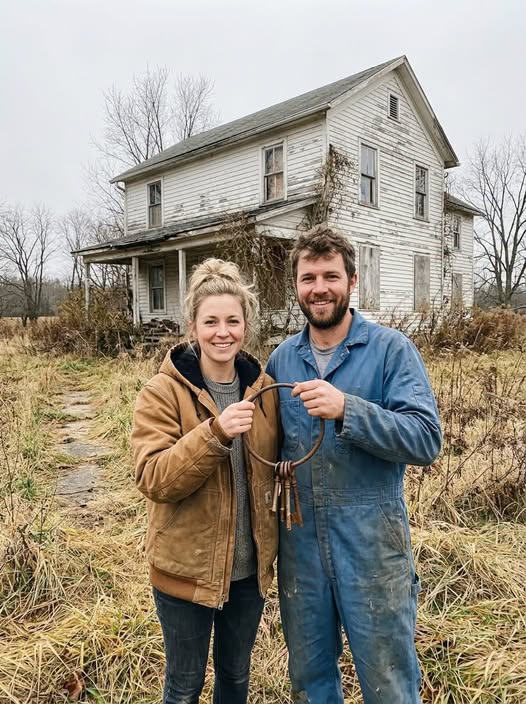
After the payment was processed, the clerk handed us a ring of old keys.
They were worn smooth in places, and one had a small brass tag attached to it.
I held them in my palm, barely believing they were ours.
We hadn’t received a large gift or an unexpected inheritance.
We had worked nights, sold something precious, saved carefully, and taken a chance on a property others had overlooked.
We went home that afternoon without telling anyone.
We wanted to make the place safe before inviting our families to see it.
The Secret in the County Newspaper
The renovation took months.
Nate repaired the electrical system one section at a time, making sure the work met the appropriate safety standards. I stripped old wallpaper, cleaned the windows, and scrubbed years of dust from the kitchen cabinets.
Some days, we made progress.
Other days, we discovered another repair that needed attention.
The first time we turned on the kitchen light and it worked, we celebrated with takeout pizza on the floor.
When the front door finally closed properly, Nate declared it the best door in the county.
I told him he was getting carried away.
But I understood what he meant.
Every small improvement represented another piece of the future we were building.
We still hadn’t told our families about the purchase.
Then the county published the auction results in its legal notices.
Nate’s grandmother read that newspaper from cover to cover every week.
Her name was Opal, and she was eighty-eight years old. She had lived in the same county for most of her life and remembered details about local families that even the oldest residents had forgotten.
On a Thursday afternoon, my phone rang at work.
It was Opal.
“Emily, I need you to do something for me.”
“Of course. Is everything all right?”
“Come get me Sunday after church.”
I smiled.
“Where are we going?”
“To see a house.”
I paused.
“What house?”
“The Miller place.”
My smile faded.
She continued before I could ask another question.
“And don’t tell Ronald.”
Ronald was her son and Nate’s father.
I agreed to pick her up, although I had no idea why she wanted to visit a neglected property we had only recently purchased.
On Sunday, I arrived outside her home shortly after church ended.
Opal was waiting on the porch in her usual gray coat. She climbed into the passenger seat without explaining herself.
During the drive, she stared out the window.
I tried asking whether she had visited the property years ago, but she gave me no answer.
When we finally turned onto the county road, she sat forward.
The moment the house appeared between the trees, she went completely still.
I parked beside the porch.
“Opal, are you sure you’re feeling all right?”
She opened the door without answering.
I hurried around the truck, intending to offer her my arm.
She refused.
“I can walk, Emily.”
She moved slowly but steadily toward the entrance, following the uneven path through the yard.
When she reached the porch, she stopped and looked at the windows.
Then she stepped inside.
I followed her into the front room.
The renovation was far from complete. Some walls still needed painting, and several pieces of furniture had yet to arrive. A single bare bulb hung from the ceiling, casting a circle of light over the floor.
Opal didn’t look at any of that.
She walked straight toward the kitchen.
I watched in confusion as she crossed the room and stopped beside the pantry door.
Then she placed her palm against the wooden frame.
Her fingers moved slowly over the grain, tracing a small mark near the edge.
Suddenly, her shoulders began to tremble.
She was crying.
Not loudly. Not dramatically.
Tears simply rolled down her cheeks as she stood there, holding the old wooden frame as though it were something precious she had feared losing forever.
I had known Opal for eleven years.
I had never seen her cry.
“Opal?” I whispered. “What’s wrong?”
She shook her head but didn’t turn around.
For several moments, she continued tracing the wood with her thumb.
Then she spoke.
“Emily, did nobody ever tell you whose house this was?”
I stared at her.
“The Miller place?”
She nodded slowly.
“This wasn’t supposed to be just another old house at an auction.”
My heart began beating faster.
“What do you mean?”
Opal wiped her cheeks and looked toward a small mark carved into the pantry frame.
“I haven’t seen this place in decades,” she whispered. “I thought I’d never walk through that door again.”
She turned toward me, her eyes filled with memories I couldn’t begin to understand.
“Your husband bought more than a house, Emily. He bought a piece of our family’s history.”
I glanced at the pantry door, then back at her.
“What happened here?”
Opal drew a shaky breath.
For the first time since we had arrived, she seemed unsure whether she should continue.
Then she reached into the pocket of her coat and pulled out a small, faded photograph.
It showed a younger woman standing on the same porch, with a baby in her arms and a man beside her.
The woman looked remarkably like Opal.
She placed the photograph in my hand.
“That was taken the summer before everything changed,” she said.
I studied the picture, trying to understand why she had kept it hidden for so many years.
Opal gently touched the photograph.
“There’s something your husband’s family never told you about this house.”
She looked toward the kitchen window.
“And I think it’s time you knew the truth.”
I waited, barely breathing.
Then she began to tell me a story that would change the way I understood Nate’s family, the old Miller property, and the bluebird card we had received on Easter.
For the first time, I wondered whether our purchase had been more than a fortunate opportunity.
Perhaps the house had been waiting for someone to return.
And perhaps Opal had finally found the courage to explain why.