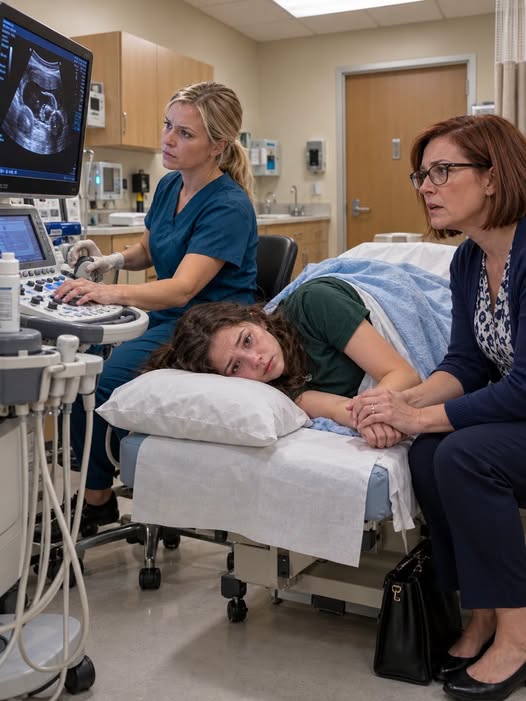
My daughter was only fifteen when she finally looked me in the eyes and whispered, ‘I stopped telling Dad when it hurts. He says I’m just trying to get attention.’”
Those words broke my heart in a way I couldn’t explain.
The next afternoon, I signed her out of school early and took her to the hospital. I didn’t tell my husband where we were going because I wanted to understand what was happening before another argument could begin.
I thought we would hear that she needed medication, rest, or perhaps a few additional tests.
Instead, halfway through the examination, the technician stopped speaking.
A few minutes later, the doctor entered the room, closed the door behind her, and asked me a question that changed everything.
“How long has her father known about this?”
For a moment, I couldn’t understand what she meant.
The examination room smelled of disinfectant, and the thin paper covering the bed crinkled whenever my daughter shifted. She sat quietly with her hands tucked inside the sleeves of her oversized hoodie.
I looked at the doctor.
“He doesn’t know,” I answered. “I haven’t told him we came here today.”
The doctor shook her head gently.
“I’m not asking about today.”
She turned toward the computer and opened an earlier entry in my daughter’s medical record.
“Your daughter was examined here five weeks ago for similar symptoms. Her father accompanied her to that appointment.”
I stared at the screen.
Five weeks ago?
I had never heard about that visit. Not once.
The doctor continued explaining that the earlier examination had raised concerns that required additional imaging. The follow-up had been recommended to investigate the source of my daughter’s pain.
But the appointment had never happened.
My daughter lowered her head and pulled her sleeves farther over her hands.
I turned toward her slowly.
“Sweetheart, did your dad bring you here five weeks ago?”
She nodded without looking at me.
I felt as though the room had tilted beneath my feet.
For months, I had watched her struggle through mornings that seemed increasingly difficult. She had started moving more slowly, skipping parts of her meals, and disappearing into her bedroom with a heating pad.
Whenever I asked whether something was wrong, she gave me the same answer.
“I’m fine, Mom.”
I had believed her because teenagers sometimes kept their discomfort private. I thought it might be stress, ordinary cramps, or the pressure of school and growing up.
I never imagined that she had already seen a doctor and that an important part of that visit had been kept from me.
The doctor remained calm.
“The current findings need prompt attention. We need to complete further tests before we can tell you exactly what’s causing her symptoms.”
She wasn’t making accusations against anyone. She was trying to understand the medical history and determine why the recommended follow-up had not taken place.
I wanted answers just as badly.
I moved my chair closer to my daughter.
“Can you tell me what happened after that first appointment?”
My daughter swallowed.
“Dad said they didn’t find anything important.”
I looked back at the doctor.
She didn’t contradict my daughter or speculate about what her father had said. Instead, she adjusted the monitor so I could read the earlier discharge instructions myself.
The recommendation for further testing was clearly documented.
It hadn’t been an optional suggestion that could easily be forgotten. It was part of the medical plan.
My stomach tightened.
I had spent weeks believing that my daughter was simply having a difficult time. Now I was learning that there had been a medical concern serious enough to require additional investigation, and I had never been given the opportunity to help her.
I reached for her hand.
“You’re not in trouble,” I told her. “Whatever happened, you can tell me. I’m not going to be angry with you for being honest.”
Her eyes filled with tears.
For a few seconds, she said nothing.
Then she whispered, “Dad got mad when we left the hospital.”
I waited.
“He said you were already stressed about work and money. He said I was making things harder for everyone.”
I felt a sharp ache in my chest.
My husband had always struggled with situations he considered unnecessary complications. An unexpected bill could ruin his evening. A change in plans could lead to an argument. Whenever a problem couldn’t be solved immediately, he often preferred to pretend it wasn’t there.
But this was our daughter’s health.
I wanted to believe there had been a misunderstanding. Perhaps he had misunderstood the doctor’s instructions. Perhaps he thought her symptoms had improved. Perhaps he had intended to arrange the appointment later and simply failed to do so.
I searched my mind for an explanation that would make the situation less frightening.
Then the doctor asked my daughter a quiet question.
“Did your father tell you not to mention the follow-up appointment to your mother?”
My daughter’s fingers tightened around mine.
She stared at the floor.
Then she nodded.
Something inside me went still.
Until that moment, I had been trying to find a reasonable explanation for what had happened. I wanted to believe that my husband had made a mistake rather than deliberately kept important information from me.
But my daughter was sitting beside me, frightened and ashamed, carrying a secret that should never have been her responsibility.
She had been dealing with pain while worrying about upsetting the adults who were supposed to protect her.
I squeezed her hand gently.
“You don’t have to protect anyone from the truth,” I whispered. “Your health comes first.”
She looked at me, and for the first time since we had entered the hospital, I saw a little of the fear leave her expression.
“What exactly did Dad say?” I asked.
She opened her mouth.
Before she could answer, my phone began vibrating inside my purse.
I pulled it out.
The name on the screen was unmistakable.
DAD.
My daughter saw it at the same moment I did.
All the color seemed to disappear from her face.
She immediately pulled her hand away and stared at the phone as though the ringing itself had frightened her.
I didn’t answer immediately.
The doctor noticed her reaction.
“Would you like a moment?” she asked softly.
I nodded.
The phone continued vibrating.
My husband was calling, completely unaware that I had just discovered the earlier hospital visit and the missing follow-up appointment.
I looked at my daughter.
“Sweetheart, you don’t have to speak to him right now. We’re going to make sure you’re taken care of first.”
She swallowed and nodded.
I silenced the phone and placed it face down on the chair beside me.
Then I turned back to the doctor.
“What happens next?”
She explained that the medical team would arrange the necessary tests, review the findings, and determine what treatment or specialist care might be needed. She also explained that the team would document the history carefully and help us understand the next steps.
I listened to every word.
I wanted a diagnosis. I wanted to know whether my daughter would recover. I wanted someone to tell me that the months of pain had not caused lasting harm.
But I also understood that we needed to deal with what had happened during the previous five weeks.
My daughter had trusted an adult with her pain and had been discouraged from seeking further help.
Whatever the explanation, that could not happen again.
I asked the doctor how I could make sure my daughter received the recommended care without further delays. She outlined the follow-up arrangements and explained whom I could contact if I had concerns about her safety or access to medical treatment.
For the first time that afternoon, I felt that I had something concrete to do.
I could ask questions.
I could keep copies of the medical instructions.
I could make sure appointments were scheduled and attended.
Most importantly, I could remind my daughter that she never needed to minimize her pain to keep the peace at home.
A few minutes later, my phone vibrated again.
Another call from my husband.
I looked at the screen, then at my daughter.
I knew that answering him would lead to questions. I knew he would want to know where we were and why I had taken her to the hospital without telling him.
But I also knew that the conversation could wait until I understood the medical situation and had considered how to protect my daughter from additional pressure.
I sent him a brief message saying that our daughter was receiving medical care and that I would speak with him later.
Then I put the phone away.
My daughter leaned against my shoulder.
“Are you mad at me?” she asked quietly.
The question hurt more than anything else she had said that day.
I wrapped my arm around her.
“No, sweetheart. Not at all.”
She looked up at me.
“Even though I didn’t tell you?”
“Especially because you were scared to tell me. I wish you hadn’t had to carry this alone, but you haven’t done anything wrong.”
Her eyes filled again, and this time she allowed herself to cry.
I held her until she was ready to sit up.
We remained at the hospital for the additional evaluation, and I made sure I understood the medical team’s instructions before leaving. There were still questions to answer, and I knew we would need to take things one step at a time.
I didn’t yet know exactly what the tests would reveal.
I didn’t know why my husband had failed to tell me about the first appointment or why he had discouraged our daughter from discussing the follow-up.
Those questions would need to be addressed carefully, with my daughter’s well-being at the center of every decision.
But I knew one thing with absolute certainty.
My daughter would no longer have to convince me that her pain was real.
That evening, I sat beside her bed while she rested. Her heating pad lay on the bedside table, where I had seen it so many times before.
For months, I had looked at that small object and assumed it was part of an ordinary teenage routine.
Now it reminded me how easily a child’s suffering could remain hidden when she believed speaking up would only create trouble.
I thought about all the times she had told me she was fine.
Perhaps she had been trying to reassure me. Perhaps she had been afraid of causing another argument. Perhaps she simply hadn’t known how to explain what she was feeling.
Whatever the reason, I wished I had understood sooner.
I leaned over and kissed her forehead.
“From now on,” I told her, “if something hurts, you tell me. You don’t have to wait until it becomes unbearable, and you don’t have to worry about upsetting anyone.”
She closed her eyes.
“Okay, Mom.”
I stayed beside her for a long time.
The next steps would not be easy. There would be medical appointments, difficult conversations, and questions that could change our family in ways I had not yet imagined.
But I was no longer willing to mistake silence for reassurance.
And I was no longer willing to let my daughter believe that asking for help made her a burden.
Whatever the doctors discovered, whatever explanation my husband offered, and whatever decisions our family would eventually have to make, one promise mattered more than anything else.
My daughter would be heard.
Her pain would be taken seriously.
And she would never have to face something frightening alone simply because an adult found the truth inconvenient.