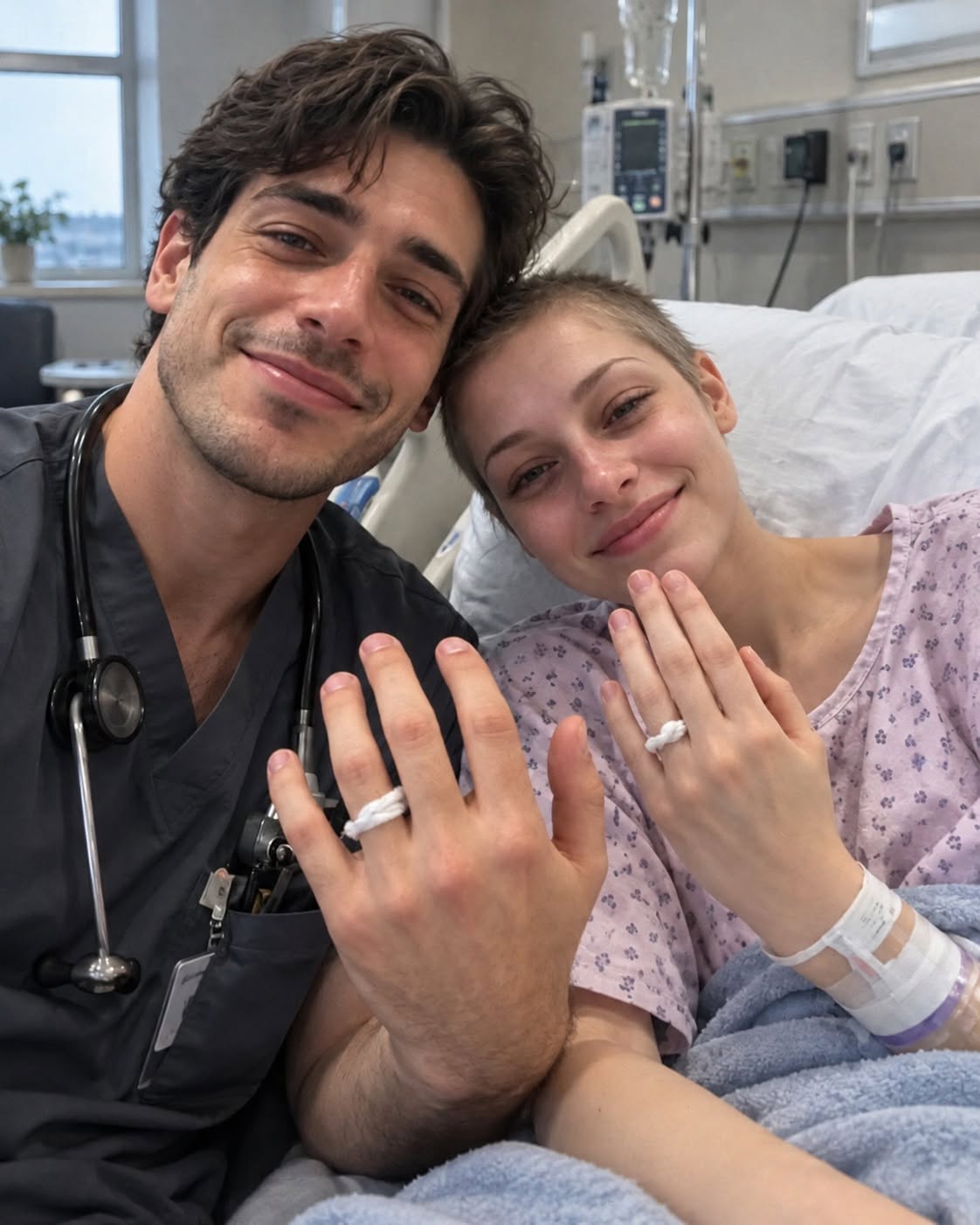
My name is Brandon. I was thirty years old, and becoming a doctor had been my greatest ambition for as long as I could remember.
My parents loved me, but they had never had enough money to pay for university. I worked weekends, took extra shifts whenever I could, and spent countless nights studying while my classmates slept.
Medical school taught me more than anatomy, diagnosis, and treatment. It taught me how fragile life could be and how difficult it was to find the right words when someone was frightened.
I believed that being a good doctor meant remaining calm, even when a situation felt overwhelming.
Then I met Chloe.
She was eighteen, bright, quick-witted, and determined to find something to laugh about even on the hardest days.
She had been admitted to the hospital for treatment of a serious illness. By the time I first met her, she had already endured more difficult days than most people her age could imagine.
Yet she greeted every new member of the medical team with a smile.
When I entered her room to discuss her treatment, she studied my serious expression and raised an eyebrow.
“Dr. Brandon, do you ever smile?”
I glanced at the chart in my hands.
“Of course I do.”
“Really? Because I’ve been here for three days, and I’m beginning to think your face forgot how.”
I tried to maintain my professional expression.
She laughed so hard that a nurse passing the doorway looked in to see what was happening.
From then on, Chloe made it her personal mission to persuade me to relax whenever circumstances allowed.
She invented silly nicknames for the hospital’s vending machines, rated the quality of the cafeteria soup, and insisted that every difficult day deserved at least one good joke.
Her humor did not mean she was unafraid.
Sometimes, when she thought nobody was watching, I saw the worry in her eyes. She knew her illness was serious, and she understood that treatment was not always successful.
Still, she continued to find small reasons to enjoy the time she had.
I admired that about her.
But admiration was not the same as a personal relationship. I was part of her medical team, and my responsibility was to provide appropriate care, respect her boundaries, and make sure she had access to the emotional support she needed.
Neither of us could have imagined how much one of her final conversations would stay with me.
The Day the Treatment Stopped Working
Several weeks later, the medical team received difficult news.
The latest results showed that Chloe’s illness had progressed despite treatment. The specialists reviewed her options carefully, but there was no longer a treatment expected to reverse the disease.
I remember the quiet in the consultation room.
Her family sat together while the doctors explained what the results meant. Nobody wanted to hear that the options had become so limited.
Chloe listened without interrupting.
When the conversation ended, she asked several practical questions. She wanted to know how her symptoms could be managed, whether she could spend time with her family, and what support would be available to make her remaining days as comfortable as possible.
Her courage impressed me, but I also understood that courage did not make the news any less painful.
Later that afternoon, I returned to check on her.
She was sitting beside the window, watching people walk along the street below.
“You look like someone who just lost an argument,” she said when I entered.
I pulled up a chair.
“Perhaps I did.”
“Well, don’t worry. I lose arguments all the time. I’m very experienced.”
I smiled despite myself.
For a moment, we talked about ordinary things. She asked whether the cafeteria had improved its soup, and I told her that I had no intention of conducting another investigation into it.
Then her expression became thoughtful.
“Dr. Brandon, can I ask you something serious?”
“Of course.”
“How do people decide what matters most when they don’t have much time?”
I considered my answer carefully.
“I think everyone finds that answer differently. Some people want to spend time with family. Others want to finish something important, visit a place they love, or simply have a peaceful day without worrying about tomorrow.”
She nodded.
“I think I want to make a few memories that aren’t about hospitals.”
I told her that the care team would do everything possible to support her wishes while ensuring that she remained comfortable and safe.
She thanked me.
Then she looked out the window again.
“I wish I could have a proper wedding someday,” she said quietly. “Not some enormous event. Just something small, with flowers, people I love, and a day that feels special.”
I didn’t know what to say.
It was a simple wish, but it carried the weight of everything she feared she might miss.
I encouraged her to talk with her family about what would make her feel most fulfilled. I also offered to connect them with the hospital’s social worker, who could help arrange meaningful experiences and provide support.
By the following morning, her sister, Paige, had arrived with a notebook full of ideas.
Chloe was already smiling.
“You’re not going to believe what my sister has planned,” she told me.
A Small Celebration Filled With Love
Paige had organized a modest celebration in a private hospital family room.
There were flowers on the table, soft music playing from a small speaker, and a few photographs of Chloe growing up.
Her parents were there, along with several close relatives and friends.
They had chosen a simple white dress for her and arranged a delicate scarf around her head. Chloe examined herself in the mirror and declared that she looked far more elegant than she had expected.
“I might have to start charging for appearances,” she joked.
Paige laughed through her tears.
The celebration was not a legal wedding, nor was it a marriage to a member of her medical team. Instead, it was a gathering centered on Chloe’s wish to experience something beautiful and memorable with the people she loved.
Her family read messages they had written for her.
Some were funny. Others recalled childhood adventures, school memories, and the little habits that made Chloe unmistakably herself.
When Paige finished reading her message, Chloe reached for her hand.
“You’d better keep all those photographs,” she said. “And don’t let anyone tell the story of my life without including the embarrassing parts.”
Paige laughed.
“I wouldn’t dare.”
I stood near the doorway for a while, grateful to see Chloe surrounded by so much affection.
Her circumstances were heartbreaking, but that afternoon was not defined entirely by illness.
It was defined by love, laughter, and the effort her family had made to give her something meaningful.
Before I left, Chloe called my name.
“Dr. Brandon?”
I turned.
“Thank you for listening to me.”
I nodded.
“You deserve to be heard.”
She smiled.
“I hope you remember that, even when you become a very important doctor.”
“I’ll try.”
“Good. And remember to smile more.”
That was the last conversation I had with her in which we joked about my serious expression.
Two days later, Chloe passed away peacefully with her family nearby.
I was deeply saddened by the news. Even though I had known that her illness was advanced, knowing what might happen and experiencing the loss were two entirely different things.
I attended her funeral with the other people whose lives she had touched.
The room was filled with flowers and photographs. Her family shared stories that made people laugh even as they cried.
Chloe had been young, but she had left behind an extraordinary collection of memories.
I thought that would be the last chapter of my connection to her family.
I was wrong.
The Small Box After the Funeral
After the service, I walked toward my car.
I was tired, and my thoughts were scattered. I kept remembering Chloe’s jokes and the way she had managed to make even difficult conversations feel a little less frightening.
As I reached the parking area, I heard someone calling my name.
“Brandon, wait!”
I turned.
Paige was hurrying toward me, holding a small cardboard box.
Her eyes were red from crying.
“I’ve been looking for you,” she said.
“Are you all right?”
She nodded, although she looked exhausted.
“There’s something Chloe wanted me to give you.”
I stared at the box.
“To me?”
“Yes. She made me promise not to give it to you until after the funeral.”
She handed it over.
My name was written across the lid in Chloe’s handwriting.
For several seconds, I couldn’t bring myself to open it.
I had spent my professional life learning to face difficult situations one step at a time. But grief did not follow a medical protocol, and there was no checklist for knowing what to do when someone who had died left you an unexpected message.
I lifted the lid carefully.
Inside was a folded letter, a small photograph, and a tiny notebook.
The photograph showed Chloe sitting by the hospital window, smiling at the camera with the same mischievous expression I remembered.
On the back, she had written:
For the doctor who finally learned to smile.
I laughed softly, then felt tears gather in my eyes.
Paige watched me.
“She wrote the letter a few days before she died,” she explained. “She said she wanted you to understand something.”
I unfolded the paper.
The Letter That Changed My Perspective
The letter began with a familiar greeting.
Dear Dr. Brandon,
If you’re reading this, Paige has finally kept one of my secrets. She’s terrible at keeping surprises, so I hope you appreciate the effort.
I smiled.
The next lines were more serious.
I wanted to thank you for treating me like a person instead of a diagnosis. I know you were doing your job, but sometimes the smallest things make a difference. You explained things honestly, listened when I was scared, and never made me feel foolish for asking questions.
I paused.
The words reminded me why I had chosen medicine in the first place.
I had wanted to help people through difficult moments, even when I couldn’t change the outcome.
Chloe continued:
I know you probably think that because my treatment didn’t work, nothing you did mattered. Please don’t make that mistake. You couldn’t promise me a different future, but you helped make some of my hardest days less lonely.
My eyes blurred.
I had often wondered whether doctors carried too many memories of the people they could not save. We were trained to assess symptoms, explain risks, and choose treatments based on the best available evidence.
Yet patients were never just the results of those decisions.
They were people with families, fears, ambitions, jokes, and hopes.
Chloe’s letter reminded me that care was not measured only by whether a treatment succeeded.
Then I reached the final paragraph.
There’s one more thing I want you to do for me. When you meet a patient who seems angry, frightened, or difficult, remember that you may not know what they are carrying. Be honest with them. Be kind. And please, for the love of everything, smile once in a while.
Beneath the message, she had drawn a tiny smiling face.
I laughed through my tears.
It was exactly the sort of thing she would have done.
At the bottom of the letter, she had added one final sentence:
You don’t have to save everyone to make a difference.
I read those words several times.
For years, I had believed that becoming a good doctor meant finding solutions, fixing problems, and doing everything possible to prevent loss.
I still believed in excellent medical care. I still believed in research, treatment, and the importance of doing everything reasonable to help patients.
But Chloe had reminded me that medicine also required humility.
Sometimes, the outcome was beyond our control.
That did not make compassion meaningless.
The Notebook Inside the Box
After reading the letter, I opened the small notebook.
Its pages contained short observations Chloe had written during her time in the hospital.
Some entries were funny.
The soup has officially disappointed me again.
Another read:
Paige says I should rest. I say I am resting emotionally while planning three imaginary vacations.
But several pages contained more serious reflections.
She wrote about being frightened of the future, worrying about her family, and trying to find ways to make ordinary days feel important.
On one page, she had listed things she wanted her loved ones to remember.
Laugh loudly.
Ask for help when you need it.
Tell people you love them while you still have the opportunity.
Don’t spend your whole life waiting for the perfect moment.
I closed the notebook and held it against my chest.
Paige sat beside me on a nearby bench.
“She wrote in it almost every day,” she said. “She told me she wanted people to understand that she was more than her illness.”
I nodded.
“She succeeded.”
For a while, neither of us spoke.
Then Paige asked whether I would keep the notebook.
“I will,” I said. “And I’ll take good care of it.”
She smiled faintly.
“That’s what she hoped.”
What Chloe Left Behind
In the months that followed, I returned to work.
The hospital remained busy. New patients arrived, families waited for updates, and difficult decisions continued to be made every day.
But I began approaching some conversations differently.
I made more time to listen.
I became more aware of the questions patients hesitated to ask and the fears they struggled to express.
I learned not to confuse a calm appearance with an absence of worry.
And, much to the amusement of my colleagues, I smiled more often.
Sometimes, I thought of Chloe when a patient made a joke during a difficult appointment.
Sometimes, I remembered her when a family needed an honest explanation delivered with patience.
I never forgot that I couldn’t promise every patient a happy ending.
What I could offer was respect, clarity, and care.
The little box remained on a shelf in my office, beside the photograph Chloe had left behind.
Whenever I felt discouraged, I would read the final line of her letter.
You don’t have to save everyone to make a difference.
Those words never made loss easy.
They simply reminded me that the value of a life, or of the care offered during it, could not be measured by a single outcome.
Chloe had wanted a special memory, and her family had helped create one.
She had wanted to be remembered for her humor and personality, not only for the illness she faced.
And she had wanted the people around her to keep living with kindness after she was gone.
Years later, I still remember the girl who challenged me to smile.
I remember her courage, her questions, and her determination to find joy in ordinary moments.
Most of all, I remember the message she left behind.
A doctor cannot control every outcome.
A person cannot prevent every loss.
But we can listen. We can show compassion. We can make difficult moments a little less lonely.
And sometimes, those small acts of kindness become the memories people carry for the rest of their lives.