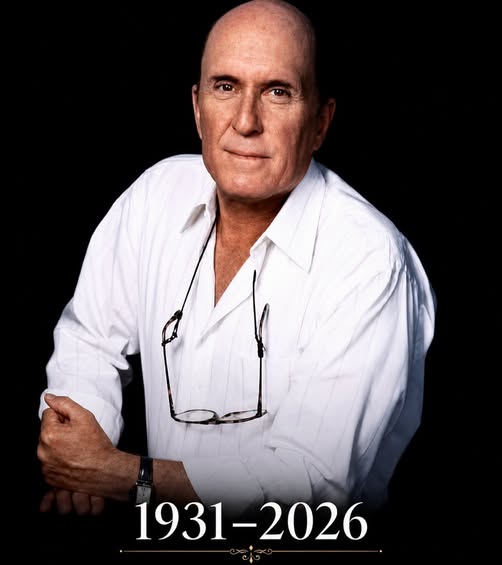
Remembering Robert Duvall: Celebrating the Life and Legacy of an Oscar-Winning Hollywood Icon
The world of film lost one of its most respected performers when Robert Duvall passed away on February 15, 2026, at the age of 95. Known for his remarkable range, commanding screen presence, and dedication to bringing believable characters to life, Duvall built a career that spanned more than six decades. His performances helped shape some of American cinema’s most memorable films, leaving behind a body of work that continues to attract audiences across generations.
Duvall died peacefully at his home in Virginia, according to announcements made by his family and representatives. His wife, Luciana Duvall, shared the news publicly, expressing the profound personal loss of saying goodbye to her husband while recognizing the extraordinary artist the world had come to admire. <Cite refs={[“turn423573news23″,”turn423573search5”]}/>
For movie lovers, his passing marked the end of a remarkable chapter in Hollywood history. For those who knew him personally, it was the loss of a husband, friend, and individual whose interests extended well beyond the screen.
Robert Duvall was never an actor who relied solely on celebrity or spectacle. Instead, he built his reputation through careful preparation, subtle expression, and a willingness to inhabit characters whose lives could be complicated, contradictory, and deeply human. Whether portraying a powerful adviser in a crime drama, a military officer in a war film, or a troubled musician searching for a new beginning, he brought an unmistakable sense of authenticity to his work.
His legacy is not limited to a single award or famous role. It rests on decades of performances that demonstrated how much depth an actor could bring to a story.
Early Life and the Road to Acting
Robert Selden Duvall was born on January 5, 1931, in San Diego, California. His father served in the United States Navy, and the family spent time in several communities connected to military life. Growing up in that environment exposed Duvall to different people, personalities, and ways of speaking—experiences that would later serve him well as an actor.
Although his future career eventually became clear, he did not immediately emerge as an obvious Hollywood star. His path developed through education, military service, and a growing interest in performance.
After attending Principia College in Illinois, Duvall served in the United States Army during the Korean War era. Following his military service, he moved to New York to pursue acting more seriously.
The decision represented a major turning point. Rather than seeking immediate fame, he concentrated on learning his craft and developing the skills necessary to portray believable characters.
In New York, he studied at the Neighborhood Playhouse under Sanford Meisner, an influential acting teacher whose approach emphasized truthful behavior, attentive listening, and emotionally convincing performances.
The training helped Duvall understand that effective acting requires more than delivering lines. A character’s gestures, pauses, posture, and reactions can communicate as much as dialogue. A convincing performance depends on understanding what motivates a person, even when those motivations remain hidden from other characters.
That philosophy became a defining feature of Duvall’s career.
He also spent time working in theater, where actors must sustain performances in front of live audiences and respond naturally to their fellow performers. Those experiences helped prepare him for the demands of film and television.
His early years were not an overnight success story. They were a period of preparation, experimentation, and gradual professional development.
By the time significant film opportunities arrived, Duvall had developed the discipline and technique that would support a long career.
A Memorable Screen Debut in To Kill a Mockingbird
One of Duvall’s earliest film appearances became an enduring part of American cinema.
In the 1962 adaptation of To Kill a Mockingbird, he played Arthur “Boo” Radley, a mysterious neighbor whose presence influences the lives of the children at the center of the story.
The character has relatively little dialogue, making the role an early demonstration of Duvall’s ability to communicate through physical performance and subtle expression.
Boo is viewed through the imaginations and fears of the neighborhood children. As the story unfolds, their understanding of him changes, revealing the difference between a reputation and the reality of a person’s life.
Duvall approached the character with restraint, helping preserve the mystery surrounding Boo while allowing the audience to sense his humanity.
The performance introduced him to a wider film audience and provided an early example of the approach that would distinguish his work.
He did not need to dominate a scene to make an impression. Sometimes, a quiet presence could be more effective than a lengthy speech.
That ability to create memorable characters without relying on constant attention became one of his greatest strengths.
Tom Hagen and the World of The Godfather
For many viewers, Robert Duvall will always be associated with Tom Hagen in The Godfather and The Godfather Part II.
Directed by Francis Ford Coppola, the films explored the Corleone family, whose personal relationships, business interests, and criminal activities become increasingly entangled.
Duvall played Hagen, the family’s trusted adviser and lawyer. Unlike several of the other central characters, Hagen often approached conflict through calculation, negotiation, and carefully chosen words.
His role required a distinctive kind of authority.
Hagen was not usually the loudest person in a room. He did not need to threaten everyone around him to demonstrate his importance. His influence came from his ability to understand the people involved, assess complicated situations, and communicate with precision.
Duvall’s restrained performance made the character believable within the film’s elaborate world.
He created a figure who could remain calm while discussing disturbing events, yet still convey the emotional strain of serving a powerful family whose loyalty came with serious consequences.
The contrast between Hagen’s professional manner and the dangerous environment around him gave the character additional depth.
Duvall received an Academy Award nomination for Best Supporting Actor for his performance in the original The Godfather. He returned to the role in the 1974 sequel, helping maintain continuity across the films. <Cite refs={[“turn423573search3″,”turn423573search16”]}/>
The success of these movies introduced Duvall to a vast international audience. His portrayal of Hagen also demonstrated how a supporting character could become essential to a film’s dramatic structure.
Hagen was not simply there to explain the family’s affairs. He represented a particular kind of loyalty, professionalism, and moral compromise.
Through him, audiences could see how people justify their choices when personal relationships and dangerous obligations collide.
Decades after the films’ original releases, the character remains one of the performances most closely associated with Duvall’s name.
Apocalypse Now and an Unforgettable Military Officer
Another defining moment in Duvall’s career came with Francis Ford Coppola’s Apocalypse Now, released in 1979.
The film, inspired in part by Joseph Conrad’s novella Heart of Darkness, follows a military mission during the Vietnam War and examines the psychological and moral consequences of conflict.
Duvall portrayed Lieutenant Colonel Bill Kilgore, a military officer whose personality combines confidence, charisma, and an unsettling relationship with the violence surrounding him.
Kilgore is one of the film’s most recognizable characters because Duvall makes him both memorable and disturbing. He appears comfortable in circumstances that would leave most people overwhelmed, creating a sharp contrast between his casual manner and the destructive environment around him.
Duvall’s performance earned him an Academy Award nomination for Best Supporting Actor.
One of the character’s best-known moments became a lasting part of film culture, frequently referenced in discussions of war movies and cinematic dialogue.
Yet the performance’s impact extends beyond a single quotation. Duvall created a character who embodies the strange contradictions of the film’s world: military discipline alongside personal eccentricity, apparent certainty amid chaos, and an almost theatrical confidence in the middle of destruction.
Kilgore was very different from Tom Hagen, but the same underlying discipline was evident in Duvall’s work.
He understood the character’s mannerisms and worldview, allowing the performance to feel consistent even when the character’s behavior became extreme.
His portrayal helped make Apocalypse Now one of the most discussed war films of its era and further established his reputation as an actor capable of taking on complex supporting roles.
The Oscar-Winning Performance in Tender Mercies
Although Duvall was already widely respected, his work in Tender Mercies demonstrated his ability to carry an emotionally intimate story as its central character.
Released in 1983, the film follows Mac Sledge, a country music singer whose life has been affected by addiction, damaged relationships, and professional disappointment.
When the story begins, Sledge is far removed from the success he once experienced. He is trying to rebuild his life, and his future remains uncertain.
The role required Duvall to portray a character who could not simply solve his problems through determination or a dramatic declaration. Sledge’s progress emerges through ordinary decisions, difficult conversations, and the slow process of rebuilding trust.
Duvall approached the character with considerable restraint.
Rather than presenting recovery as an easy transformation, he allowed the audience to see the uncertainty and vulnerability beneath Sledge’s reserved personality.
The film’s quiet atmosphere provided room for small moments to carry emotional weight. A look, a pause, or an incomplete sentence could reveal how much the character struggled to express.
Duvall’s work was particularly notable because he also performed the songs associated with the character. This added another dimension to his portrayal, allowing the music to become part of Sledge’s identity rather than a separate element imposed on the story.
His performance earned him the Academy Award for Best Actor at the 56th Academy Awards, recognizing one of the most significant achievements of his career. <Cite refs={[“turn423573