My Neighbor Cut Down the Maple Tree My Late Husband Planted for Our Son — Then One Phone Call Changed Everything
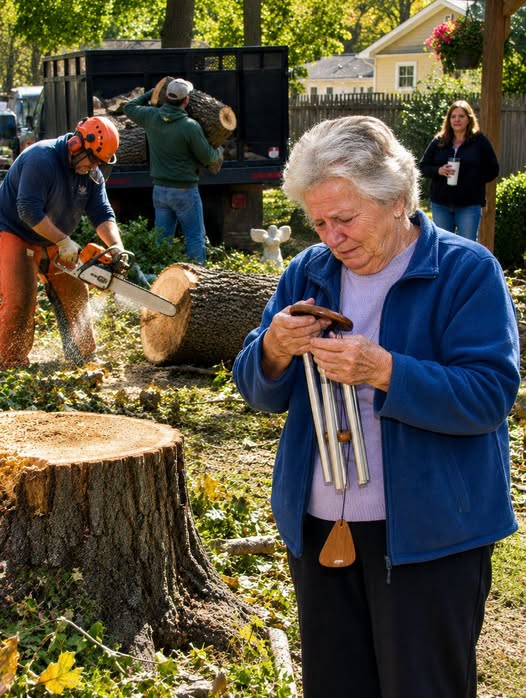
When I returned home from the cemetery, I heard the unmistakable roar of a chainsaw before I even reached my driveway.
At first, I thought someone down the street was trimming a few branches. Then I turned onto my road, glanced toward my front yard, and felt my stomach drop.
The maple tree was gone.
For more than four decades, it had stood beside our house, growing from a fragile sapling into a magnificent tree that shaded our front lawn. Now, all that remained was a freshly cut stump, scattered branches, and pieces of wood being loaded onto a trailer.
My late husband, Tom, had planted that tree on the day our son was born.
And my neighbor, Pam, had ordered it removed.
As I stepped out of my car, I noticed something crushed beneath a pile of branches. It was the little wind chime I’d hung from the tree only three months after Tom died.
Its delicate metal tubes were bent, and its wooden sail had split in two.
Pam stood near the fence separating our properties, holding a glass of iced tea. She looked entirely untroubled.
“You’re finally home,” she called. “I took care of that tree problem for good.”
I stared at the empty space in my yard, struggling to understand what I was seeing.
“You had my tree cut down?”
Pam shrugged.
“The branches were a nuisance. The leaves kept getting into my swimming pool, and I was tired of dealing with them.”
I looked at the workers, then back at her.
“That tree was planted when our son was born. My husband put it in the ground himself.”
She took another sip of her drink.
“Linda, you can plant another tree. You can’t bring your dead husband back.”
For a moment, the entire yard seemed to fall silent.
Even the chainsaw operator lowered his equipment and looked away.
I bent down, picked up the broken wind chime, and brushed the sawdust from its surface. My hands were trembling, but I made myself stand straight.
Then I looked at Pam.
“You’re absolutely right,” I said quietly.
Her expression softened into a satisfied smile, as though she believed the matter was settled.
I turned around and walked into my house without saying another word.
Inside, I placed the damaged wind chime on the kitchen counter. Then I opened the drawer where Tom had kept our important documents.
At the back sat a folder bearing the official seal of our city.
I hadn’t opened it in years.
Tom had explained its significance to me long ago, shortly after a neighborhood dispute had made him concerned about the future of his beloved maple. At the time, I’d listened without fully appreciating why he was so determined to keep the paperwork safe.
Now, standing alone in the kitchen, I finally understood why he’d insisted.
I opened the folder, read the documents carefully, and reached for my phone.
I made one call.
The next morning, at precisely 7:15, Pam opened her front door and discovered an official notice attached to it.
A few moments later, she noticed several people gathered near her driveway.
Her face went pale.
Then she began shouting my name.
By lunchtime, everyone on our street was talking about what had happened.
Some neighbors thought I’d gone too far. Others believed Pam had brought the situation upon herself.
But the truth was more complicated than either side realized.
To understand why that single phone call changed everything, you have to go back to the day Tom planted the maple tree.
The Tree That Began With a Promise
It was 1979 when our son, Jeff, was born.
I remember that day as clearly as if it had happened yesterday. The hospital room smelled faintly of fresh linens and disinfectant, and sunlight streamed through the window in long golden strips.
Tom had barely slept. He spent most of the morning looking at our newborn son as though he couldn’t believe someone so small could change his entire world.
When the hospital finally released us, I expected him to drive straight home and help me settle in.
Instead, he disappeared into the backyard shed.
I found him a little later carrying a young maple sapling, a shovel, and a bag of garden soil.
“What are you planning?” I asked.
He smiled.
“Something for Jeff.”
He chose a spot in the front yard where the tree would receive plenty of sunlight. Then he dug a hole, carefully loosened the roots, and lowered the sapling into the ground.
It was barely taller than my shoulder.
Tom packed the soil around it and stepped back to admire his work.
“One day,” he said, “our boy will climb this tree.”
I laughed.
“That tree might take years to get big enough.”
“Then we’ll give it years,” he replied.
That was Tom. He believed the best things in life deserved patience.
Over the following decades, the little sapling became part of our family’s history.
Jeff learned to walk beneath its branches. He chased squirrels around its trunk, collected its leaves in autumn, and eventually climbed high enough to make me nervous.
Tom would stand on the lawn with his hands on his hips, pretending to be stern.
“Keep your feet on the sturdy branches!” he would call.
Jeff would laugh and promise he knew what he was doing.
As he grew older, the tree became a meeting place for neighborhood children. They built imaginary forts beneath its canopy, played hide-and-seek around the trunk, and spent summer afternoons lying in the shade.
When Jeff became a father, he brought his own children to visit.
His daughter once asked whether the tree had been there before she was born.
“Long before you,” Tom told her. “Your dad was practically a baby when I planted it.”
She looked up through the branches in amazement.
“So it grew up with Dad?”
“That’s right,” Tom answered. “And now it’s growing up with you.”
I watched the two of them standing beneath the leaves and thought about how many memories a single tree could hold.
It wasn’t simply a plant in our yard anymore.
It was a living record of our family.
When the House Became Too Quiet
Tom passed away in February.
He had been part of my daily life for so long that I struggled to understand how ordinary things could continue without him.
His coffee mug remained in the cupboard. His favorite chair still faced the living-room window. The toolbox he’d used for countless household repairs sat exactly where he’d left it.
For weeks, I found myself turning toward the garage whenever I heard a sound outside, expecting to see him working on another project.
But the garage stayed quiet.
So did the garden.
Spring arrived, and the maple tree began to produce fresh leaves. I started spending more time near the front window, watching the branches move in the breeze.
One afternoon, I found a small wind chime in a box of garden decorations. Tom had always liked the gentle sounds of wind moving through metal tubes, so I decided to hang it from one of the lower branches.
When I finished, I stood beneath the tree and listened.
The chime produced a soft, delicate melody.
It wasn’t a sign or a message. It was simply a familiar sound that brought back memories of Tom working outside, humming while he repaired a fence or planted flowers.
Still, it comforted me.
Whenever the breeze picked up, I could hear the chime from my kitchen.
Sometimes I’d stop what I was doing and look outside.
For a few seconds, the house didn’t feel quite so empty.
I knew the grief would never disappear completely. I was learning, slowly, to carry it with me.
I never imagined that the tree would soon become the center of a bitter dispute.
The Neighbor Who Couldn’t Tolerate a Falling Leaf
Pam moved into the house next door three years before the tree was cut down.
Her property was considerably larger than ours, and the backyard featured a swimming pool surrounded by pale stone paving and neatly arranged outdoor furniture.
At first, we got along reasonably well.
We exchanged greetings when collecting the mail. She occasionally asked about loca