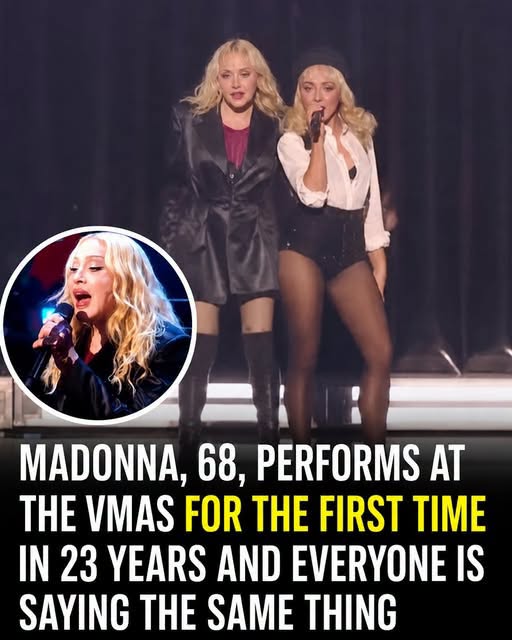
Madonna Returns to the MTV VMAs After 23 Years — Her Star-Studded Performance Gets Everyone Talking
Few artists have maintained a presence in popular culture as consistently as Madonna. Across decades of changing musical styles, new generations of performers, and countless shifts in the entertainment industry, she has continued to find ways to attract attention and spark conversation.
On September 27, 2026, the pop icon returned to the MTV Video Music Awards stage for the first time in 23 years. Her appearance was more than another performance at a major awards ceremony. It brought her back to an event closely connected with some of the most recognizable moments of her career.
The performance opened the 2026 VMAs in Los Angeles and featured appearances by Sabrina Carpenter and Charli XCX, alongside several other familiar faces. Combining music, elaborate staging, visual references to Madonna’s history, and elements associated with her latest musical era, the production created a memorable opening for the ceremony.
For longtime fans, the return offered an opportunity to revisit the relationship between Madonna and the awards show that helped define the MTV era. Younger viewers, meanwhile, saw a collaboration between an established pop legend and artists who represent different chapters of contemporary pop music.
The result was a performance that connected the past with the present while giving audiences plenty to discuss.
A Long-Awaited Return to the VMA Stage
Madonna’s relationship with the MTV Video Music Awards began with the very first ceremony in 1984. At that event, she performed “Like a Virgin,” wearing a bridal-inspired outfit that became one of the most recognizable images from the early years of the show.
The performance helped establish her as an artist willing to challenge conventional expectations. Rather than treating a television appearance as a simple opportunity to sing a hit, Madonna used the stage to create a visual moment that audiences would remember.
That approach became a recurring feature of her career.
Over the years, she returned to the VMAs with performances that explored different musical eras, fashion influences, and theatrical concepts. Her appearances frequently reflected the larger artistic identity she was developing at the time.
By the time she last performed at the ceremony in 2003, the VMAs had already become closely associated with her career. That appearance featured Britney Spears and Christina Aguilera and remains one of the event’s most discussed performances.
More than two decades later, the announcement that Madonna would return created considerable anticipation among fans and music observers.
According to the official announcement from CBS and MTV, she was selected to open the 2026 ceremony. The appearance coincided with the release of her album Confessions II, giving the performance a connection to her current musical work as well as her extensive history with the show. <Link url=”https://www.paramountpressexpress.com/mtv/shows/2026-mtv-video-music-awards-vmas/releases/?view=113249-madonna-to-open-the-2026-video-music-awards-vmas-with-her-first-vmas-performance-in-23-years-airing-sunday-sept-27-on-cbs” title=”Read the official announcement from CBS and MTV”/>.
The significance of the return was not simply the length of time that had passed. It was also the opportunity to see how an artist whose career helped shape the awards show would approach a new performance in a very different entertainment landscape.
Revisiting the Performance That Started It All
To understand the attention surrounding Madonna’s 2026 appearance, it helps to revisit her history with the VMAs.
In 1984, MTV was still establishing itself as a major force in music culture. Music videos were becoming an increasingly important way for artists to reach audiences, and television performances offered opportunities to build a recognizable public identity.
Madonna’s performance of “Like a Virgin” stood out because it combined music, fashion, movement, and theatrical presentation. The bridal gown, distinctive styling, and deliberately provocative staging made the performance a talking point beyond the song itself.
The appearance helped demonstrate that a live television performance could become a cultural reference point rather than a moment that disappeared when the broadcast ended.
Madonna continued to develop that approach in subsequent years.
In 1989, she performed “Express Yourself” at the VMAs with an energetic presentation that reflected the song’s themes of confidence and self-expression. The following year, her performance of “Vogue” drew on visual references to historical fashion and theatrical elegance.
In 1998, she performed “Ray of Light” with Lenny Kravitz, bringing another musical chapter to the awards stage.
These appearances demonstrated her interest in treating performances as complete visual experiences. Clothing, choreography, staging, lighting, and music worked together to create a distinctive atmosphere.
That history helps explain why her return in 2026 carried significance beyond the announcement of another celebrity appearance.
Audiences were not simply waiting to hear a familiar voice. They were curious about the creative direction she would choose and whether she would once again turn the VMAs stage into a setting for an elaborate artistic statement.
Sabrina Carpenter Joins Madonna for the Opening
One of the central features of the 2026 performance was Madonna’s collaboration with Sabrina Carpenter.
Carpenter has developed a strong presence in contemporary pop music through her songwriting, performances, and carefully constructed visual style. Her appearance alongside Madonna created a connection between two generations of artists who have approached pop performance with an emphasis on personality and presentation.
According to coverage of the ceremony, Carpenter appeared at the piano as Madonna began the opening sequence. The staging incorporated theatrical costumes and choreography before the performance moved into “Bring Your Love,” their collaboration.
The pairing gave the opening a different dimension from a traditional solo performance.
Rather than relying exclusively on nostalgia, Madonna shared the stage with an artist whose audience includes many listeners who encountered her music long after Madonna’s earliest hits became popular.
That generational connection is important in an industry where musical trends and audiences can change quickly. A collaboration allows artists to introduce different audiences to one another’s work while creating something that belongs to the present.
For Carpenter, appearing with Madonna also placed her within a performance tradition associated with major pop spectacles and highly recognizable stage imagery.
For Madonna, the collaboration demonstrated that her current musical era could be presented alongside references to the past without becoming entirely dependent on them.
The result was a performance that acknowledged her established status while giving the opening a contemporary focus.
Coverage from Variety described Carpenter’s appearance as part of the production’s opening sequence and noted that Madonna later brought Charli XCX into the performance. <Link url=”https://au.variety.com/2026/music/news/madonna-sabrina-carpenter-charli-xcx-mtv-vmas-performance-40773/” title=”Read Variety’s report on the performance”/>.
Charli XCX Adds Another Musical Connection
The performance also featured Charli XCX, another artist whose work has helped shape conversations about modern pop music.
Charli emerged during a different era of the music industry from Madonna, building a reputation through electronic production, experimental pop, and collaborations that frequently cross genre boundaries. Her presence added another layer to the evening’s combination of musical generations.
During the performance, Charli joined Madonna for “Danceteria Afterhours,” a newly released remix connected to Madonna’s Confessions II era.
The staging moved into a club-inspired environment, incorporating a bathroom-set concept and a series of guest appearances. The visual changes gave the performance a theatrical quality, allowing it to move between musical sections rather than remaining in one setting throughout.
This approach reflected a long-standing feature of Madonna’s live work: the use of visual storytelling to give individual songs a larger context.
The performance was not presented simply as a sequence of tracks. It developed as a series of connected scenes, each with its own atmosphere, costumes, and references.
Charli’s participation also reinforced the connection between Madonna’s influence on pop culture and the artists working within the genre today.
Musical influence is rarely a straightforward process. New performers borrow ideas, challenge conventions, and develop styles that differ from those of their predecessors. Collaborations can make those connections visible without suggesting that contemporary artists must imitate earlier generations.
The appearance of Madonna and Charli together offered an example of how established stars and newer artists can share a stage while maintaining distinct identities.
A Theatrical Production Filled With Details
The 2026 opening performance included several elements designed to make it feel like a complete production rather than a conventional awards-show set.
Reports described a piano-centered opening, costume changes, dancers, a choir, and a club-inspired scene. The performance also included appearances by Julia Garner, Debi Mazar, Sombr, Seth Rogen, and producer Andrew Watt.
These cameos contributed to the sense that the staging was built around a broader visual concept. Instead of presenting a single performer in front of a static backdrop, the production used changing environments and recognizable guests to create a series of connected moments.
Such staging is familiar territory for Madonna.
Throughout her career, she has treated clothing and visual presentation as important components of her musical identity. Her performances have often drawn on fashion history, nightlife, religious imagery, film, and other cultural references.
The 2026 appearance continued that approach by combining contemporary collaborators with details associated with her earlier career.
For audiences who recognized the references, the production offered an additional layer of meaning. For viewers encountering some of those ideas for the first time, the performance worked as a large-scale pop spectacle in its own right.
Not every viewer will interpret theatrical staging in the same way. Some may appreciate the details and references, while others may focus primarily on the music or prefer a simpler live presentation.
That variety of responses is normal for a performance built around a distinctive visual style.
What is clear is that the production was designed to make an impression and to connect several different parts of Madonna’s artistic history.
Why Madonna’s Relationship With MTV Matters
Madonna’s return is also an opportunity to consider the role MTV played in the development of modern pop stardom.
When the network launched in 1981, music videos became an increasingly influential part of how artists presented themselves. A successful video could help a song reach a wider audience while giving listeners a visual image to associate with the performer.
Madonna became one of the artists who understood the potential of that format.
Her videos and television appearances helped create a recognizable combination of music, fashion, movement, and character. Rather than presenting the same image in every release, she frequently adjusted her style to match the musical direction of each era.
That ability to change became a defining feature of her career.
The VMAs developed into a venue where artists could turn music videos and live performances into major public moments. Madonna’s appearances were part of that history, and her influence helped establish expectations for how a pop performance could combine music with spectacle.
Her return in 2026 therefore carried a symbolic connection to the network’s early years.
The music industry has changed dramatically since her first VMA performance. Streaming services have transformed how listeners discover songs, social media allows artists to communicate directly with fans, and music videos compete with an enormous range of online content.
Yet major live events still offer something distinctive: the chance to bring artists and audiences together around a shared moment.
Madonna’s appearance demonstrated how a performer associated with MTV’s early era could participate in that tradition while collaborating with artists whose careers developed under different conditions.
The Influence of Confessions II
The performance also coincided with a new chapter in Madonna’s recording career.
Confessions II provided the musical context for the 2026 appearance, connecting the event to a project that revisited dance music and elements of the artist’s established sound.
The album’s title also invites comparison with Confessions on a Dance Floor, her 2005 release that became an important part of her catalog.
That earlier album was closely associated with dance-pop production and a continuous club-oriented listening experience. Its influence remained part of discussions about Madonna’s musical legacy long after its initial release.
A follow-up project naturally invites questions about how an artist revisits an earlier creative period without simply repeating it.
For a performer with a career spanning decades, that balance can be challenging. Fans may appreciate familiar sounds and visual references, but they may also want to see evidence of continued experimentation.
The VMAs performance offered a public presentation of the new era, combining its music with staging that referenced Madonna’s longstanding relationship with nightlife, dance, and visual transformation.
The presence of Carpenter and Charli XCX also placed the project in conversation with contemporary pop music rather than presenting it as a self-contained exercise in nostalgia.
That approach gave the performance multiple points of connection: the history of Madonna’s career, the sound of her newer material, and the work of artists representing different stages of the genre.
What Audiences Were Talking About
The headline suggests that everyone was saying the same thing about Madonna’s return, but public reactions to a major performance are rarely completely uniform.
Music publications highlighted different aspects of the event, including the significance of her first VMA performance in 23 years, the collaborations with Carpenter and Charli XCX, and the elaborate staging.
Some coverage emphasized the historical importance of seeing Madonna return to a ceremony she had helped define. Other accounts focused on the visual references, celebrity appearances, and relationship between the new material and her earlier work.
These are different ways of interpreting the same performance.
For longtime fans, the appearance may have brought back memories of the 1984 debut, the theatrical presentation of “Vogue,” or the 2003 performance with Spears and Aguilera.
For younger audiences, the collaborations may have been the main attraction. Seeing Madonna share the stage with contemporary artists created an opportunity to experience her music in a setting connected to today’s pop culture.
Other viewers may have been more interested in the production itself: the costumes, choreography, scene changes, and guest appearances.
A performance can generate strong discussion precisely because people bring different expectations to it.
Some value musical delivery above everything else. Others enjoy elaborate staging and theatrical presentation. Still others judge a performance by how it connects to an artist’s wider career.
Rather than assuming a single universal reaction, it is more accurate to say that Madonna’s return generated substantial attention and gave music commentators several aspects to discuss.
The enduring interest surrounding the event reflects both her long career and the cultural importance of the VMAs as a platform for major pop performances.
A Career Built on Reinvention
Madonna’s longevity is frequently discussed in connection with her willingness to change her image and explore different musical directions.
Across her career, she has worked with a wide range of producers, musicians, dancers, designers, and directors. Her releases have moved through dance-pop, electronic music, ballads, and other styles, with each period introducing different visual and musical ideas.
Reinvention does not mean that every project receives the same response. Artists who take creative risks often divide audiences, and established performers may face different expectations from listeners who discovered them at different points in their careers.
Some fans prefer the sound of an earlier era. Others welcome new collaborations and changes in style. Many appreciate both, depending on the project.
Madonna’s 2026 VMA appearance brought those different perspectives together.
The references to her early MTV performances acknowledged the history that helped establish her reputation. The collaborations with Carpenter and Charli XCX connected that history with current pop music. The theatrical staging reflected her continuing interest in presentation as part of a musical performance.
That combination allowed the event to function as both a look back and a presentation of new work.
For artists with long careers, the challenge is not simply to reproduce what once made them successful. It is to decide which elements of their identity remain meaningful and how those elements can be expressed in new circumstances.
The VMA performance offered one example of how Madonna continues to approach that challenge.
A Moment That Connected Generations
One of the most interesting aspects of the event was the way it brought together people who encountered Madonna’s music at very different times.
Some viewers remember watching her early music videos on MTV. Others discovered her catalog through radio, streaming playlists, films, or the influence of artists who came after her.
These experiences can create different relationships with the same performer.
A longtime listener might associate “Like a Virgin” with a particular period in music history. A younger listener might know Madonna primarily through her later recordings or cultural reputation. Another audience member might be more familiar with Carpenter or Charli XCX and encounter Madonna’s work through the collaboration.
A shared live event allows those different audiences to meet around a common performance.
This is one reason major awards ceremonies remain culturally relevant even as music consumption becomes increasingly individualized. They provide a setting where artists from different generations can appear together and where audiences can discuss the same moment.
Madonna’s return made that connection particularly visible because her history with the VMAs reaches back to the event’s inaugural year.
The performance did not erase the differences between musical generations. Instead, it placed those differences on the same stage, allowing the audience to see how pop music evolves while retaining connections to its past.
Looking Back at the 2003 Performance
For many viewers, Madonna’s last appearance at the VMAs in 2003 remains a significant reference point.
That performance featured Britney Spears and Christina Aguilera in an opening sequence that became widely discussed because of its staging and onstage kiss. The moment generated extensive media coverage and became part of the event’s history.
In the years that followed, Madonna continued releasing music, touring, and participating in major cultural events. However, she did not perform at the VMAs again until 2026.
The 23-year gap gave her return a particular significance.
Audiences had changed. The music industry had changed. The ways in which performances were shared and discussed had changed as well.
In 2003, television broadcasts and entertainment publications played a central role in shaping the immediate public conversation. By 2026, social platforms and online video had added new ways for viewers to respond, share clips, and revisit performances.
The context was different, but the basic appeal of a major live moment remained.
A high-profile awards-show performance can bring an artist’s work to audiences who might not otherwise watch a full concert. It can also prompt longtime fans to revisit older material and introduce newer listeners to the history behind a familiar name.
Madonna’s return connected those possibilities with her personal history at the ceremony.
More Than a Nostalgia Performance
It would be easy to describe Madonna’s appearance solely as a return to the past, but that would overlook its contemporary elements.
The collaborations, the new music, and the elaborate staging were all connected to her current artistic activity. While the production included references to earlier periods, it was not simply a recreation of the 1984 or 2003 performances.
That distinction matters.
Nostalgia can be powerful, especially when an artist has a long catalog of recognizable songs and memorable public appearances. However, a performance that relies only on earlier successes can leave little room for new ideas.
Madonna’s 2026 set combined historical references with newer material and contemporary collaborators. This created an opportunity to acknowledge the past while presenting something designed for the present.
Whether individual viewers preferred one section over another is a matter of personal taste. The broader creative strategy was to connect multiple eras of pop music in one production.
The approach also reflected the way musical legacies are maintained. Artists do not exist outside the influence of their predecessors, and younger performers often develop their own identities in conversation with the work that came before them.
A collaboration can make that relationship visible without reducing either artist to a symbol.
What Her Return Means for the VMAs
The VMAs have always depended in part on performances that audiences remember after the ceremony ends. Some become associated with a particular song, others with an un