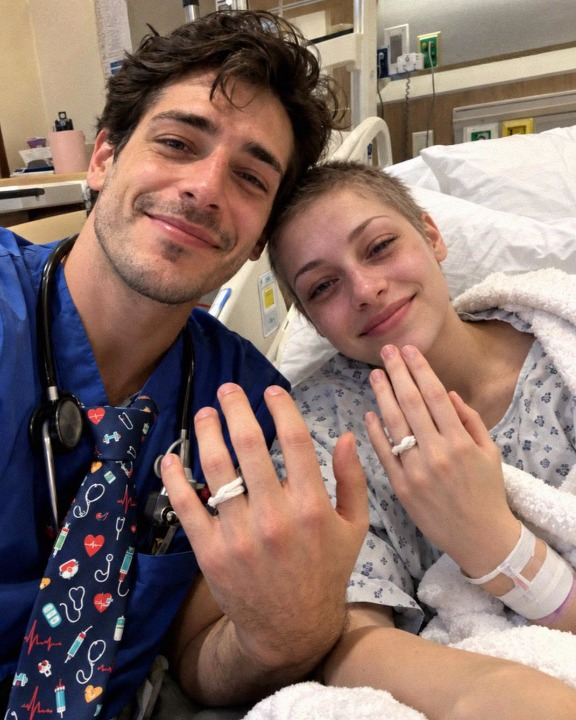
My name is Lucas. I was thirty years old when I learned that life can change in ways no medical textbook can prepare you for.
Becoming a doctor had been my dream for as long as I could remember. My family did not have much money, and my parents could not afford to cover the cost of my education. I knew that if I wanted to finish medical school, I would have to work for it.
So I did.
During the week, I attended lectures, studied late into the night, and completed clinical rotations. On weekends, I worked whatever hours I could manage to pay for rent, food, books, and tuition.
There were evenings when I was so tired that I fell asleep with my notes open beside me. There were mornings when I wondered whether I had chosen a path that demanded more than I could give.
But whenever I thought about quitting, I remembered why I had started.
I wanted to help people during the moments when they felt most frightened and vulnerable. I wanted to be the kind of doctor who could offer not only medical care but also patience, reassurance, and understanding.
I never imagined that one of my patients would teach me a lesson about those things that I would carry for the rest of my life.
Her name was Alicia.
I first met her while working on a hospital rotation. She was eighteen years old and receiving treatment for a serious illness that had already taken much of her strength.
Despite everything she was going through, Alicia had a remarkable sense of humor.
She could make a nurse laugh during a difficult shift, tease a doctor who looked too serious, and turn an ordinary conversation into something memorable.
The first time I entered her room, I was checking her chart and reviewing the notes from the previous shift.
She watched me for a moment before speaking.
“Doctor Lucas, do you always look that serious?”
I glanced up.
“Only when I’m trying to concentrate.”
“Well, you should know that smiling is free,” she said. “You might want to try it sometime.”
I tried to maintain my professional expression, but I couldn’t help smiling.
She laughed.
“There! See? It wasn’t that difficult.”
From then on, whenever our paths crossed, she found some new way to make me smile.
Sometimes she told me ridiculous stories about her childhood. Other times, she invented funny names for the machines in her room or pretended to be the director of an imaginary hospital where every patient was required to tell at least one joke a day.
Even when treatment left her exhausted, she tried to find something worth laughing about.
I admired that about her.
However, I also understood that humor did not mean she was never frightened. There were days when she looked out the window without speaking, and I could see how much she was carrying.
During those moments, I learned that helping someone did not always mean finding the perfect words.
Sometimes, it meant sitting quietly, listening, and allowing a person to express whatever they were feeling without trying to change it.
As time passed, Alicia and I developed a close bond. We spoke about music, books, our childhood memories, and the things we had hoped to do when we were older.
She wanted to visit the ocean at sunrise, learn to make a proper chocolate cake, and travel somewhere she could see the stars without city lights.
“I have a very long list,” she told me one afternoon.
I smiled.
“Then I hope you get to cross off every item.”
She looked at me thoughtfully.
“Me too, Lucas. Me too.”
But eventually, the medical team had a difficult conversation with Alicia and her family.
The treatments were no longer providing the results everyone had hoped for. Her condition had progressed, and the doctors explained that further treatment was unlikely to change the outcome.
Alicia had very limited time remaining.
The news affected everyone who cared about her. Her sister, Emily, spent long hours by her bedside. Nurses who had known Alicia for months stopped to visit whenever they could.
I continued doing my job, but I found it difficult to accept how quickly her circumstances were changing.
Alicia, however, remained determined to use her remaining time in a way that felt meaningful to her.
One afternoon, she asked to speak with me.
“Lucas, I have one final wish.”
I pulled a chair closer to her bed.
“Tell me.”
She looked at me with a small, uncertain smile.
“I want to get married.”
I was surprised.
“Married?”
She nodded.
“Yes. And I want you to be the person standing beside me.”
For a moment, I thought she might be joking, as she often did when she wanted to make me laugh.
But her expression remained gentle and serious.
“Alicia,” I said softly, “this is a very important decision. I want to understand what you’re asking.”
She reached for my hand.
“I know. I’m not asking because I’m afraid of being alone. I’ve thought about it, and I know that time is short. I simply want one beautiful memory that belongs to me.”
She paused.
“And I want to share it with you.”
Her words stayed with me long after I left the room.
I understood that her request came from a deeply personal place. I also knew that our circumstances were unusual, and that any decision had to be made thoughtfully, freely, and with respect for the professional boundaries of medical care.
I spoke with the appropriate people about how to handle the situation responsibly. We made sure Alicia had the opportunity to discuss her wishes independently and that her care remained the priority.
After careful conversations, we decided to arrange a small ceremony that reflected what she wanted: a quiet moment of love and connection surrounded by people who mattered to her.
The next day, the hospital room became a place of unexpected happiness.
There were no grand decorations, no elaborate reception, and no expensive clothing.
I wore a simple shirt and tie instead of my usual clinical attire. Emily brought a small bouquet of flowers. A nurse helped Alicia arrange a soft white scarf over her head, and another staff member found a few gentle decorations for the room.
Someone placed a small card on the table.
It read, “Today is for love.”
Alicia looked around at everything and smiled.
“You know,” she said, “I always imagined my wedding would be much bigger.”
I laughed softly.
“I’m sorry we couldn’t arrange a castle.”
She raised an eyebrow.
“Lucas, if you think I’m accepting anything less than a castle in my next life, you clearly haven’t been paying attention.”
Everyone in the room laughed.
For a little while, we were not thinking about hospital schedules, difficult conversations, or the uncertainty surrounding the days ahead.
We were simply celebrating a moment that mattered to Alicia.
The ceremony was small and personal. We exchanged promises, held hands, and listened as a staff member offered a few words about kindness, companionship, and the importance of cherishing the time we have.
Alicia’s smile never seemed to disappear.
When the ceremony ended, Emily hugged her sister and wiped away tears.
Alicia looked at me.
“See?” she whispered. “I told you I wanted something beautiful.”
“You certainly got that,” I replied.
I thought the memory would stay with me forever.
I just didn’t realize how soon it would become one of the most precious memories of my life.
Two days later, Alicia passed away peacefully with her sister nearby.
I cannot adequately describe the feeling of losing someone whose laughter had become part of my everyday life.
Even though I understood her medical condition and knew that time was limited, knowing what might happen had not made saying goodbye any easier.
After her funeral, I stood beside my car, holding the small card from our ceremony in my hand.
The sky was gray, and the air was cool. People were leaving the cemetery in quiet groups, speaking softly to one another.
I remained where I was, unable to bring myself to leave.
I kept remembering Alicia’s jokes, the way she raised her eyebrows when she was about to tease me, and the determination with which she had insisted that our wedding include a little humor.
I was still standing there when I heard someone calling my name.
“Lucas!”
I turned.
Emily was hurrying toward me, holding a small wooden box.
Her eyes were red, and she looked as though she had been searching for me.
“Emily?” I asked. “Is everything all right?”
She stopped in front of me and took a breath.
“My sister asked me to give you something,” she said. “But she made me promise to wait until after the funeral.”
She held out the box.
I stared at it.
My name was written across the lid in Alicia’s familiar handwriting.
For a moment, I could not move.
Then I carefully accepted it.
“What is this?” I whispered.
Emily shook her head.
“I don’t know everything that’s inside. She prepared it herself and told me not to open it.”
My hands trembled slightly as I lifted the lid.
Inside was a folded letter, a small photograph, and a notebook decorated with little stars.
The photograph showed Alicia sitting beside her hospital window, smiling at the camera. On the back, she had written, “For Lucas, who helped me find reasons to smile on the hardest days.”
I picked up the letter.
The first line read:
Dear Lucas,
If you’re reading this, it means I have already said goodbye in the only way I could. I wish I could be there to see your face, because I imagine you’ll be trying very hard not to cry.
I stopped reading.
Emily placed a hand on my shoulder.
“Take your time.”
I drew a breath and continued.
I want you to know that our little wedding meant more to me than I can explain. It wasn’t about pretending that life was perfect or that I wasn’t afraid. It was about having one day when I could focus on love instead of everything I couldn’t control.
You listened to me when I wanted to talk, and you made me laugh when I needed a little light. You never made me feel that my illness was the only thing worth noticing about me.
Thank you for remembering that I was still Alicia. I was still a sister, a friend, a person with dreams, silly jokes, and a terrible habit of making lists.
I laughed through my tears.
Even in a letter, she had found a way to tease herself.
The letter continued.
I have one more request. Please don’t let the sadness of losing me become the only thing you remember about our time together.
Remember the jokes. Remember the flowers. Remember the way everyone laughed when I asked whether there would be cake.
And remember that there are people everywhere who need someone to listen to them. You chose a life in medicine because you wanted to help people. Keep doing that, Lucas. Not because you can save everyone, but because you can make a difference in the time you have with them.
You don’t have to carry my memory by staying sad. You can carry it by being kind.
I lowered the letter and covered my face with one hand.
Emily stood beside me, crying quietly too.
After a few moments, I opened the little notebook.
Its pages contained short entries Alicia had written during her hospital stay. Some were funny observations about hospital food. Others were lists of places she wanted to visit and recipes she hoped to try.
Near the back, I found a page titled, “Things I Hope Lucas Remembers.”
There were only five items.
- Make time to laugh, even on difficult days.
- Listen carefully before deciding you know what someone needs.
- Don’t measure a person’s life only by how long it lasts.
- Keep a little room in your heart for unexpected happiness.
- Never forget that kindness can make an ordinary day meaningful.
At the bottom, she had drawn a tiny smiling face.
Beside it, she had written, “This is your reminder to smile. Yes, I’m still reminding you.”
I laughed, and the sound surprised me.
It was not the carefree laughter I remembered from our time together. It was mixed with grief, longing, and a sadness that would take time to understand.
But it was laughter all the same.
Emily smiled through her tears.
“That sounds like her.”
I closed the notebook and held it against my chest.
For the first time since the funeral, I felt that I could breathe a little more easily.
The pain of losing Alicia had not disappeared. I knew it would return in unexpected moments: when I heard a familiar song, when I saw a silly joke, or when I remembered the small ceremony in her hospital room.
But her letter gave me something I could carry forward.
It reminded me that love does not have to last for decades to matter. A meaningful connection can change the way we see the world, even when circumstances give us very little time.
In the months that followed, I returned to my work with a different understanding of what it meant to care for people.
I continued studying medicine, listening to patients, and trying to make difficult days a little less lonely for the people who needed support.
Sometimes, I would take out Alicia’s notebook and read one of her funny observations. Her handwriting brought back memories of her laughter, and I would find myself smiling before I even realized it.
I could not give her the long life she had hoped for. I could not take away every difficult moment she experienced.
But I could honor the person she had been.
And that was what I tried to do.
Alicia’s final gift was not a valuable object or a secret that changed my life overnight. It was a reminder that even when we cannot control how much time we have, we can still choose how we spend it, how we treat one another, and what we leave behind in the hearts of the people we meet.
I had met Alicia while trying to become the kind of doctor who could help others.
In the end, she taught me something no textbook had ever explained quite so clearly.
Sometimes, helping someone means offering treatment or practical support. Sometimes, it means listening without judgment. And sometimes, it means allowing a person to experience joy, dignity, and connection even when life is difficult.
I still keep her letter in a safe place.
Whenever I read the final line, I can almost hear her voice.
And Lucas, please remember to smile. It really is free.
I smile every time.
Not because losing her no longer hurts, but because remembering her reminds me that our time together was about more than goodbye.
It was about love, laughter, and the extraordinary difference one person can make in another person’s life.
Some people leave us far too soon, but the kindness they give us can remain long after they are gone.