I was standing in the refrigerated aisle of our local supermarket, reaching for a carton of milk, when I heard a trembling voice behind me.
“Please, ma’am. I only need one.”
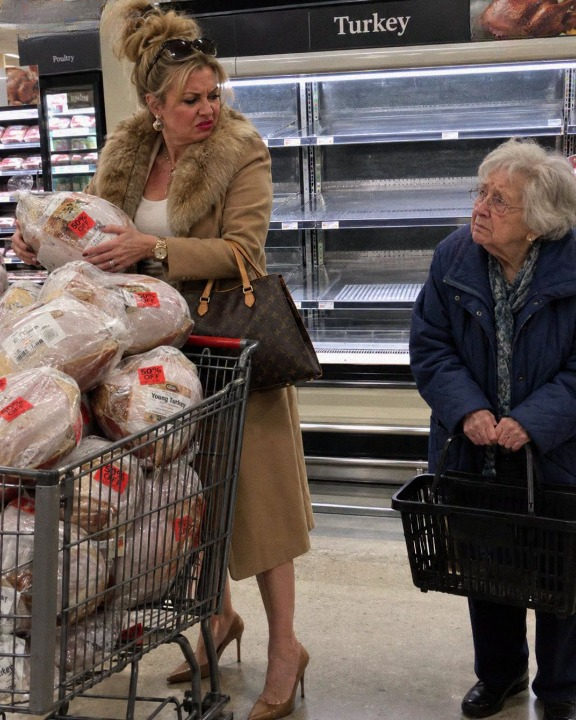
I turned toward the sound and saw an elderly woman wearing a faded blue coat. She held a small shopping basket against her side, and her tired eyes were fixed on the discounted turkeys inside the refrigerator.
Standing opposite her was a woman dressed in an elegant camel-colored coat and expensive heels. Her handbag looked brand-new, and her shopping cart was already overflowing with packages of turkey.
Not two or three.
Not even five.
She had taken every discounted turkey in the refrigerator.
Each package carried a bright red clearance sticker showing a price of $9.99. For shoppers trying to stretch their budgets, the discount was an opportunity to prepare a warm family meal without spending too much.
But for the elderly grandmother standing nearby, it meant something much more important.
“My grandson has been sick with the flu,” she explained quietly. “I take care of him by myself. I wanted to make him some soup, but the regular turkeys cost nearly forty dollars. I simply cannot afford one at that price.”
The wealthy woman glanced at her, then reached for another package.
“Then buy chicken,” she replied.
“The chicken isn’t discounted either,” the grandmother said. “I only need one turkey. Please, you already have so many.”
The woman in the expensive coat placed another package into her cart.
“And?” she asked.
I watched the grandmother hesitate before reaching toward the last turkey she could see.
For a brief moment, I thought the other woman might finally understand. Surely, anyone could see that one turkey would make very little difference to a person who had already collected so many.
Instead, the wealthy woman grabbed the package first.
“I got here before you,” she said.
The grandmother lowered her hand.
“I understand, but could you please leave me just one? I can pay for it right now.”
The woman shook her head.
“No. I want them all.”
A heavy silence settled over the aisle.
I had seen people argue over parking spaces, complain about prices, and become impatient in crowded stores. But there was something particularly upsetting about watching someone refuse such a small request when the consequences for the other person were so significant.
I decided to speak up.
“Excuse me,” I said. “Would it really hurt to leave her one turkey? You already have enough for several meals.”
The woman slowly turned toward me.
“That’s none of your business,” she replied.
“I think it becomes everyone’s business when someone is asking for a little consideration.”
She gave a dismissive laugh.
“I came here to shop, not to provide charity for strangers.”
The grandmother’s cheeks turned pink. She looked down at the basket she was holding, as though she wished she could disappear into the floor.
“I wasn’t asking you for charity,” she said softly. “I offered to pay. I just cannot afford the regular price.”
Then she reached into her coat pocket and carefully counted the money she had brought.
“I have ten dollars,” she continued. “I can give you the money if you would rather sell it to me yourself.”
The wealthy woman stared at the few bills in the grandmother’s hand.
“If ten dollars is such a problem for you, perhaps turkey soup isn’t what you should be buying.”
Her words seemed to stop the entire aisle.
A man standing nearby lowered his shopping basket. A young mother holding her child’s hand looked at the floor in disbelief. Even the supermarket employee arranging products at the end of the refrigerator paused to listen.
The grandmother swallowed hard.
“My grandson hasn’t eaten properly in two days,” she whispered. “He has barely had an appetite, and I thought a little soup might help him feel better.”
The woman pushed her overflowing cart forward.
“That’s not my problem.”
She was almost past us when she turned her head and added, “And before anyone decides to make a scene, you should remember who my family is.”
I recognized her immediately.
Her name was Beatrice. Her family owned several apartment buildings, a number of car dealerships, and one of the largest houses in town. People frequently mentioned their wealth, and Beatrice herself was often seen at charity events and expensive restaurants.
I had never met her personally, but I knew enough to understand why she expected people to recognize her name.
She seemed convinced that her family’s reputation gave her the right to dismiss anyone who disagreed with her.
The grandmother stood quietly beside the refrigerator, holding her almost-empty basket.
I wanted to say something else, but before I could speak, Beatrice’s shopping cart bumped against a display of packaged groceries as she tried to maneuver it around the corner.
Then the supermarket speakers crackled.
“Attention, shoppers. May we have everyone’s attention, please?”
Beatrice barely glanced upward.
She continued pushing her cart, apparently assuming the announcement had nothing to do with her.
Then a man’s voice came through the speakers again.
“Beatrice, would you please stop for a moment?”
The change in her expression was immediate.
She stopped so abruptly that the cart rolled forward a few inches before she pulled it back.
Several shoppers turned toward her.
Beatrice looked up at the ceiling speakers, her hand tightening around the cart handle.
“What is this?” she muttered.
The man’s voice continued.
“You just told the people in aisle six that they should remember who your family is.”
The supermarket became unusually quiet.
Beatrice looked around at the people watching her.
“Yes?” she answered uncertainly.
There was a short pause.
“Well, I think that’s an excellent suggestion. Perhaps everyone should take a moment to remember what a family’s reputation is actually built on.”
Beatrice’s face lost its confident expression.
“Oh, no,” she whispered.
The man continued speaking.
“Beatrice, please remain where you are for a moment. I would like to speak with you before you leave the store.”
She looked toward the front of the supermarket.
“Why?” she called out. “What’s going on?”
The answer came through the speakers.
“Because there is something important I believe you should see.”
A murmur spread through the aisle.
The grandmother looked confused. I was equally curious. Nobody seemed to know who was speaking, although his calm, authoritative tone suggested that he had some connection to the store.
A few moments later, the supermarket manager appeared at the end of the aisle. Beside him stood a tall man in a dark jacket, holding a folder.
Beatrice stared at him.
“Father?” she said.
The man nodded once.
It was Richard, the chairman of the local supermarket group and Beatrice’s father.
He had apparently been visiting the store when an employee informed him about the incident. After hearing what had happened, he asked the manager to make an announcement so Beatrice would wait while he came to speak with her.
“What’s all this about?” Beatrice demanded. “I was shopping.”
Richard glanced at the cart full of discounted turkeys.
“I can see that,” he replied. “And I can also see that you have purchased nearly every discounted turkey available.”
“I intend to pay for them,” she said defensively. “There’s nothing wrong with buying something that’s on sale.”
“You’re right,” he answered. “There is nothing wrong with buying discounted groceries. But that’s not what concerns me.”
He turned toward the grandmother.
“Ma’am, I understand you asked for just one turkey because your grandson is sick and your budget is limited. Is that correct?”
The grandmother nodded.
“Yes, sir. I wasn’t trying to cause trouble.”
“You haven’t caused any trouble,” Richard assured her. “You asked a reasonable question, and you deserve to be treated with respect.”
Then he turned back to his daughter.
“Beatrice, this store offers discounted food so that more people can afford groceries. Customers are free to purchase items within the store’s normal purchasing limits. But having the ability to buy something does not mean we should ignore the people around us.”
Beatrice crossed her arms.
“Are you seriously criticizing me in front of all these people?”
“I’m asking you to think about your actions,” he replied. “You were free to purchase the turkeys, but you were also free to show kindness when someone asked for one.”
She looked away.
Richard opened the folder he was carrying.
“I was here today to review the store’s community food program. We have been working with local organizations to make sure families facing difficult circumstances have access to affordable meals.”
He paused before continuing.
“What I just witnessed is a reminder of why that program matters.”
Beatrice glanced at the grandmother, then at the shoppers gathered around them.
For the first time, she appeared to realize that the situation was no longer simply about a disagreement over groceries.
It was about how she had treated someone who was already struggling.
Richard turned to the store manager.
“Please make sure this grandmother receives one turkey at the discounted price. If the current stock is unavailable, arrange for another suitable option. The store’s community program can help if she needs additional support.”
The grandmother’s eyes filled with tears.
“Thank you,” she whispered. “I don’t know what to say.”
“You don’t need to say anything,” Richard replied kindly. “Everyone deserves a chance to provide a decent meal for their family.”
The manager immediately arranged for a turkey to be brought from the store’s reserve stock. He also offered the grandmother information about a local food assistance program, explaining that it could help her with groceries if her grandson’s illness left her struggling to manage expenses.
Meanwhile, Beatrice remained beside her cart.
Her father turned toward her once more.
“You can still purchase the groceries you need,” he told her. “But I hope you’ll think about what happened here today. Money can buy many things. It cannot buy the respect people develop when they see us treating others well.”
Beatrice said nothing for several seconds.
Then she looked at the grandmother.
“I’m sorry,” she said quietly. “I shouldn’t have spoken to you that way.”
The grandmother studied her face before answering.
“Thank you. I hope you remember how difficult it can be for someone who has very little.”
Beatrice nodded, though she still seemed uncomfortable.
After a brief conversation with her father and the manager, she agreed to return several of the turkeys to the refrigerator so other shoppers could purchase them. The manager confirmed that the remaining packages would be available under the store’s usual clearance rules.
There was no dramatic argument, no cheering crowd, and no public celebration. People gradually returned to their shopping, and the supermarket resumed its ordinary rhythm.
But something had changed.
The grandmother now had the turkey she needed, along with information about resources that could help her family in the future. She thanked the manager and carefully placed her groceries into her basket.
As she passed me, she smiled.
“I only wanted to make something warm for my grandson,” she said.
“I know,” I replied.
She walked toward the checkout, holding her basket a little more confidently than before.
I watched her go and thought about what had happened.
Beatrice had entered the supermarket believing that having enough money meant she could take whatever she wanted without considering anyone else. Her father had reminded her that a person’s character is revealed not by what they can afford, but by how they treat people who have less.
It was a lesson the entire aisle had witnessed.
And perhaps the most important part was not the announcement over the speakers, the appearance of the supermarket chairman, or even the moment Beatrice apologized.
It was the simple fact that a struggling grandmother had asked for one small kindness, and someone finally listened.
We cannot always know what another person is going through. The shopper standing beside us might be caring for a sick child, supporting an elderly relative, or trying to stretch a limited income until the end of the month.
A few dollars can mean very little to one person and make a meaningful difference to another.
That does not mean anyone must surrender everything they purchase or accept every request they receive. It means that when we have the opportunity to help someone without placing ourselves in hardship, kindness is worth considering.
As I left the supermarket, I thought about the grandmother heading home to prepare a warm meal for her grandson.
I hoped he would feel better soon.
And I hoped Beatrice would remember that afternoon for a different reason than the embarrassment she had experienced.
After all, the strongest family reputations are not built on expensive houses, impressive businesses, or the ability to buy everything on a shelf.
They are built on honesty, humility, and the way we treat people when we have nothing to gain from being kind.
Sometimes, a single moment in an ordinary supermarket is enough to remind us of what truly matters.