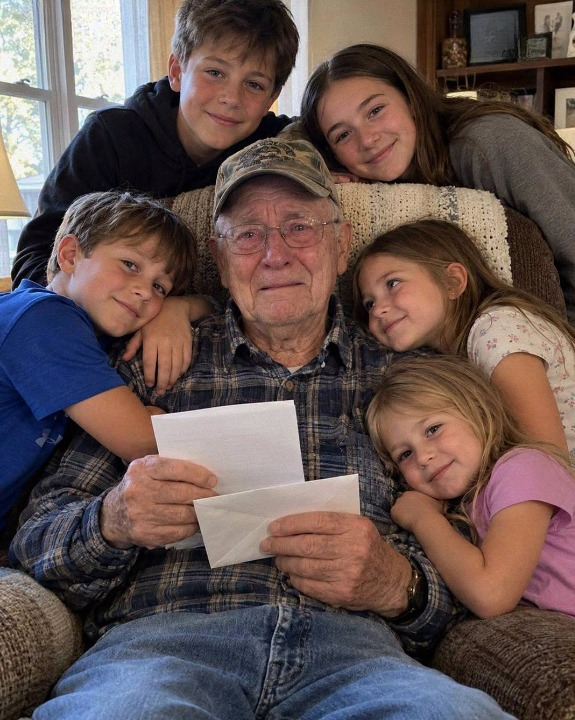
We have five children, a noisy house, and barely enough time to sit down together at the end of the day.
Our lives are a constant cycle of school runs, grocery shopping, homework, laundry, and trying to remember which child needs what for the next morning. We love our busy family, but there are days when my husband and I barely have time to finish a cup of coffee while it is still warm.
Then Walter moved in next door.
He was eighty-six years old, recently widowed, and living alone in a house that seemed far too quiet for someone who had spent more than four decades sharing it with the woman he loved.
At first, we were simply friendly neighbors.
We exchanged greetings over the fence, helped each other with small household tasks, and occasionally chatted when we happened to be outside at the same time.
None of us imagined that, within two years, Walter would become one of the most important people in our children’s lives.
We certainly never expected that we would eventually decide to make him an official member of our family.
But on the afternoon we presented him with the adoption papers, Walter read the first page, slowly lowered the folder onto the table, and looked at us with an expression I had never seen before.
Fear.
“There’s something I need to tell you,” he said quietly. “Something I should have told you a long time ago.”
Then he glanced at our five children and asked whether they could finish their cake in the other room.
That was when I realized there was a part of Walter’s life we knew nothing about.
The Neighbor Who Changed Our Lives
My husband and I have five children.
We always wanted a big family, and although we wouldn’t trade our children for anything, raising five of them is no small undertaking.
Our house is rarely quiet. Someone is always looking for a missing shoe, arguing over a toy, asking for a snack, or announcing that a school project is due the next morning.
We have two incomes, but the bills never seem to stop arriving. Between groceries, school expenses, clothing, and everyday necessities, we have learned to plan carefully.
Still, our home is full of life.
Two summers ago, Walter moved into the house next door.
He was eighty-six at the time and had recently sold the home where he had lived with his wife for forty-one years.
She had passed away, and he told us that staying in their old house had become too painful.
Every room reminded him of her.
The kitchen reminded him of the meals they had shared. The garden reminded him of the afternoons they had spent outside. Even the quiet evenings in the living room seemed to carry memories of conversations that would never happen again.
He bought a smaller property, hoping a fresh environment might make life easier.
Unfortunately, moving didn’t make the loneliness disappear.
I remember the first proper conversation we had with him. My husband was repairing a section of our fence when Walter wandered over to introduce himself.
He was polite, neatly dressed, and a little reserved.
We invited him to sit with us for a few minutes.
He accepted.
Before long, we were talking about the neighborhood, the weather, and how quickly children seemed to grow up.
When Walter heard the noise coming from our backyard, he smiled.
“You certainly have a lively household,” he said.
“That’s one way to describe it,” I replied, laughing.
He looked toward the children playing outside.
“I miss having that kind of noise around.”
At the time, I thought he was simply making conversation.
I didn’t realize how much those words meant to him.
How Walter Became Grandpa
At first, Walter only stopped by occasionally.
Sometimes he came over to return a tool my husband had lent him. Other times, he brought a small bag of apples from the market or asked whether we needed help carrying something.
Then one afternoon, our eight-year-old son was playing with a ball in the front yard.
Walter was sitting on his porch, watching.
“Would you like someone to throw that back to you?” he called.
Our son immediately ran over.
Within minutes, they were tossing the ball between them, laughing whenever one of their throws went off course.
The next day, they did it again.
Soon, Walter became a familiar presence whenever the children were outside.
He taught them how to play a few old-fashioned games, showed them how to care for the plants in his garden, and listened patiently to stories about school that most adults would probably have forgotten five minutes later.
He never rushed them.
If one of the children wanted to explain something complicated about a toy or describe an entire cartoon episode, Walter listened as though the information were genuinely important.
And to him, it was.
One evening, I was preparing dinner when I noticed Walter sitting at our kitchen table.
I had invited him to stay for a meal, just as I had done several times before.
He accepted, and we all ate together.
After that, he began joining us more frequently.
Eventually, I stopped formally asking whether he wanted to stay for dinner.
If he was visiting around mealtime, I simply set another plate on the table.
He became part of our routine without anyone making a big announcement about it.
The children began calling him Grandpa.
Nobody had instructed them to do so.
One afternoon, our youngest climbed onto the sofa beside him and asked, “Grandpa, can you read this story?”
Walter looked surprised.
Then his face softened.
“Of course, sweetheart.”
From that day forward, the name stayed.
Walter never corrected them.
In fact, I noticed that he seemed happier whenever they called him Grandpa.
He remembered their birthdays, asked about their schoolwork, and celebrated their little achievements as enthusiastically as we did.
He also became someone I could talk to when parenting felt overwhelming.
He never pretended to know everything about raising children in the modern world. Instead, he shared stories about the mistakes he had made, the things he wished he had done differently, and the lessons he had learned over the years.
Sometimes, his advice was practical.
Sometimes, it was simply a reminder to slow down and appreciate the moments we were living through.
Without realizing it, we had become a family in every way that mattered.
Except on paper.
The Day We Realized Something Was Missing
The following spring, Walter became unwell.
It wasn’t a major emergency, and he eventually recovered, but the experience frightened us more than we expected.
Until then, we had treated his presence in our lives as something permanent.
He was the neighbor who sat at our table, told stories to our children, and waved from his porch.
It was easy to forget that he was getting older and that one day he might need more help than we could provide informally.
During his illness, my husband and I found ourselves asking practical questions.
What would happen if Walter needed someone to make decisions on his behalf?
Who would be contacted if he were hospitalized?
Would we be allowed to receive information about his condition, or would we remain neighbors with no formal connection?
We realized that loving someone and having legal authority to help them were two different things.
We began researching the options available to adults who wanted to establish a formal parent-child relationship.
That was when we learned that adult adoption is legally possible in some places, although the requirements and consequences vary depending on local law.
The idea stayed with us.
We weren’t trying to replace Walter’s late wife or rewrite his past. We simply wanted him to know that he had a permanent place in our family.
We also wanted to understand what legal arrangements might make sense if he ever needed support.
After looking into the requirements in our area and considering the implications, we decided to discuss adult adoption with him.
We knew it would be an unusual proposal.
But Walter had become much more than a neighbor.
He was Grandpa to our children.
He was a trusted friend to my husband and me.
And he deserved to know how deeply he had become part of our lives.
We decided to present the idea on his next birthday.
A Birthday Surprise
Walter turned eighty-eight on the eleventh.
He had mentioned that he didn’t usually celebrate his birthday anymore.
His wife had always organized something special, even when they had very little money. After she passed away, the day had become another reminder of everything he had lost.
We wanted to change that.
So we planned a small celebration at our house.
Nothing extravagant.
We baked a cake, decorated the kitchen, and asked the children to wear their nicer clothes.
Our second-oldest daughter insisted on helping organize the surprise.
She even volunteered to carry the folder containing the adoption documents.
“Grandpa Walter is going to love it,” she announced.
I smiled.
“I hope so, sweetheart.”
The children made him handmade cards. One drew a picture of Walter standing in our garden, surrounded by all five children. Another wrote that he was the best grandpa in the neighborhood.
When Walter arrived, he looked genuinely surprised.
He stood in the doorway, looking at the decorations and the cake on the table.
“What is all this?” he asked.
“Your birthday party,” my husband replied.
Walter laughed softly.
“I haven’t had one of these in years.”
“Well, you’re having one today,” I told him.
We ate cake, listened to the children argue cheerfully over who would get the biggest slice, and shared stories from the past two years.
Walter was smiling throughout the meal.
Then, when everyone had finished eating, my daughter brought over the folder.
“This is your special present,” she told him.
Walter looked at the folder, then at us.
“What have you two been planning?”
My husband reached across the table.
“We wanted to ask you something important.”
I explained that we had been thinking about how much he meant to our family.
I told him how the children had come to see him as their grandfather and how grateful we were for everything he had brought into our lives.
Then I explained our idea.
“We would like to make our relationship official, if that’s something you would want too. We’ve looked into adult adoption, and we prepared some information for you to review. There’s no pressure to agree. We simply want you to know that you’re family to us.”
For a moment, Walter said nothing.
He opened the folder.
He read the first page.
Then he turned to the next.
His smile slowly disappeared.
The color drained from his face.
He carefully closed the folder and placed it on the table.
“There is something I need to tell you,” he said.
His voice was so quiet that I had to lean forward to hear him.
“I was going to tell you eventually. But I should have done it sooner.”
He looked at the children.
“Would you mind letting the grown-ups talk for a few minutes? You can finish your cake in the living room.”
The children looked confused, but they gathered their plates and went into the next room.
When the door closed behind them, Walter took a deep breath.
Then he looked at my husband and me.
The Secret Walter Had Kept
“I need you to understand something before you go any further with these papers,” he began.
My husband reached for my hand beneath the table.
Walter stared at the folder.
“For a long time, I believed I would never be part of another family. After my wife died, I thought those days were behind me.”
He paused.
“Then your children came into my life, and everything changed.”
I felt my eyes fill with tears.
“We know,” I said gently. “That’s why we wanted to do this.”
Walter shook his head.
“No. There’s something else.”
He explained that, after his wife’s death, he had begun reviewing the personal documents they had kept together for decades.
Among them were old letters, family records, and papers he had never had much reason to examine before.
One particular document had raised questions about his family history.
For years, Walter had believed that he understood his family’s story. He knew the people who had raised him, remembered the relatives who attended family celebrations, and had spent much of his life assuming that the records he possessed told the whole story.
But while sorting through his late wife’s belongings, he had discovered an old letter that suggested a significant part of his history might have been misunderstood.
He had spent months trying to make sense of it.
“I didn’t want to bring uncertainty into your lives,” he explained. “You already have five children to raise. I never wanted to become another responsibility you felt you had to carry.”
I shook my head.
“You’re not a responsibility, Walter.”
He gave me a sad smile.
“I know that now. But I haven’t always known how to accept kindness.”
He looked down at the adoption documents again.
“Before I sign anything, I need to show you the letter. You deserve to understand why I’ve been so hesitant to talk about my past.”
He reached into the inside pocket of his cardigan and took out a small, worn envelope.
The paper had yellowed with age.
He placed it beside the folder.
“I found this among my wife’s things,” he said. “She knew about it. We discussed it years ago, but I thought we had settled the matter.”
He paused, struggling to find the right words.
“After she died, I began wondering whether I had misunderstood what she was trying to tell me.”
My husband and I exchanged a glance.
We had expected Walter to be surprised by our proposal. We had expected tears, perhaps a long embrace, or even a polite refusal.
We had not expected this.
I gently asked, “What does the letter say?”
Walter looked toward the living room, where the children were laughing.
Then he returned his attention to us.
“It concerns my family,” he said. “And before you make me part of yours legally, I want you to hear the whole story.”
What Family Really Means
Walter didn’t open the envelope immediately.
Instead, he told us how difficult it had been to accept the idea that he might belong to another family after so many years of living independently.
He had spent decades building a life with his wife. They had shared ordinary routines, raised their hopes together, and supported each other through difficult seasons.
When she died, he felt as though the part of his life that made sense had disappeared.
Moving next door to us had not erased his grief, but it had given him something he had not expected to find again: a place where he was wanted.
He spoke about our children, describing small moments we had almost forgotten.
He remembered the day our youngest had proudly shown him a drawing.
He remembered helping our son learn to throw a ball.
He remembered the first dinner he had shared with us and how strange it had felt to sit at a crowded table after so many months of eating alone.
“I used to think family was something you were given at birth,” he said. “Then I thought it was something you built with a spouse. After losing my wife, I wasn’t sure what it meant anymore.”
He glanced at the folder.
“Now I think it may also be something people choose.”
I reached across the table and placed my hand over his.
“That’s what we were trying to tell you.”
Walter finally opened the old envelope.
He removed the letter, unfolded it carefully, and began explaining what he had discovered about his past. It was a complicated family matter, one that would require him to check records and speak with people who might know more.
He didn’t have all the answers yet.
Neither did we.
But for the first time, he wasn’t trying to face the uncertainty alone.
We listened without interrupting. We asked questions when he was ready to answer them and gave him time when he needed a moment to collect his thoughts.
By the time we finished talking, the cake had been forgotten, and the birthday candles had burned down.
Walter looked exhausted, but the fear in his expression had softened.
“I’m sorry I kept this from you,” he said.
“You don’t have to apologize for needing time,” my husband replied. “But you don’t have to carry everything by yourself anymore.”
Walter nodded slowly.
Then he looked toward the living room.
“Do you think the children will still call me Grandpa after all this?”
I couldn’t help laughing through my tears.
“Walter, they’ll probably call you Grandpa even if you ask them not to.”
For the first time that afternoon, he laughed, too.
We didn’t rush him into signing anything that day. We agreed to take the time necessary to understand the family history he had uncovered and to obtain appropriate legal advice before making a final decision about adoption.
The papers could wait.
Our relationship did not depend on a signature.
The children returned to the kitchen a few minutes later, carrying the remaining pieces of cake.
Our youngest climbed into Walter’s lap and announced that he had saved him the biggest slice.
Walter wrapped an arm around the child and smiled.
Looking at them together, I understood something I had not fully appreciated before.
We had wanted to give Walter a family.
But, in many ways, he had already given us one more person to love, one more voice at our dinner table, and one more set of memories that our children would carry into adulthood.
We didn’t know exactly what the old letter would reveal, or whether adult adoption would ultimately be the right legal step.
What we did know was that Walter no longer had to face his questions alone.
And that was what mattered most.
Because family is not always defined by age, paperwork, or shared history.
Sometimes it begins with a neighbor who stays for dinner.
Sometimes it grows when a child gives someone a new name.
And sometimes, when life has taken away nearly everything familiar, family appears unexpectedly and reminds a person that there is still room for love, belonging, and a new beginning.